GenAI creative and content creation: an established use, a legitimacy still arbitrated
Creative GenAI quickly established itself in marketing content creation practices. Images, texts, creative concepts or visual combinations are now produced on a large scale with the help of generative artificial intelligence tools.
But while adoption is massive, the creative legitimacy of AI remains far from homogeneous.
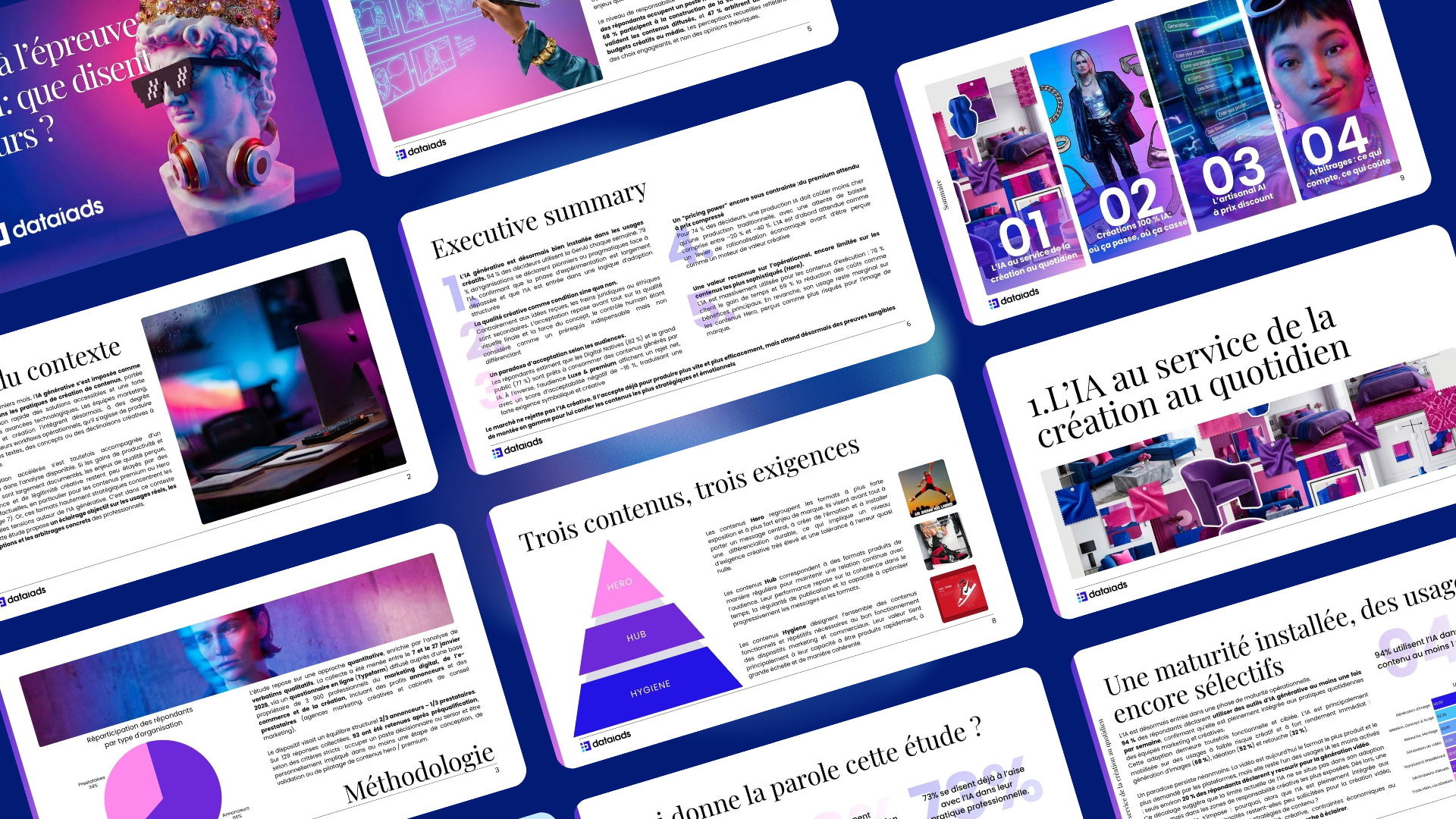
To objectify this gap between use and acceptance, Dataïads conducted a quantitative and qualitative study with marketing, communication and creation decision-makers, directly involved in the production and validation of high-stakes content.
A study focused on decisions, not technology
The study is based on a panel mainly composed of decision-makers (CMOs, Head of, Directors, Senior Managers), from advertisers and service providers, operating in contexts of high operational pressure.
More than 90% of respondents hold a decision-making or senior position and personally validate broadcast content, including premium or high-visibility content.
The objective was not to assess the technical performance of GenAI, but to understand Where, when, and why it is considered acceptable, or not, in content creation.
Three levels of content, three levels of acceptance of GenAI
The study highlights a very clear segmentation according to the type of content produced:
- Hygiene content : functional, repetitive formats with low creative risk.
GenAI is widely accepted there, mainly for reasons of efficiency, speed, and cost savings. - Hub content : regular, engaging formats, designed to nurture a continuous relationship with the audience.
AI is used in a supervised manner, with a strong expectation of brand consistency and human control. - Hero/premium content : formats with high exposure, carriers of meaning, image and differentiation.
It is in this field that the legitimacy of GenAI remains the most fragile.
This hierarchy is not based on the perceived quality of the renderings, but on the level of symbolic risk associated with each type of content.
A quality considered sufficient, but rarely differentiating
The decision-makers interviewed mostly believe that the quality of the content generated by GenAI is satisfactory for current professional use.
GenAI is perceived as a efficiency tool, rarely as a lever for desire or creative uniqueness.
The benefits mentioned are clear:
- saving time,
- acceleration of production,
- ability to produce more variants,
- better cost control.
On the other hand, artistic value, narrative depth and conceptual strength remain associated with strong human intervention, especially on content with high brand stakes.
Price as a central point of tension
A structuring lesson from the study concerns the economic perception of content creation by AI.
Nearly three out of four decision makers believe that content mostly produced with GenAI should cost less than traditional production with equivalent perceived quality.
This expectation is not based on a detailed analysis of real costs, but on a collective imaginary:
GenAI is perceived as an automatic productivity lever, which makes price parity difficult to accept, especially for premium content.
GenAI accepted as a lever for efficiency, monitored as a creative lever
The study shows that the obstacles to the adoption of GenAI in content creation are not primarily technical.
They are symbolic and strategic :
- risk of rejection by the public,
- fear of a loss of brand consistency,
- difficulty in assuming a creation perceived as “automated” on formats with high visibility.
GenAI is therefore accepted as a production infrastructure, but remains tightly controlled as soon as it touches on brand image, emotion or storytelling.
What this study really reveals
This Dataïads study does not conclude that creative GenAI has been rejected.
It highlights a more nuanced reality:
- GenAI is already integrated into content creation workflows,
- its acceptance depends directly on the perceived level of risk,
- The question is no longer “can we produce with AI?” ”, but “where does its legitimacy end today? ”.
Creation assisted by GenAI is progressing, not by rupture, but by successive arbitrations, guided by creative responsibility and the protection of brand value