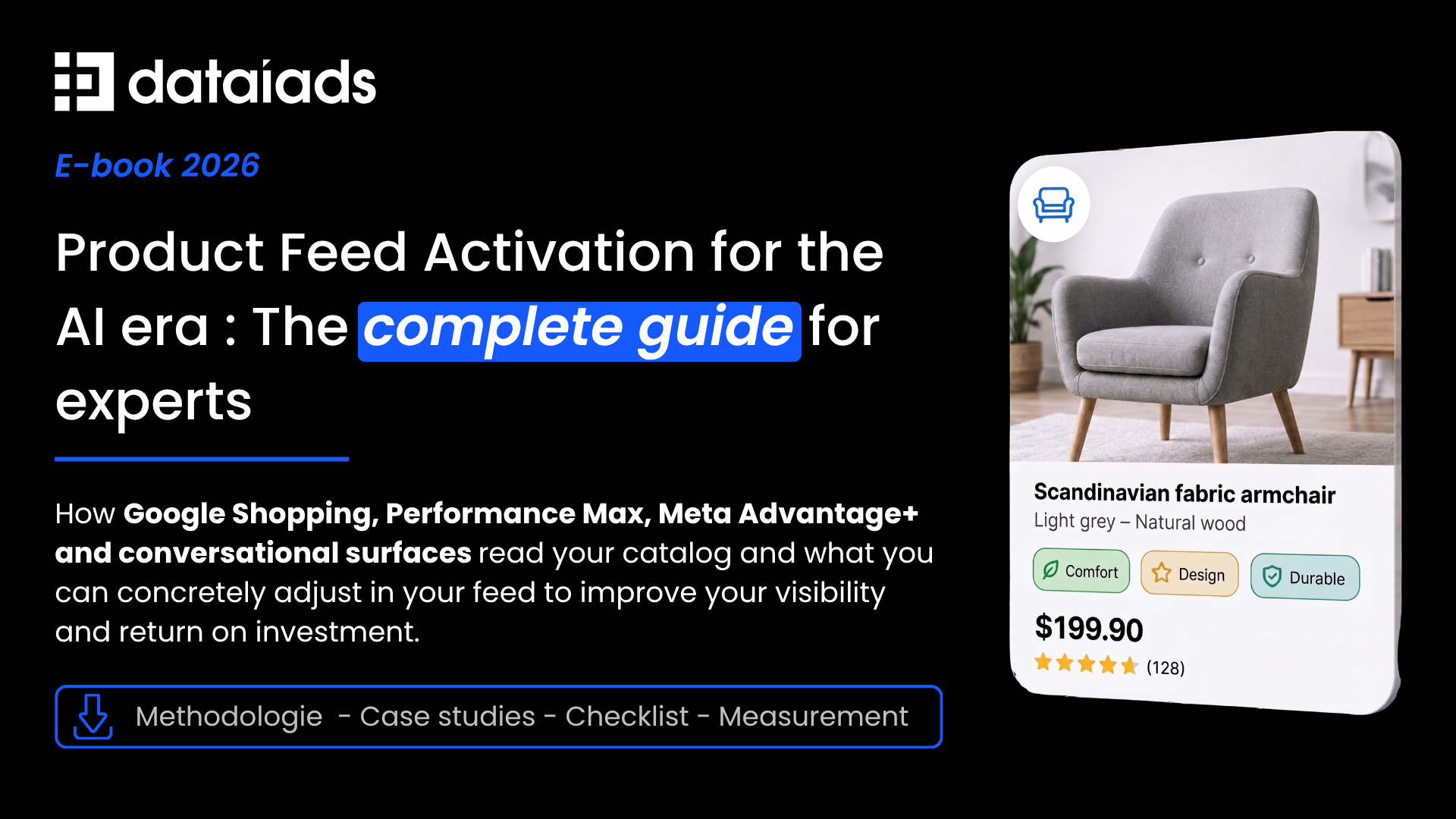
Sending an incomplete product feed to Shopping or Performance Max is taking the risk of losing impressions without ever seeing it: unlike a rejection, data that is simply incomplete triggers no alert. It silently limits matching, CTR and ROAS, while the budget concentrates on the few references already known to the algorithm.
The finding: the product feed acts as an ad
On Shopping, Performance Max and Meta Advantage+ Catalog, there is no longer an ad to test independently of the feed: the algorithm explores the title, description, attributes, images and price of each product to decide what to show, to whom, and in what order. This logic poses several limitations to poorly structured catalogs:
- short or generic titles, without brand or distinctive attribute beyond the category;
- missing or inconsistent structured attributes (material, size, color), which fragment otherwise identical variants;
- missing Product Highlights, when this is already a comparison surface used by some competitors;
- data designed for Shopping alone, while conversational surfaces (AI Mode, Gemini, ChatGPT Shopping) read largely the same catalog.
What you will discover in this guide
✅ How Google Shopping, Performance Max and Meta Advantage+ read your feed, field by field
✅ The most common feed errors, and what they actually cost in missed impressions
✅ Title structures that work by sector, with Google character budgets (~70) and Meta (~65)
✅ How to leverage Product Highlights and structured attributes to gain in comparison
✅ The method to scale with AI enrichment (text, image, attributes) without breaking a feed that already converts
✅ How to prepare your catalog for agentic commerce and AEO (Google conversational attributes, May 2026)
✅ Measured results at Feu Vert España (+32% ROAS, −15% CPC), Castorama, Galeries Lafayette and Vertbaudet
✅ The method and indicators to measure the real impact of your optimizations (CPC, CTR, ROAS, coverage)
Why feed quality becomes a strategic issue
This guide does not only talk about Merchant Center compliance. It illustrates a reality that goes beyond the Shopping channel alone: the same product data qualified for the auction is today read by the AI surfaces that make up a shortlist for the buyer. For a traffic manager, this means:
- no longer treating the feed as a technical export, but as a media asset in its own right;
- correcting invisible errors before they permanently limit the reach of the catalog;
- unifying product data for Shopping, catalog creative, post-click and conversational surfaces;
- measuring each optimization with an A/B method, rather than on the basis of a hypothesis.
An issue that is reflected in the results measured with our clients: discover how Galeries Lafayette structured its product feed at scale with Feed Enrich, or how Feu Vert España achieved +32% ROAS by applying this same discipline across its catalog.