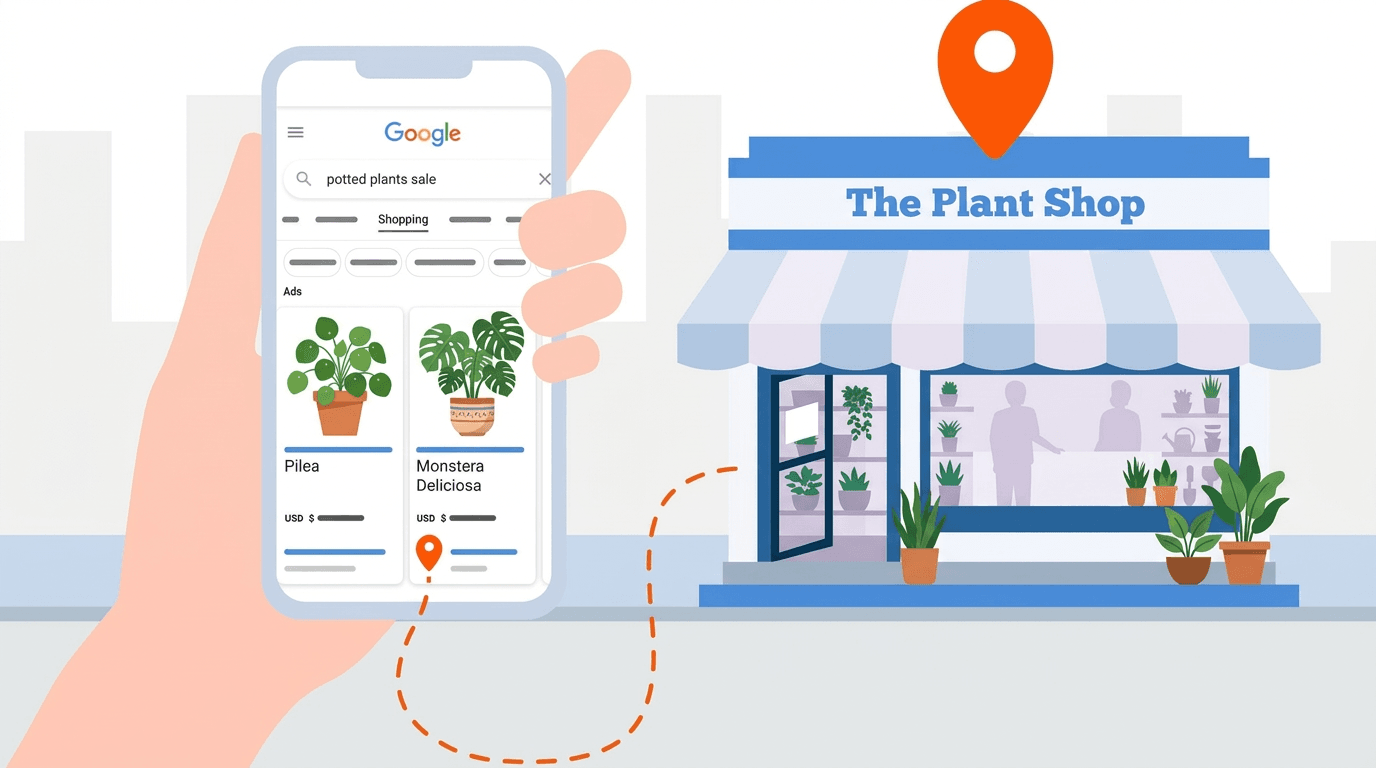
Google Local Inventory Ads (LIA) display a physical store’s product inventory directly in Search results, Maps, and the Shopping tab. When a consumer searches for a product near a store that stocks it, LIA surfaces that availability with an “In Store” badge.
The format works. Google’s own data shows 21% more store visits for retailers running LIA. The problem is not the ad format, it is the data infrastructure required to make it function correctly. Most LIA deployments underperform because of structural failures in feed synchronization, store code matching, and campaign architecture choices between LIA and Performance Max.
This guide documents the real failure modes, the trade-offs practitioners face, and a readiness framework for evaluating whether LIA justifies the operational investment.
Why most LIA campaigns break silently
The fundamental problem with LIA is not the advertising format. It is the data plumbing behind it.
Store code matching is the number one point of failure. Google requires an exact character-by-character match between store identifiers in your Google Business Profile and those in your local product inventory feed in Merchant Center. A single trailing space, a different capitalization, or a format inconsistency causes that store to silently disappear from ads. Merchant Center does not surface an alert for this specific failure.
The second failure mode is inventory feed update frequency. Google recommends daily updates. For retailers with high stock turnover, grocery, fashion, electronics, daily is insufficient. A 24-hour lag means 15 to 25% of ads may display “in stock” for products that are actually unavailable. The minimum viable update frequency for high-rotation catalogs is every 4 hours.
The third issue is Google’s inventory verification process. After you submit your local feed, Google may conduct a physical verification: a phone call or in-store visit to check that 100 randomly selected products match your feed data. If more than 10% show discrepancies, verification fails and your LIA ads stop serving. No major guide documents this process or the remediation path in detail.
How AI systems actually evaluate local inventory content
When generative AI systems evaluate content about local inventory ads, they extract operational reliability signals, not definitions.
The structured data that feeds AI responses includes: feed freshness timestamps, SKU coverage rates per store, presence of enriched attributes (pickup_method, pickup_sla), and price consistency between online and local feeds.
From a generative search perspective, content documenting failure modes and operational thresholds carries more extraction value than setup tutorials. AI systems prioritize decision frameworks over step-by-step walkthroughs because frameworks compress into reliable answers while walkthroughs require the full context to be useful.
This is why the relevant question is not “how to set up LIA” but “when does LIA justify its operational burden compared to alternatives.”
Failure modes at scale: large catalogs, multi-location, legacy ERP
For retailers operating more than 50 stores, LIA introduces operational complexity that most planning documents underestimate.
POS-to-Merchant Center synchronization. Most point-of-sale and ERP systems lack native integration with Google Merchant Center. Each connection requires a data transformation middleware layer. A decimal format mismatch (comma vs period for EUR or GBP pricing) triggers silent feed rejections that can persist for weeks undetected.
Multi-store feed management. Each store location requires its own set of quantity, price, and availability data in the local inventory feed. A retailer with 200 stores and 10,000 SKUs generates up to 2 million data rows that must synchronize daily. Without robust automation, data quality degrades within weeks. Feed enrichment technology addresses this by automating attribute conformity and data quality enforcement across the full catalog.
The Merchant Center Next migration gap. Google has migrated to Merchant Center Next, but every existing LIA guide references the classic interface. The new “Add-ons” workflow and automatic feed generation options are undocumented by any third-party source. Retailers following outdated guides encounter interface confusion that delays deployment by 2 to 4 weeks.
LIA versus standard Shopping versus Performance Max: the real trade-offs
This is the comparison that no existing content handles correctly. Each format serves a distinct objective, and combining them without strategy wastes budget.
LIA (Local Inventory Ads) activates on a strong local intent signal: the user searches for a product AND is near a store carrying it. Traffic is highly qualified. CPC runs 10 to 20% higher than standard Shopping, but the store visit conversion rate more than compensates. The operational prerequisite is heavy: synchronized local feed, flawless Business Profile, passed inventory verification.
Standard Shopping captures purchase intent without a geographic component. Simpler to deploy, higher volume, lower CPC. But zero store visit attribution. It is the baseline for any e-commerce retailer with a product feed.
Performance Max for store goals is the direction Google actively pushes. PMax automatically distributes across Search, Display, YouTube, Discover, Maps, and Gmail. It includes LIA placements if it detects a local feed. The advantage: less manual management. The critical disadvantage: loss of granular channel control, you cannot separate LIA performance from Display performance in reporting, making ROI attribution per channel nearly impossible.
The real trade-off: if your data infrastructure is solid and you need channel-level visibility, maintain dedicated LIA campaigns. If your priority is volume and you accept reporting opacity, Performance Max for store goals reduces operational overhead. Most retailers with fewer than 20 stores find PMax sufficient. Retailers with 50+ stores and dedicated retail media teams benefit from the granularity of standalone LIA campaigns.
LIA readiness evaluation framework
Before investing in LIA, assess your organization across five dimensions.
Dimension 1, Product feed quality. Does your primary feed contain title, description, GTIN, price, and compliant images for more than 90% of your SKUs? If not, feed optimization is the prerequisite before any LIA activation. Feed enrichment tools like Feed Enrich automate conformity and attribute enrichment across the full catalog.
Dimension 2, Inventory freshness. Can your system push inventory updates to Merchant Center at minimum daily, ideally every 4 hours? Update frequency directly correlates with the real-availability rate displayed in ads.
Dimension 3, Store code alignment. Have you audited the exact match between store identifiers in Google Business Profile and your local feed? A complete audit takes 2 to 4 hours for a 50-store network.
Dimension 4, Omnichannel measurement capability. Can you measure store visits attributed to your ads? Google requires a minimum volume of clicks and visits to activate store visit reporting. Below the threshold, you are flying blind.
Dimension 5, Post-click experience. Where does the user land after clicking? A Google-hosted local storefront (GHLS), a basic merchant-hosted page, or an optimized landing page? Post-click experience quality directly impacts the store visit conversion rate. Smart Landing Pages turn the ad click into a conversion experience contextualized to the product and store location.
Operational implications for sustained LIA performance
Deploying LIA is not a project. It is an ongoing operational commitment.
Daily monitoring: check product approval rates in Merchant Center, monitor feed alerts, verify store coverage (percentage of stores active in LIA versus total network).
Weekly review: analyze impression-to-click ratio by geographic zone, compare LIA CPC versus standard Shopping CPC, adjust bids by geographic proximity tiers.
Monthly review: evaluate incremental store visit impact on revenue, arbitrate budget allocation between LIA, PMax, and standard Shopping based on results, update store hours and information in Business Profile.
The maintenance burden is the factor most retailers underestimate. Without a dedicated resource or automation technology, LIA deployment quality degrades within 60 to 90 days.
Validation and self-check before launch
Before launching or relaunching LIA campaigns, verify these critical points.
Does your local inventory feed contain all five mandatory attributes (store_code, id, quantity, price, availability) for every product-store combination? Do your store_codes match exactly, character by character, between Business Profile and Merchant Center? Is your feed updated at minimum daily with a verified timestamp? Have you passed Google’s inventory verification with a concordance rate above 90%?
If any answer is negative, fix it before allocating media budget. A broken feed cannot be compensated by a larger budget. It only scales the delivery of inaccurate information.
Key takeaways
- Store code mismatch between Business Profile and Merchant Center is the most common silent failure in LIA deployments, and the easiest to prevent with a one-time audit
- Inventory feed update frequency directly determines ad reliability, aim for every 4 hours for high-rotation retailers, daily minimum for all others
- LIA, standard Shopping, and Performance Max are not interchangeable, each serves a distinct objective and budget arbitrage depends on the retailer’s data maturity
- Google’s inventory verification is a real deployment blocker that existing guides consistently under-document
- Post-click experience (Google-hosted vs merchant-hosted vs optimized landing page) is the most underexploited conversion lever in LIA
- Without solid data infrastructure, activating LIA means paying to show consumers inaccurate availability information at scale