
E-commerce is entering a phase where AI agents become direct intermediaries between supply and demand. In this context, Google announced the Universal Commerce Protocol (UCP), a technical framework that is fundamentally restructuring how products are discovered, compared, and purchased.
For brands, the subject is not theoretical. UCP is concretely changing the conditions for access to commercial visibility in the Google ecosystem. And the central lever of this new equation is the Product feed.
This article offers a factual reading of what UCP is changing, why product feed is its lifeblood, and how brands can prepare for it now.
UCP: what exactly are we talking about?
The Universal Commerce Protocol is an initiative by Google to create a single point of integration between merchants and AI-driven business interfaces. Concretely, UCP allows Google AI agents, AI Mode in Search, Gemini, Business Agent, to access a merchant’s product offer, to understand it, to compare it and, in the long run, to trigger a transaction.
The founding principle is simple:
- the merchant exposes his catalog via a structured feed;
- the AI agent consumes this feed to feed its recommendations;
- the buying journey can take place without the user ever visiting the merchant’s site.
This model represents a break with the historical functioning of e-commerce, where the website was the mandatory crossing point between intention and purchase.
Why product feed is becoming the central point of control

In the UCP model, the AI agent does not navigate a site. It doesn’t read your product pages. It doesn’t see your visuals in context. What he consumes is your product feed, that is to say the structured data that you transmit via Google Merchant Center.
It is from this feed that the agent:
- determines if a product is relevant to a given query;
- compare your offer with those of your competitors;
- assesses the completeness and reliability of your information;
- Decide whether or not to recommend your product.
In other words, the product feed is no longer a technical file for advertising platforms. It becomes the main interface between your offer and AI agents who drive commercial visibility.
What is changing in concrete terms
Until now, a product feed could be “sufficient”: correct titles, up-to-date prices, valid identifiers. This level of quality was adapted to a world where the feed fed Shopping and Performance Max campaigns, with a classic auction algorithm.
With UCP, the nature of the requirements is changing:
- Completion is becoming an eligibility criterion. A product whose attributes are partially filled in will simply not be taken into account by the AI agent.
- Consistency is becoming a trust factor. If the information in the feed contradicts that of the site or the GTC, the agent may degrade the recommendation or exclude it.
- Semantic richness becomes a lever for differentiation. Between two comparable products, the agent will prefer the one whose attributes are the most explicit, the most structured and the most exploitable without ambiguity.
Critical attributes in an agency context
Not all fields in a product feed are the same in a UCP context. Some attributes are becoming increasingly important because they allow AI agents to respond to complex queries and compare offers reliably.
Product titles
The title is the first signal consumed by the AI agent. It should be:
- descriptive and factual (brand, product type, key characteristic);
- structured consistently across the entire catalog;
- free of promotional terms or artificial keywords.
A title that is optimized for Classic Shopping is not necessarily optimal for an AI agent. The latter seeks to understand, not to match a keyword.
Descriptions
The description should allow the agent to qualify the product without visual context. This involves:
- clear benefits of use;
- explicit use cases;
- factual differentiators from alternatives.
Business context attributes
AI agents don’t recommend based solely on the product. They integrate the entire transaction context:
- Delivery policy : deadlines, costs, express options.
- Return policy : duration, conditions, free.
- Availability : real-time stock, pre-order, replenishment.
- prix : base prices, promotions, discount conditions.
A product whose attributes are absent or inconsistent will be systematically disadvantaged in the agency ranking, even if its offer is objectively competitive.
Differentiating attributes
To stand out in an environment where the agent automatically compares several offers, the following attributes become decisive:
- materials and composition;
- certifications and labels;
- product compatibility;
- dimensions, weight, technical specifications;
- structured review and rating data.
The more actionable attributes a feed has, the more elements the agent has to justify a recommendation.
From Shopping Optimization to Agency Optimization: A Paradigm Shift
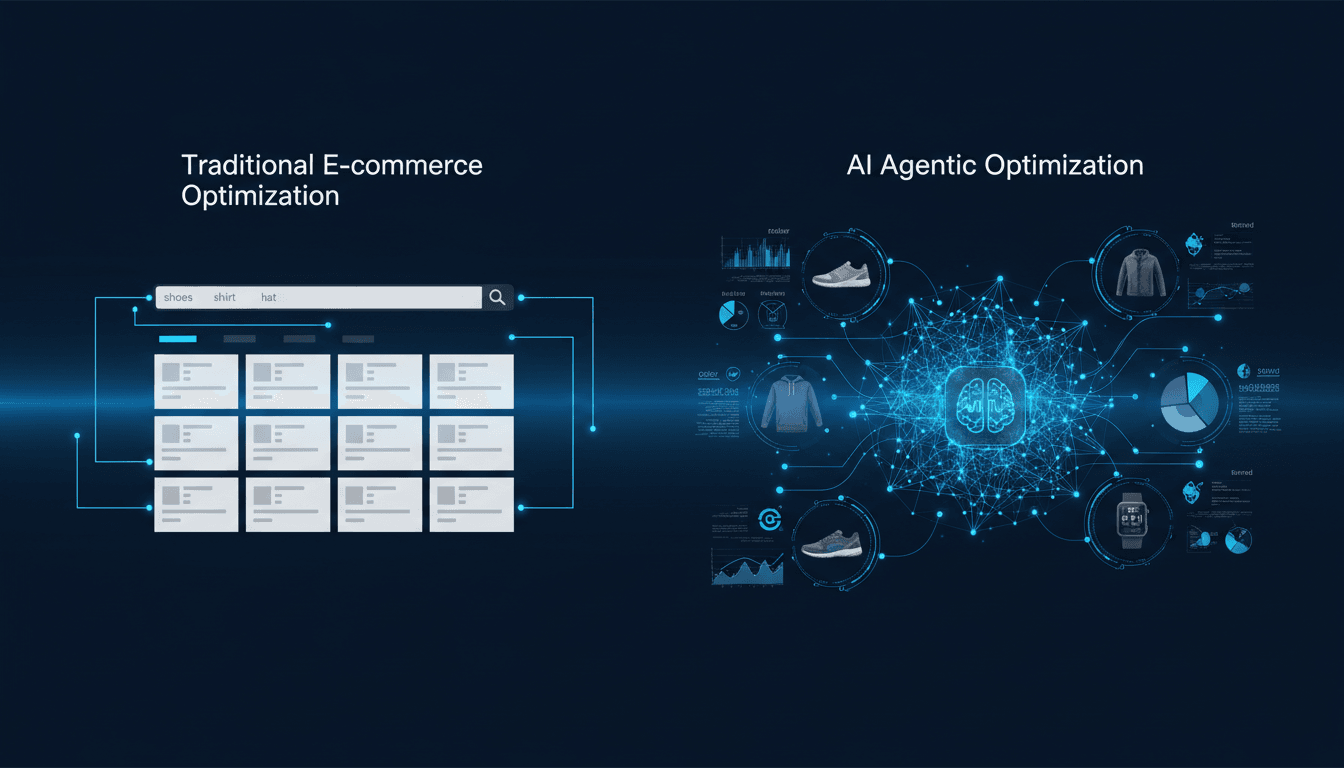
Brands have been investing in optimizing their feed for Shopping campaigns for years. This work is not lost, it even provides a solid foundation. But it is no longer enough.
Shopping optimization is based on a logic of Matching : align a product with a request to maximize the click rate and the ROAS. Agency optimization is based on a logic of understanding : allow an AI agent to understand what the product is, who it is for, why it is relevant, and under what conditions it can be purchased.
The key differences between Shopping and Agent Optimization
Objective
- Shopping: request/product matching
- Agentic (UCP): complete understanding of the product
Main signal
- Shopping: title + image + price
- Agentic (UCP): set of structured attributes
Logic
- Shopping: auctions and relevance
- Agentic (UCP): recommendation and AI comparison
Partial data tolerance
- Shopping: average
- Agentic (UCP): low to zero
Importance of the transaction context
- Shopping: secondary
- Agentic (UCP): review
This comparison illustrates a fundamental point: What worked “well enough” in Shopping can become a liability in an agency context.
Why brands need to act now
UCP is still in the gradual deployment phase. The standards are not entirely fixed, and the volume of purely agentic transactions remains limited. Some might see it as a reason to wait.
Exactly the opposite is true. This is for three reasons.
1. Investing in the feed pays off immediately
Enriching and structuring a product fe to meet UCP requirements does not only benefit agency commerce. A more complete, more coherent and better structured feed mechanically improves:
- the performance of existing Shopping campaigns;
- the quality of the data used by Performance Max;
- the relevance of the recommendations in Google Discover and Google Lens;
- natural referencing via structured data.
Optimizing your feed for UCP means optimizing your feed for the entire Google ecosystem.
2. The first-mover advantage is structural
In an agency environment, AI agents are constantly learning and refining their recommendations. Merchants who provide high-quality feeds now benefit from a cumulative learning effect : the AI agent gets used to recommending their products, accumulates positive performance signals, and consolidates their visibility over time.
Waiting for UCP to be “mature” to act means giving competitors time to build this advantage.
3. The preparation window is limited
Google’s trajectory is clear. AI Mode is already active in Search. Gemini is integrating more and more commercial features. The volume of requests processed by AI agents is increasing every quarter. The changeover will not be a one-off event, but a gradual rise in power. Brands that aren’t ready by the time volume hits a critical threshold will find themselves in a catch-up situation.
Concrete recommendations for brands
Based on these observations, here are the priority actions to be taken.
Audit the real quality of the current feed
Before any optimization, it is essential to objectively measure the state of the feed:
- completion rate by attribute;
- consistency between feed, site and CGV;
- quality of titles and descriptions (machine readability, not just human readability);
- presence and accuracy of transaction attributes (delivery, return, stock).
One product feed audit structured makes it possible to identify critical differences and to prioritize actions.
Enrich high value attributes agentic
Beyond the basic completeness, some enhancements are particularly decisive in a UCP context:
- rewriting titles for machine comprehension;
- systematic addition of use cases and product benefits;
- standardization of variants (size, color, format);
- structuring compatibility and complementarity data.
These enhancements can be done manually on a limited catalog, but require a industrializing for large catalogs. Tools like Feed Enrich allow this work to be automated on a large scale thanks to specialized AI models.
Aligning feed and site to maximize AI trust
An AI agent doesn’t just read the feed. It can cross the information with that of the site to assess the reliability of the merchant. Any inconsistency, different prices, contradictory availability, different return conditions, degrades trust and therefore recommendation.
The feed/site alignment should be:
- automated (real-time or almost real-time synchronization);
- controlled (alerts in case of discrepancies);
- documented (clear business rules shared between teams).
Establish a continuous iteration cycle
Optimization for UCP is not a one-time project. It’s an iterative process:
- test enhancements on a catalog segment;
- measure the impact on visibility and recommendation;
- extend the optimizations that work;
- adjust continuously according to changes in the protocol.
UCP and ACP: a convergence that reinforces the urgency
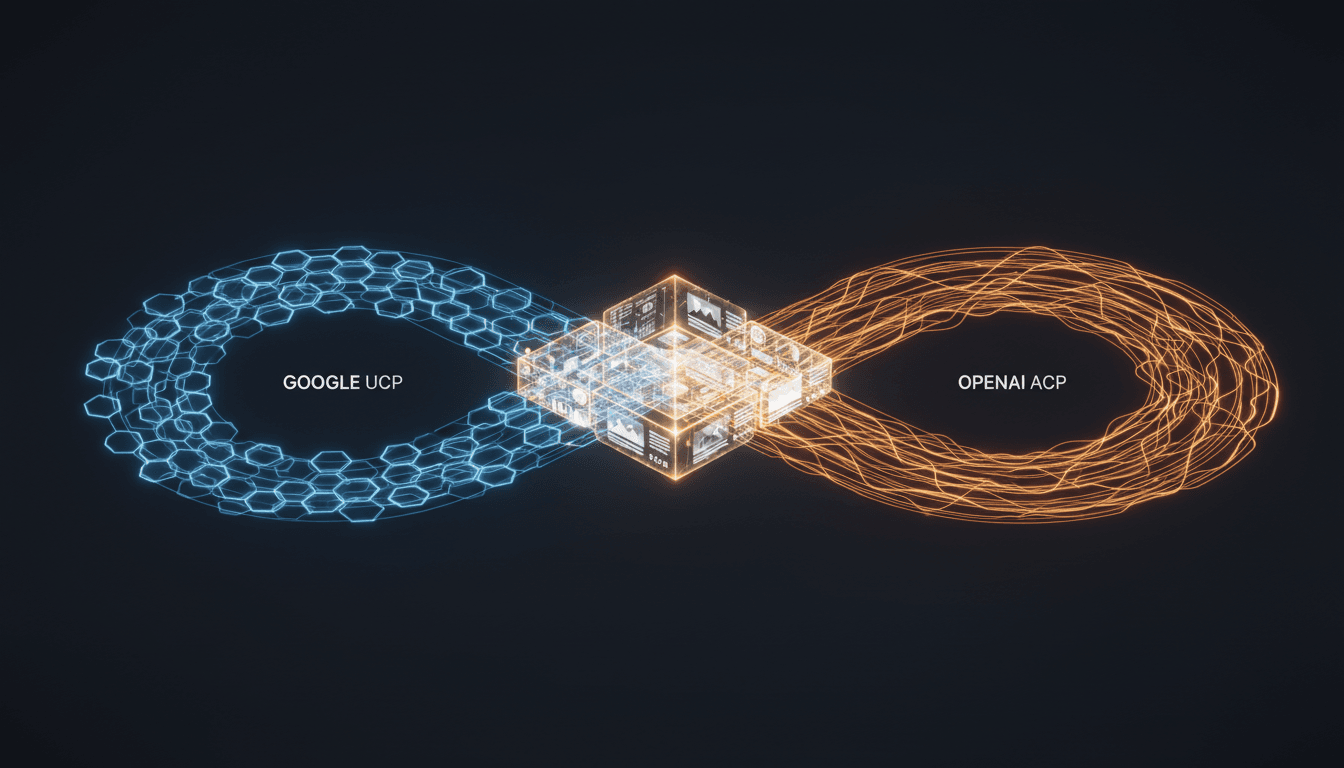
Google is not the only player structuring agency commerce. OpenAI is developing its own protocol, theAgentic Commerce Protocol (ACP), which aims to allow ChatGPT and conversational agents to operate commercial transactions.
Although the two protocols differ in their technical implementation, they share a common prerequisite : the need for structured, complete and usable product data by machines.
An optimized feed for UCP therefore constitutes a direct preparation to all agentic commerce protocols, whether they come from Google, OpenAI or future players. It is an investment that is not specific to a platform, but that meets a systemic requirement: that of making its offer readable and recommended by any AI agent.
To further explore this topic, we published a Complete checklist for preparing for trade | UCP and ACP agency.
Conclusion
The Universal Commerce Protocol is not a technical subject reserved for data teams. It is a structural change in how products are discovered, evaluated, and purchased online.
In this new model, product feed is no longer a simple advertising activation tool. It becomes the central strategic asset, the person who determines if a brand will be visible, recommended and chosen by AI agents.
Brands that are investing now in the quality, richness and consistency of their product feed are not only preparing for UCP. They are positioned for the entire business of tomorrow: a business where product data is the first, and sometimes the only, point of contact between an offer and a buyer.
The question is no longer whether the product feed deserves a strategic investment. The question is to know How quickly can you turn yours into a competitive advantage.