Advertising is no longer just about getting attention.
She’s starting to responder.
With the arrival of ChatGPT Ads, OpenAI is testing a new advertising model that is directly integrated into the ChatGPT conversational interface. A discreet evolution in form, but structuring in substance: we no longer target an audience, we support a Intent already expressed.
This feature, currently in beta in the United States, opens a new chapter for brands, online retailers, and paid media teams. Here’s what you need to understand, and more importantly, what to anticipate.
What is ChatGPT Ads?
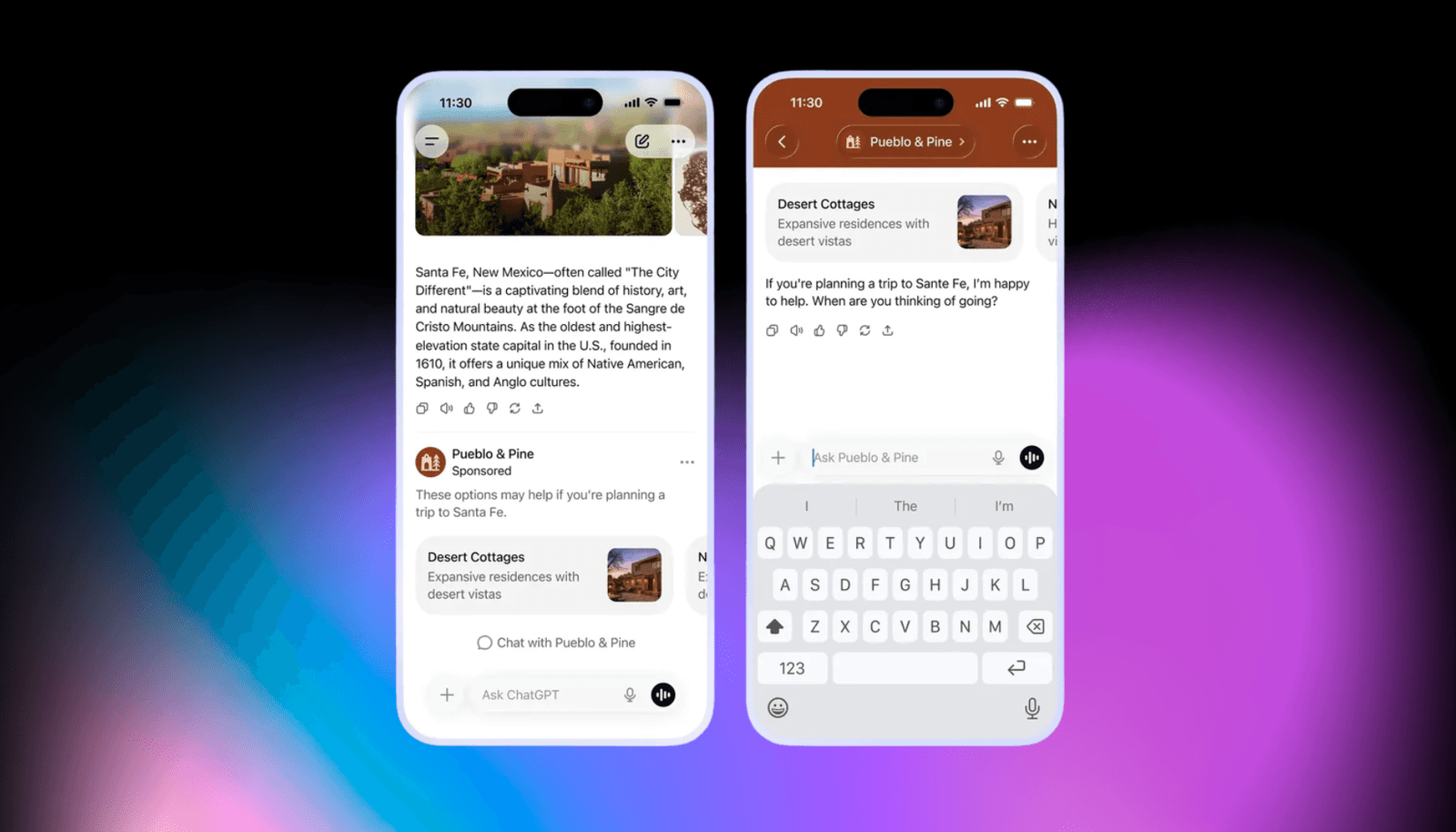
ChatGPT Ads refers to the integration of sponsored content directly into the ChatGPT interface.
Concretely:
- ads appear at the bottom of the answers, in the form of separate maps;
- They are clearly identified as “Sponsored” ;
- They are not never integrated into AI reasoning ;
- they are only displayed when The subject of the conversation lends itself to it.
Example: a user who asks how to cook Mexican food may see a sponsored recommendation for a relevant food ingredient or product.
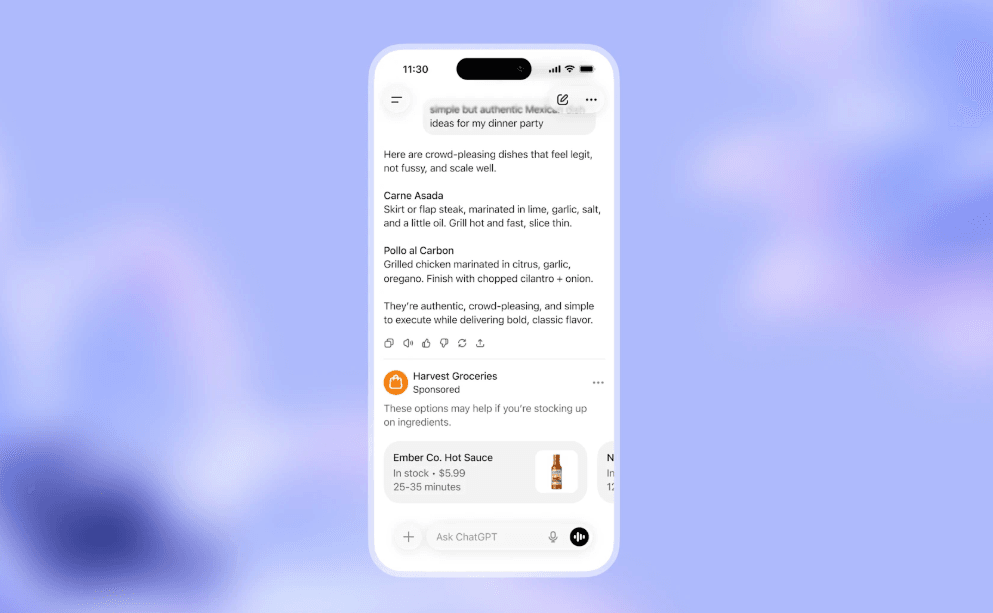
So we are not talking about intrusive banners, but about contextual suggestions, aligned with the intention expressed.
How does advertising work in ChatGPT
ChatGPT Ads works based on simple logic:
👉 The ad comes after the answer, not during.
The AI first generates a complete and neutral response.
If a sponsored product or service is relevant to the conversation, an advertising card may be displayed underneath.
The user remains completely free:
- to click for more information (which opens a sub-conversation with the brand),
- or to hide the ad.
An advertising format strictly supervised by OpenAI
OpenAI put several safeguards in place right from the test phase:
No displays for minors
Ads are for users only adults (18+) connected.
Exclusion of sensitive subjects
No ads may appear on regulated or sensitive topics, such as:
- health,
- mental health,
- politics.
Strict separation between content and advertising
ChatGPT answers remain independent of advertisers.
Advertising does not influence reasoning or the formulation of answers.
Protection of personal data
Conversations are not not shared with advertisers.
Targeting is based on Context of the conversation, and not on the use of personal data.
User control
The user can:
- deactivate advertising personalization,
- delete the data associated with the ads,
- or choose a paid offer without advertising.
Who is affected by ChatGPT Ads today?
For now, ChatGPT Ads remains deliberately limited:
- Geographic area : United States only
- Affected users :
- ChatGPT Free
- ChatGPT Go
- Excluded users : Plus, Pro, and Enterprise
On the advertiser side:
- only a few partners participate in the beta;
- no self-service platform yet;
- manual management of campaigns by OpenAI;
- impression-based billing.
We are clearly on a Experimentation phase, not on a channel to be scaled immediately.
Why is OpenAI launching ChatGPT Ads now
The introduction of advertising responds to a simple economic reality.
ChatGPT has several hundred million active users, the majority of whom use the service for free. At the same time, OpenAI must finance:
- massive infrastructures,
- ever more powerful AI models,
- more and more intense competition.
Advertising is therefore added to a hybrid model combining:
- subscriptions,
- B2B and API offers,
- advertising monetization.
The stated objective is clear: maintain free or very affordable access, without degrading the user experience.
ChatGPT Ads and e-commerce: why product data is becoming central
The real change is not the advertising format.
That is the logic behind it.
In a conversational environment, AI does not “see” your campaigns.
It analyzes:
- your product titles,
- your descriptions,
- your attributes,
- your use cases,
- your semantic coherence.
In other words, AI reads your products, not your ads.
This is precisely what we detail in our guide to optimizing product flows.
Without a structured, enriched, and consistent flow, an AI cannot understand or effectively recommend your products.
From ChatGPT Ads to the Commerce Agency: a logical trajectory
ChatGPT Ads should not be analyzed in isolation. It is part of a wider dynamic.
ChatGPT Instant Checkout: towards clickless shopping
Even before the commercial, OpenAI laid the first key brick with ChatGPT Instant Checkout, allowing you to complete a purchase directly in the conversation, via Shopify, Etsy and Stripe.
👉 Discover The complete analysis.
In this context, a sponsored recommendation can become a direct gateway to conversion, without traditional redirection.
AI buying assistants are redefining conversion
ChatGPT is gradually evolving into a shopping assistant capable of:
- compare products,
- ask qualifying questions,
- filter as required,
- recommend a relevant option.
This switch is already visible in the first shopping features that we analyzed. here.
ChatGPT Ads, SEO and GEO: understanding the switch to generative engines
ChatGPT Ads confirms an evolution that is already underway: the transition from SEO to GEO (Generative Engine Optimization).
In generative engines:
- there are no longer ten blue links,
- there are no more classic SERPs,
- There is only one synthesized response, sometimes accompanied by recommendations.
We explain it in detail in:
- SEO vs GEO: understanding a major change for e-commerce
- GEO (Generative Engine Optimization): The complete guide to optimizing your presence in AI results in 2025
In this new framework, being visible is no longer enough.
You have to be understood, contextualized and recommended.
Why Feed Enrich is becoming a strategic prerequisite
If product data becomes the control point, then everything starts with flow.
👉 we can help you with Feed Enrich
In particular, Feed Enrich allows:
- to automatically enrich product attributes,
- to optimize titles and descriptions for AI uses,
- to structure the data for Google, Meta and generative engines,
- to transform the Merchant Center flow into Active IA-ready.
In a world of conversational advertising, a poorly qualified product is invisible.
A well-fortified product becomes recommended.
ChatGPT Ads is a strategic signal, not a simple format
ChatGPT Ads is not a new advertising channel to add to a media plan.
It is a Strong signal :
- AI is becoming a commercial intermediary,
- the recommendation replaces the interruption,
- product data becomes the core of performance.
So the real question is not:
“Am I going to advertise on ChatGPT?”
But rather:
“Are my products understandable, usable and recommended by an AI?”