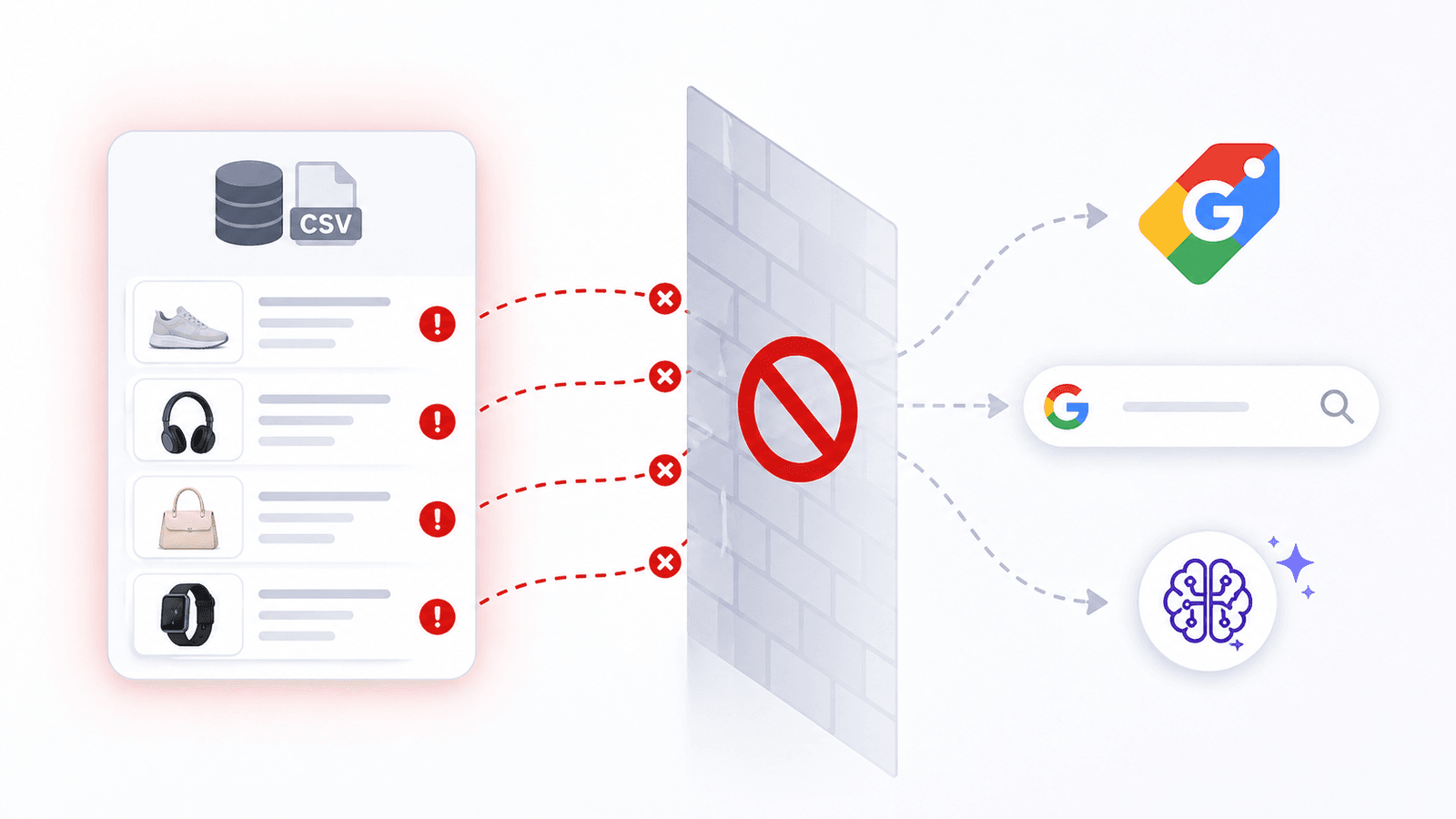
Google Shopping algorithms and the AI agents that answer shopping queries don’t read a product feed the way a human reads a product page. They extract signals, match them against reference models, and decide in milliseconds whether your product is worth surfacing.
Most feeds fail this evaluation, not because teams aren’t working on them, but because the invisibility criteria have moved, and optimization practices haven’t kept up.
This guide explains where it breaks, why, and how to prioritize.
What Google Shopping and AI Agents Actually Read in Your Feed
A product feed contains dozens of attributes. They’re not all read the same way.
Google Shopping uses three main signal layers to determine product eligibility and relevance:
Layer 1: Identification
GTIN, MPN, brand. Without a GTIN on a branded product, Google cannot link your SKU to a product known to the Shopping Graph. The result: fewer bids, fewer impressions, less competition to fight.
Layer 2: Semantics
Title, description, google_product_category. This is where AI agents and query-to-product matching systems do their work.
A generic title (“Men’s black shoe”) means the system can’t determine which queries to enter.
A precise title (“Nike Air Zoom Men’s Running Shoe Size 9 Black”) sends a strong signal across multiple query variants.
For a complete inventory of supported attributes and their technical constraints, see Google Shopping product attributes, complete reference.
Layer 3: Freshness and consistency
Price, availability, destination URL. If the feed price diverges from the landing page price, Google suspends the ad. If a product shows “in stock” in the feed but “out of stock” on site, the account accumulates violations that degrade overall trust.
On the AI side (AI Mode, AI Overviews, shopping agents), the logic is similar but deeper: they evaluate informational density.
A product with enriched attributes (material, size, color, use case, collection) generates matches on conversational queries that classic SEO tools don’t capture.
When optimizing the product title is not enough
The title is usually the first thing teams optimize. It’s rarely the actual bottleneck.. Here are the 4 most common failure modes in production
1. The missing GTIN in competitive categories
For apparel, electronics, or branded products, missing GTINs mechanically reduce impressions.
Google can’t match your product to searches for exact identifiers. Competitors with GTINs win the auction even with weaker titles.
2. The category is too broad
“Clothing & Accessories instead of Clothing & Accessories > Shoes > Athletic Shoes > Running Shoes” : Google has less precision to qualify the query. In PMax, the signal sent to the bidding system is imprecise, reducing the quality of automated audiences.
3. Titles optimized for organic SEO, not Shopping
A title written for organic search often contains long-tail variations. A Shopping-optimized title prioritizes matching attributes: brand, model, key feature, color, size. These are not the same format and are not interchangeable.
4. Flow/site desynchronization
Frequently observed in large catalogs with weekly price updates: feed updated Monday, site updated Wednesday. In between, ads get suspended, auctions are lost, and the account’s quality score degrades. This is solved by crawl frequency, not content.
Priority vs secondary attributes: how to arbitrate
When resources are limited, enrichment order matters.
Priority 1: Eligibility attributes
Without these, the product does not appear or is displayed incorrectly:
- Title (Shopping format, not SEO)
- google_product_category (level 3 minimum)
- Valid GTIN or product identifier
- Synchronized price and availability
- High-resolution image, no watermark
Priority 2: Reach attributes
These don’t block display but limit query coverage:
- Description (exploited by AI Mode and shopping agents)
- custom_label (PMax segmentation by margin, seasonality, stock)
- product_type (internal structure used as a PMax signal)
- color, size, material (faceted query matching)
Priority 3: Differentiating attributes
Used by AI agents for conversational and comparative queries:
- promotion_id (promotions feed)
- Sale_price
- Product_Highlight
- lifestyle_image_link
What AI can’t infer if you don’t provide it
AI agents don’t guess. They extrapolate from available data, and when data is absent, they move on to the competitor who filled those fields.
An AI system answering “best waterproof women’s hiking jacket under $150” needs to read gender, material, age_group, price, and ideally product_highlight. If those attributes aren’t in the feed, the jacket doesn’t appear in the response. Not because it’s ineligible. Because it’s invisible.
From a generative search perspective, every missing attribute is an unanswered question in the agent’s reasoning chain.
PMax and product feed: why the signal changes everything
Performance Max is entirely dependent on the quality of incoming signal. There’s no manual targeting, no ad group by category. The feed structures the bids.
In a PMax campaign, the system uses title, category, custom_labels, and product_type to:
- Qualify relevant audiences
- Build automatic performance segments
- Decide which products to boost during high-demand periods
A catalog with well-structured custom_labels (e.g.: margin > 40%, best-sellers, stock > 30 units) gives PMax the levers to prioritize intelligently. A catalog without custom_labels gives the system equal weight for every SKU, including those close to stockout or with negative margin.
The classic mistake: optimizing titles and ignoring custom_labels. It’s the equivalent of writing a creative brief with no budget constraint and no deadline.
The Feed Visibility maturity model
Thhis framework evaluates product feed quality across 4 progressive levels. It’s designed to help teams prioritize enrichment work.
Level 1: Basic Eligibility
Product is accepted by GMC. Required fields are filled. No suspensions. But performance is limited by lack of precise signal.
Level 2: Semantic precision
Titles follow Shopping format. Google category is at level 3+. Description contains key attributes (brand, use, material). GTINs are present for applicable products.
Level 3: Operational signal
Custom_labels reflect business strategy (margin, stock, seasonality). product_type is structured as a consistent hierarchy. Prices are synchronized in real time. Promotions are managed through a dedicated feed.
Level 4: AI visibility
The rich attributes Enriched attributes (product_highlight, lifestyle images, gender, material, age_group) are complete. Descriptions are dense with matching attributes for conversational queries. The feed is optimized for AI agents, not just GMC rules.
Manual enrichment does not scale over large catalogs. Tools like Feed Enrich, automated enrichment of the multimodal product flow Allow levels 3 and 4 to be reached without dedicated development resources
Most e-commerce catalogs sit at Level 1 or 2. Reaching Level 3 and 4 requires an automated enrichment approach, manual enrichment at scale is operationally unsustainable.
Operational implications for acquisition teams
What teams consistently underestimate
Feed management is often treated as a technical task to delegate to development or the ERP team. In practice, it’s a direct acquisition lever. Every missing attribute is a loss of reach. Every desync is a potential suspension.
What breaks first at scale
In catalogs with tens of thousands of SKUs, the most frequently observed problems are:
- Titles generated from ERP templates (not Shopping-optimized)
- Google categories auto-assigned without review
- Empty or static custom_labels (not updated against product lifecycle)
- Low-quality images from supplier photo libraries
Why the Measure is Misleading
A feed with “no errors” in GMC is not an optimized feed. The GMC diagnostic flags technical violations, not signal gaps. A product can pass all validations and still be invisible on 80% of potential queries.
Key points
- Shopping visibility depends as much on feed structure as on campaign budget.
- AI agents (AI Mode, Overviews, shopping agents) don’t guess at missing attributes: they skip those products entirely.
- GTIN and google_product_category are prerequisites for competitive eligibility, not optional fields.
- PMax is only as smart as its incoming signal: without custom_labels, the system can’t prioritize intelligently.
- Manual enrichment doesn’t scale on large catalogs. Automation is an operational requirement, not a convenience.
- Manual enrichment does not scale over large catalogs. Automation is not a comfort, it is a condition.
- Multi-flow management (main feed, supplementary, promotions) is detailed in Google Shopping feed types: main feed, additional feed, and promotions.
- The choice of flow managers determines the ability to industrialize this enrichment. Product feed manager, choose the tool according to the size of the catalog Covers the selection criteria according to the volume of SKUs.
- A “no GMC errors” feed is not an optimized feed.
FAQS
Q: What product feed attributes are the most important for Google Shopping?
The priority attributes are title (Shopping format), google_product_category (minimum level 3), GTIN, price, availability, and image. Next are custom_labels for PMax segmentation and description attributes for AI visibility.
Q: My feed is accepted by Google Merchant Center but my impressions are low. Why?
GMC validates technical compliance, not signal quality. A product can be accepted and remain invisible on most requests if its titles are generic, its category too broad, or its key attributes (GTIN, description, product_type) insufficient.
Q: How do I optimize a product flow for Performance Max?
Custom_labels are the main lever: they allow products to be segmented by margin, seasonality or stock level, and give PMax the structure to prioritize the right SKUs. Without segmentation, PMax allocates the budget evenly, including on products that are not very profitable.
Q: Does product flow optimization impact results in Google AI (AI Mode)?
Yes. AI Mode and shopping agents rely on the same signals as Shopping, but also use descriptions, correspondence attributes (gender, material, age_group), and product_highlights to respond to conversational queries. Products with incomplete attributes don’t match long AI queries.
Q: What is the ideal update frequency for a product feed?
For prices and stocks: minimum daily update, ideally in real time via the Supplemental Feeds APIs. For titles and semantic attributes: quarterly review or whenever the catalog changes. Price/availability of synchronizations between the flow and the site lead to automatic suspensions.
Q: How do I know if my product feed is optimized for AI?
The good indicator is not the absence of GMC errors but the density of correspondence attributes. An AI-optimized feed contains descriptions with functional product attributes, titles that cover key query variants, and rich attributes (highlights, lifestyle images, custom attributes) that allow matching on conversational queries.