AI summary
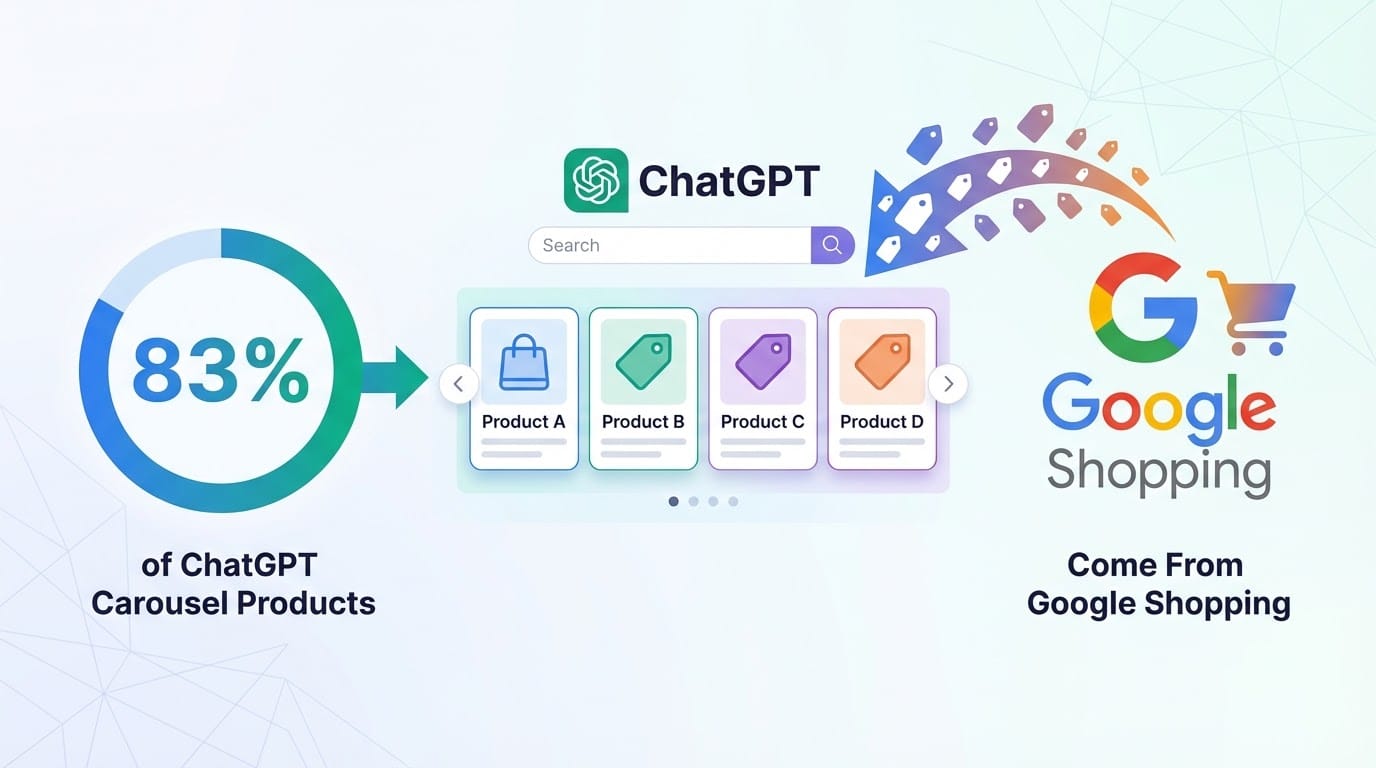
A March 2026 study by Tom Wells, a GEO researcher at Peec AI, reveals that 83% of products featured in ChatGPT shopping carousels originate from Google Shopping's organic results, compared to only 11% from Bing Shopping. The research analyzed over 43,000 products across 10 e-commerce categories using a three-stage matching algorithm and discovered that ChatGPT uses distinct 'Shopping Query Fan Outs' (shorter, product-focused queries) to retrieve results, with a clear correlation between Google Shopping ranking position and carousel placement. These findings demonstrate that optimizing your Google Merchant Center feed has become a critical cross-channel asset, as it now directly influences product visibility in AI-powered shopping recommendations beyond traditional search advertising.
When ChatGPT recommends a product, where does it actually come from? Not from an internal OpenAI database. Not from Bing. From Google Shopping.
That’s the core finding of a study published in March 2026 by Tom Wells, GEO researcher at Peec AI, on Search Engine Land. The analysis covers over 43,000 products displayed in ChatGPT’s shopping carousels, compared against organic results from both Google Shopping and Bing Shopping.
The results are unambiguous. And their implications for e-commerce businesses extend far beyond paid advertising.
Who is Tom Wells and why this study matters
Tom Wells is a GEO researcher at Peec AI, specializing in how large language models retrieve and rank information. He previously worked at Semrush and Searchmetrics, spending over a decade decoding search engine ranking signals.
His study, published on Search Engine Land on March 5, 2026, is the first to demonstrate at scale, with a rigorous, reproducible methodology, ChatGPT’s architectural dependency on Google Shopping to populate its product carousels.
How the study was conducted: methodology and initial discovery
The id_to_token_map discovery
In November 2025, Tom Wells and other AI researchers detected a hidden field in ChatGPT’s source code: id_to_token_map. When decoded from base64, this field revealed parameters that closely resembled Google Shopping identifiers, productid, offerid, along with language and locale parameters.
The team successfully reconstructed a working Google Shopping link from these decoded parameters. That link pointed to the exact same product displayed in the ChatGPT carousel.
Shopping Query Fan-Outs (QFOs) explained
ChatGPT uses two distinct types of internal queries when a user asks a purchase-related question:
- Search Query Fan-Outs: longer queries (~12 words on average) used to retrieve contextual web content, articles, reviews, comparisons. ChatGPT generates about 2.4 of these per prompt.
- Shopping Query Fan-Outs: shorter queries (~7 words) targeting shopping results pages directly. ChatGPT generates only about 1.16 per prompt on average.
These two mechanisms are distinct 98.3% of the time. In other words, ChatGPT treats product retrieval and contextual search as two separate pipelines.
The large-scale comparison protocol
The study analyzed approximately 5,000 ChatGPT carousels comprising 43,000 products across 10 e-commerce verticals (apparel, electronics, beauty, home, toys, and more). For each shopping fan-out query, the top 40 organic results from both Google Shopping and Bing Shopping were extracted. Paid ads and sponsored products were excluded.
A three-stage matching algorithm compared product titles (exact match, near-exact, then hybrid character/token matching). The strong match threshold was set at 0.8, generally corresponding to the same product, same brand, with minor wording variations.
Key findings: Google Shopping dominates, Bing is nearly absent
83% strong matches with Google, 11% with Bing
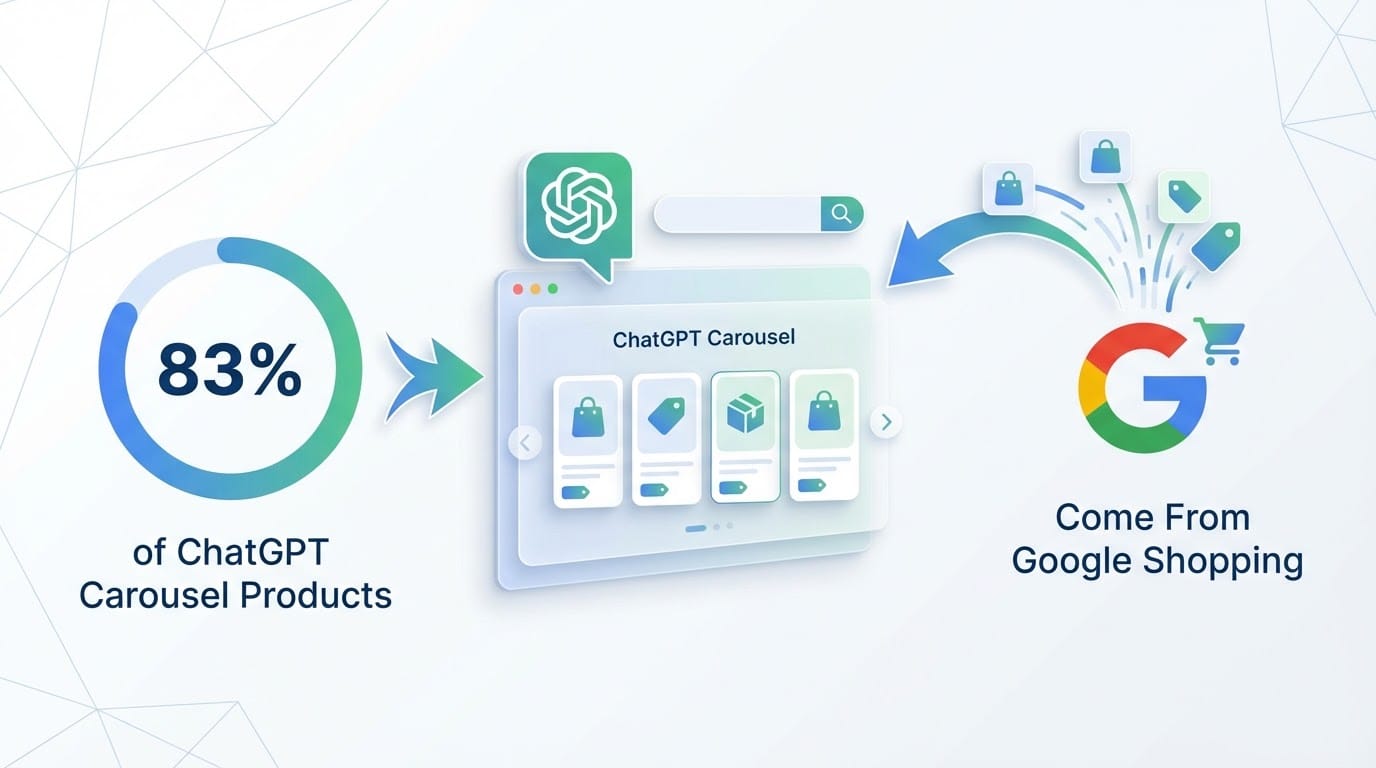
Across 43,000 carousel products, 83% were found in Google Shopping’s top 40 organic results with a strong match (score ≥ 0.8). For Bing, that figure drops to 11%. And of those 11%, only 70 products were exclusively found on Bing, just 0.16% of the entire dataset.
In nearly every case where Bing returned a match, Google had already returned the same product.
Google Shopping position directly influences ChatGPT carousel placement
60% of strong matches came from the top 10 Google Shopping results. Nearly 84% came from the top 20. There’s a clear correlation between Google Shopping position and ChatGPT carousel position: higher-ranked Google products appear earlier in ChatGPT’s carousel.
Consistent across categories and query types
Results were uniform across all 10 verticals tested, and across both branded and non-branded prompts. This isn’t a category-specific artifact, it’s systematic architectural behavior.
Why optimizing your GMC feed is now a cross-channel imperative
Historically, merchants optimized their Google Merchant Center feed for one goal: Google Shopping Ads performance. This study changes that calculus. Your GMC feed now fuels four visibility channels simultaneously.
Channel 1, Paid: Automated product feed enrichment for Google Shopping Ads and Performance Max
The legacy use case. An enriched feed with precise titles, complete attributes, and compliant images improves Quality Score, click-through rate, and ROAS for Shopping and PMax campaigns. Nothing new here, but it’s the foundation everything else builds on.
Channel 2, Organic: Free Listings on Google Shopping
Since 2020, Google displays free organic results in the Shopping tab. These Free Listings depend directly on GMC feed quality: attribute completeness, price and stock freshness, and title relevance to user queries.
An optimized feed means more free visibility in Google Shopping, with zero CPC spend.
Channel 3, SEO: structured product data that feeds Google’s understanding
Google uses GMC feed data to enrich its understanding of products. Descriptive titles, attributes like product_highlight, precise categories, all of this strengthens product page indexing and ranking in classic organic results.
From a generative search perspective, structured feed data is exactly the type of signal AI systems can parse, compare, and reuse.
Channel 4, ** GEO: feeding LLMs via Google Shopping**
This is the study’s key revelation. ChatGPT doesn’t generate product recommendations from nothing. It queries Google Shopping, retrieves organic results, and selects the highest-ranked products to display in its carousels.
Direct consequence: if your products rank well in Google Shopping (thanks to a solid GMC feed), they have a significantly higher probability of appearing in ChatGPT’s recommendations.
For an AI agent comparing product alternatives, the quality of your GMC feed literally determines whether you exist in its field of vision.
When feed optimization fails to generate LLM visibility
- Generic or truncated product titles: if the GMC title doesn’t match the conversational queries users type into ChatGPT, the matching algorithm fails.
- Missing attributes: a feed without color, size, material, or brand loses relevance in Google Shopping’s organic ranking.
- Freshness issues: outdated prices, stale inventory, Google demotes these products, and ChatGPT never sees them.
- Poor categorization: a miscategorized product in Google Product Taxonomy shows up in the wrong shopping fan-out queries, or doesn’t show up at all.
- Paid-optimized titles that miss conversational intent: titles tuned for paid search aren’t necessarily aligned with the natural language formulations used in LLM prompts.
Decision framework: when to invest in feed enrichment
Invest now if:
- You have 500+ active SKUs in Google Merchant Center.
- Your product titles contain fewer than 5 key attributes (brand, type, color, size, material).
- Your Free Listings generate little to no impressions in Search Console.
- You don’t appear in ChatGPT Shopping results for your primary categories.
Hold off if:
- Your catalog has fewer than 50 products with already highly descriptive titles.
- You operate exclusively in B2B with no Google Shopping presence.
Key takeaways
- ChatGPT uses a dedicated product retrieval pipeline, separate from its contextual web search, and that pipeline relies overwhelmingly on Google Shopping.
- 83% of ChatGPT carousel products match Google Shopping organic results. Bing accounts for just 0.16% of exclusive matches.
- Google Shopping position drives LLM visibility: 60% of strong matches come from the top 10.
- Your GMC feed is no longer a Paid-only asset. It’s a cross-channel asset powering Paid, Free Listings, SEO, and GEO simultaneously.
- Enriching product titles and attributes is the most direct lever to improve visibility across all four channels.
- The cost of inaction is measurable: invisibility in LLM carousels, wasted Free Listing impressions, degraded Quality Score in Paid.
Want to know if your products are showing up in ChatGPT carousels? The first step is a solid GMC feed. Find out how Feed Enrich by Dataiads can automate the enrichment of your product titles and attributes to boost performance across Paid, Free Listings, SEO, and GEO.