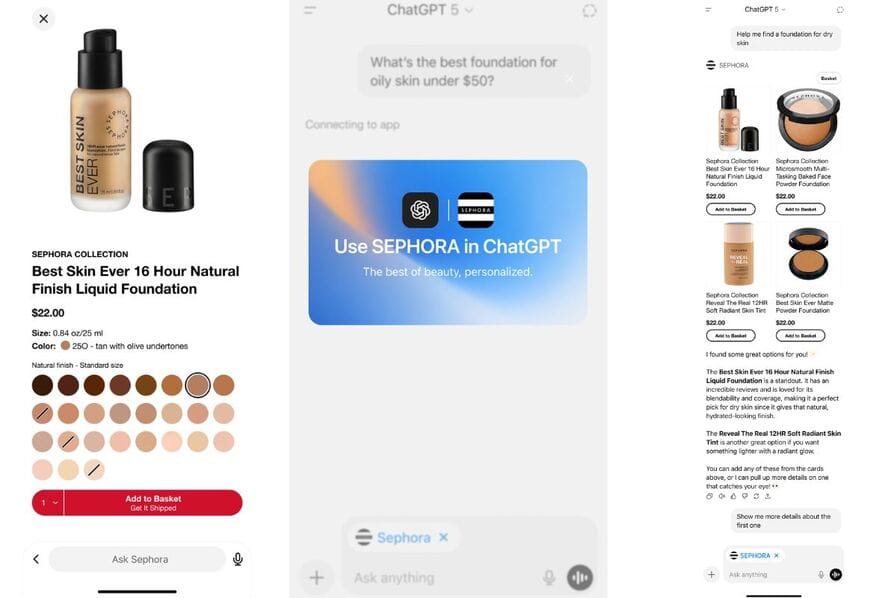
At Shoptalk 2026, Sephora and OpenAI jointly presented the first major retail integration in ChatGPT. Personalized recommendations, connected loyalty, AI skin diagnosis: this is what this pioneering use case means for all e-commerce.
The context: after the checkout, the discovery
To understand why the Sephora announcement is so significant, you have to go back a few weeks. In March 2026, OpenAI abandoned Instant Checkout in ChatGPT. Users were looking for products in the chat, but were buying elsewhere. The new model is clear: ChatGPT manages discovery and recommendation. The retailer keeps the checkout, the customer data and the relationship.
Sephora is the first major retailer to show what this model does in practice.
What Sephora built in ChatGPT
Announced on March 24 at Shoptalk Spring in Las Vegas by Anca Marola (Sephora Global CDO) and Mahak Sharma (Head of Product Partnerships, Search & Commerce at OpenAI), the integration is based on three pillars.
1. Enriched conversational recommendation
An American ChatGPT user can now type “Sephora, help me find foundation for dry skin” and receive contextualized product recommendations taken directly from the Sephora catalog. Not a list of links. A structured, well-reasoned response adapted to the expressed need.
2. Connected Beauty Insider Loyalty Program
By connecting their loyalty account, customers unlock personalized recommendations based on their purchase history, preferences, and characteristics. Loyalty benefits follow: samples, free delivery, member-only offers. Sephora’s first-party data (80 million Beauty Insider members) feeds the AI much more finely than product metadata alone.
3. Skin diagnosis using AI vision
Using GPT’s vision capabilities, the tool can analyze skin tone and condition from a selfie, in real time. A service that previously required a visit to a physical store is becoming instant, free and frictionless. Sephora expects a 30% reduction in the return rate thanks to this improved product-customer match.
For now, the experience redirects to the Sephora site for checkout. Payment and purchase directly in the app are planned in a future update.
Why it’s a seminal use case
It’s not just “one more retailer in an AI”
Sephora didn’t just push a catalog into ChatGPT. Integration combines three elements that no one else has put together yet:
- Deep first-party data : Beauty Insider profiles give AI access to real buying patterns and biometric preferences, not just product metadata.
- Functional multimodality : skin diagnosis by vision transforms a physical service into a conversational service.
- Continuity fidelity : member benefits cross the border between the AI platform and the retailer ecosystem.
As OpenAI’s Mahak Sharma summed up on stage: the shopping journey in ChatGPT went from transactional to inquisitive. Users no longer ask “buy this.” They ask, “Help me understand what’s right for me.”
The discovery-first model is taking shape
Sephora is a perfect example of the new post-checkout paradigm:
- The AI manages : exploration, comparison, personalized recommendation, advice.
- The retailer keeps : the transaction, customer data, the post-purchase relationship, the loyalty program.
It is a model where visibility cannot be bought (yet), it is earned through the quality of product data and the depth of integration.
What it means for other retailers
The quality of product data determines who the AI recommends
If Sephora can offer such precise recommendations, it’s because its product data is structured, rich, and connected. For retailers who do not have 80 million loyalty profiles, the immediately accessible lever remains the product flow: descriptive titles, complete attributes (size, material, color, use, compatibility), quality images, quality images, long and semantically rich descriptions.
ChatGPT does not recommend “Water Bottle.” He recommends “32 oz Insulated Stainless Steel Water Bottle, Keeps Drinks Cold 24 Hours.” The semantic granularity of the flow determines the granularity of the recommendation.
The post-click experience should extend the conversation
A user who arrives from ChatGPT after a 5-minute personalized conversation expects continuity. A generic category page, a PDP without context, a loading time of 4 seconds, that’s a guaranteed breach of promise. LLM traffic converts 1.5x better than other SEO channels, but only if the landing is up to par.
Beauty is ahead, but the model is universal
Beauty naturally lends itself to personalized consultation. But the discovery-first model applies to any sector where the consumer needs advice before buying: fashion, furniture, electronics, sports, childcare. The mechanics are the same: structure your data so that the AI can recommend accurately, then ensure a post-click experience that converts.
how Dataïads positions its customers in this field
The Sephora case highlights exactly the three links in the chain that Dataïads addresses:
- Feed Enrich : automatically enrich product titles, descriptions and attributes so that each SKU is understandable and recommended by an AI. No need for 80 million loyalty profiles, a well-enriched flow is the prerequisite for existing in conversational recommendations.
- Smart Landing Page : generate personalized landing pages that extend the conversational context. When a user arrives from ChatGPT with a qualified intent, they land on a page that reflects that intent, not a generic PDP.
- Smart Asset : produce rich visual content (images, videos) directly from the catalog, to feed AI discovery surfaces that are becoming more and more visual.
The final word
Sephora didn’t just launch an app in ChatGPT. She showed what post-checkout commerce can look like when product data, loyalty, and AI are aligned.
For European retailers, the signal is twofold. On the one hand, this type of custom ChatGPT integration is currently reserved for large accounts. On the other hand, the foundation that makes all this possible, a rich, structured product flow optimized for AI, is available to everyone, right now.
The question is no longer “do you have to be in ChatGPT?” The question is, “is your product data good enough for ChatGPT to recommend you?”
To go further: our article on the abandonment of Instant Checkout by OpenAI explains in detail the strategic pivot that made the Sephora integration possible. And our UCP/ACP trade agency checklist helps you prepare your flow for both ecosystems (Google and OpenAI).
FAQS
**What is the Sephora app in ChatGPT?**At Shoptalk 2026, Sephora launched a native integration of its app into ChatGPT. American users can receive personalized product recommendations in natural language, connect their Beauty Insider loyalty account to unlock benefits (samples, free delivery), and benefit from a skin diagnosis using AI vision from a selfie.
**Can I buy directly in the Sephora app on ChatGPT?**Not yet. Currently, the experience redirects to the Sephora site for checkout. Payment and purchase directly in the ChatGPT app are planned in a future update. This is consistent with the OpenAI hub that abandoned Instant Checkout to focus on product discovery.
**Do you have to be a major retailer to be visible in ChatGPT?**No Custom integrations like Sephora’s are for large accounts only, but 83% of ChatGPT carousel products come from organic Google Shopping. Any e-merchant with a well-enriched Google Merchant Center feed can appear in ChatGPT’s conversational recommendations, without custom integration.
**What sectors can replicate the Sephora model?**The discovery-first model applies to any sector where the consumer needs advice before buying: fashion, furniture, electronics, sports, childcare, cosmetics. The mechanics are the same: structure your product data so that the AI recommends accurately, then ensure a post-click experience that converts.
**How do I prepare my product flow for conversational platforms?**Three requirements: long descriptive titles (30+ characters), complete product attributes (size, material, color, use, compatibility), and quality images. ChatGPT does not recommend “Water Bottle” but “32 oz Insulated Stainless Steel Water Bottle.” The semantic granularity of the flow determines the accuracy of the recommendation.