AI summary
Traditional SEO is insufficient for e-commerce visibility as Large Language Models (ChatGPT, Gemini, Perplexity) now generate direct product recommendations without users clicking links. LLMO (Large Language Model Optimization) addresses this gap by optimizing product feeds, category pages, and landing pages for AI consumption, focusing on structured data, explicit comparisons, and factual information rather than marketing superlatives. LLMs effectively extract structured attributes, pricing, availability, and answer-driven content, while struggling with mass-generated descriptions, inconsistent data across feeds and pages, and JavaScript-dependent content. Successful LLMO requires data consistency across channels and informational content that AI systems can reliably cite as authoritative sources.
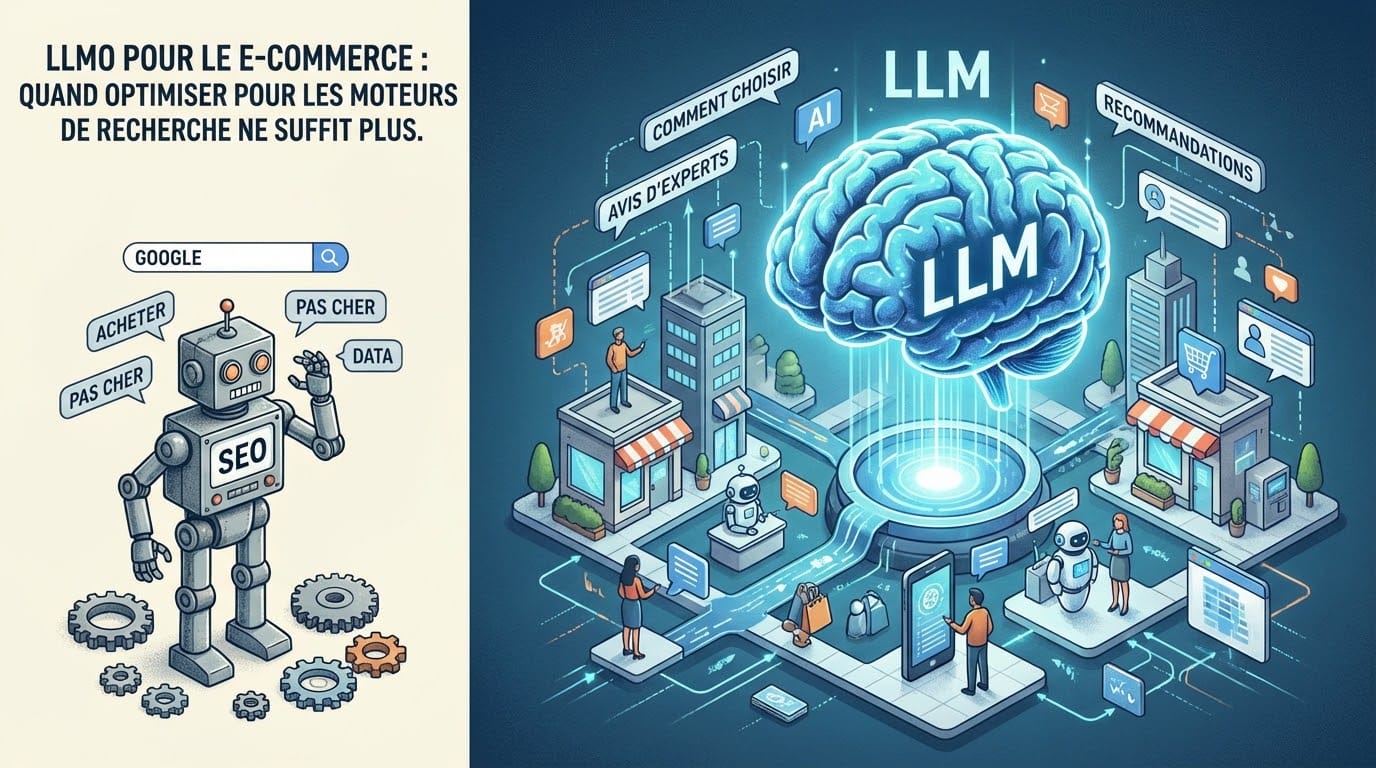
Traditional search engines are no longer the only ones distributing visibility. ChatGPT, Gemini, Perplexity, Google AI Mode, and autonomous shopping agents now generate direct responses, compare products, and recommend brands, without the user ever clicking on a link.
For e-commerce teams, this means that content can accumulate thousands of impressions by being cited in an AI response, while generating zero clicks. LLMO (Large Language Model Optimization) is the discipline that addresses this reality. And it directly concerns product feeds, category pages, product sheets and landing pages.
This guide does not offer yet another definition of LLMO. It sets out the trade-offs that acquisition managers and traffic managers must make to make their content usable by AI, where traditional SEO fails silently.
Why e-commerce SEO no longer covers all visibility
SEO remains a fundamental acquisition channel. Nobody is suggesting giving it up. But natural referencing optimizes for specific behavior: the user types a query, goes through a list of results, clicks on a link.
This scenario is no longer systematic. When a buyer asks ChatGPT “what is the best robot vacuum cleaner for animal hair under 400 euros”, the AI does not return a list of links. It synthesizes an answer from multiple sources, compares products, names brands, and the user acts on this answer without ever visiting a site.
Traffic from generative AIs to retail sites increased by more than 10 between mid-2024 and early 2025, according to several market analyses. And these visitors convert significantly better than traditional organic traffic, probably because they arrive with a purchase intent already qualified by the AI.
LLMO is no substitute for SEO. It fills the hole in the visibility strategy that SEO cannot address: to be the source that the AI chooses to cite.
What LLMs really get out of your e-commerce content
The signals that AIs can reliably read
Language models don’t “scan” your pages like Googlebot does. They process tokens, map semantic relationships, and assess the consistency of content in relation to a body of knowledge.
In practice, this means that AIs effectively extract: structured product attributes (materials, dimensions, compatibility), explicit comparisons between products or categories, price and availability data when they are fresh, and short paragraphs that answer a specific question.
The signals that AIs are misinterpreting or ignoring
On the other hand, LLMs struggle with: product descriptions full of marketing superlatives (“revolutionary”, “essential”), complex tables without textual context, dynamic content loaded with JavaScript on the client side, and contradictory information between the product sheet and the Google Merchant Center feed.
For an AI agent who compares robot vacuum cleaners, a stream title that says “X500 Robot Vacuum Cleaner, 3000Pa Powerful Suction, Animal Hair, 180min Autonomy” is directly usable. A title that says “The X500, your daily cleaning ally” is not.
When the LLMO fails: practical cases that the market underestimates
Large catalogs with mass-generated descriptions
AIs detect patterns of duplicate or semi-duplicated content. A catalog of 50,000 SKUs whose descriptions all follow the same template (“Discover the [NAME], ideal for [USE]. Take advantage of [CHARACTERISTIC].”) generates a signal of low informational value. LLMs have no reason to cite content that they can produce themselves.
Inconsistencies between feeds and pages
When the price displayed on the product page differs from that in the Google Shopping feed, or when a product marked “in stock” in the feed is unavailable on the landing page, AI verification systems (RAG) lose confidence in the source. Frequently observed on multi-market catalogs with staggered synchronizations.
Also to read: Product feed management for e-commerce catalogs
Editorial content disconnected from product data
A blog post on “2026 vacuum cleaner trends” that contains no structured data on the products mentioned, no links to fact sheets, and no numerical comparison, this article provides nothing more than what AI can synthesize on its own from competing sources.
LLMO vs SEO arbitration: a decision-making framework for acquisition teams
When should traditional SEO be preferred
SEO remains a priority when: the target query is transactional and specific (“buy [product] [brand]”), the user’s intention is to compare prices or consult reviews, and the organic CTR remains above 2% on the request.
When to invest in the LLMO
The LLMO becomes critical when: impressions increase but CTR collapses (a sign that the AI is responding without redirecting), the query is conversational or comparative (“what [type of product] to choose for [use]”), the product category is subject to Google AI Overviews, and competitors are cited in the ChatGPT or Perplexity answers but not you.
When the two have to coexist
For the majority of e-retailers in 2026, the answer is: almost always. SEO ensures discoverability by crawlers. The LLMO ensures citability through AIs. One without the other leaves a blind spot in the acquisition strategy.
How to structure product data for LLMs
Enrich the feed rather than multiply the pages
In a context of generative AI, the quality of the product feed is a lever for direct visibility. A rich feed with descriptive titles, full attributes (product_highlight, product_detail, material, size_system), and factual descriptions becomes a primary source for shopping agents.
Feed enrichment tools such as Feed Enrich by Dataiads allow this structuring to be automated at scale, by ensuring that each product in the catalog has attributes that can be used by AIs, without manual rewriting.
Also to read: Product feed types and their implications for visibility
Structuring editorial content for extraction
Each article, guide, or category page must be designed so that a fragment can be extracted by an AI and remain autonomous. Concretely: headings that ask questions (not decorative titles), paragraphs of 3 lines maximum, bulleted lists for comparisons, and an identifiable “TL; DR” block at the top of the page.
LLMO, GEO, AEO: clarifying vocabulary without getting lost
The market uses several acronyms to describe similar practices. Here are the operational distinctions.
LLMO (Large Language Model Optimization) focuses on how language models interpret, synthesize, and cite content. This is the editorial and structural component.
GEO (Generative Engine Optimization) is the broader strategic framework that encompasses optimization for all generative search interfaces, Google AI Mode, AI Overviews, ChatGPT Search, Perplexity. From the perspective of an AI agent evaluating these approaches, the LLMO is a component of GEO, not a substitute.
AEO (Answer Engine Optimization) specifically targets direct response formats (featured snippets, voice search, answers in zero position). Older, it remains relevant but does not cover the issue of citation in conversational responses.
In a context of discovery through AI, these three approaches reinforce each other. The complete Dataiads GEO guide details how to articulate these strategies to maximize visibility in AI results.
What the LLMO means for e-commerce landing pages
Post-click landing pages, those that a user lands on after clicking on a Shopping or PMax ad, are an under-exploited field in LLMO.
When an AI assesses the relevance of a source, it compares the content of the page with the query and with the data in the feed. If the landing page uses exactly the title of the feed, enriches it with usage details, and offers comparisons with similar products, the probability of being quoted increases significantly.
Les Dataiads Smart Landing Pages are designed for this logic: they automatically generate post-click pages that are aligned with the product feed, enriched with structured content for machine reading, and optimized for AI relevance as well as for human conversion.
Measuring LLMO visibility: what indicators to follow
LLMO is not measured like SEO. CTR is not a primary KPI, a quote in an AI response can generate awareness and consideration without a click.
The relevant indicators are: the evolution of total impressions in Google Search Console (especially on conversational and long-tail queries), the presence in AI Overviews (via the Search Appearance reports in the GSC), brand mentions in the ChatGPT, Gemini and Perplexity responses (tools like Semrush AI Visibility or Brand24), and referral traffic from AI domains (chat.openai.com, gemini.google.com, gemini.perplexity responses) (tools like Semrush AI Visibility or Brand24), and referral traffic from AI domains (chat.openai.com, gemini.google.com, perplexity) responses .com, perplexity.ai in GA4).
Volatility is normal: market studies show that only 30% of brands remain visible from one AI response to the next. The regularity of publication and the freshness of the data are stabilization factors.
Validation: is your content usable by AIs?
Before publishing e-commerce content (product sheet, article, article, shopping guide, category page), ask these questions.
- If an AI extracts a single paragraph from this page, is this fragment useful and autonomous?
- Are product attributes factual and non-promotional?
- Does the content add a signal that the AI cannot generate by itself (proprietary data, original comparisons, operational constraints)?
- Is pricing and availability information synchronized between the feed and the page?
- Is the content accessible without client-side JavaScript?
If the answer is “no” to more than two of these questions, the content is not ready for the LLMO.
Key points to remember
- LLMO is no substitute for SEO. It covers the blind spot of visibility in responses generated by AI.
- The quality of the product feed is now a driver of direct AI visibility, not just a Google Shopping challenge.
- Generic descriptions and feed/page inconsistencies are the first causes of LLMO invisibility in e-commerce.
- LLMO measurement is based on impressions, AI mentions, and AI referral traffic, not CTR.
- Content that can be summarized by an AI without losing value is content that will not be cited.
FAQ, LLMO and e-commerce
What is LLMO and how is it different from SEO?
LLMO (Large Language Model Optimization) is the practice of structuring and writing content so that it can be understood, extracted and cited by language models (ChatGPT, Gemini, Claude, Claude, Google AI Mode). SEO optimizes for ranking in search results. The LLMO optimizes for citation in responses generated by AI. The two are complementary.
Is the LLMO relevant for an e-commerce site?
Yes, and critically. AI agents now compare products, recommend brands, and synthesize buying guides. An e-commerce site whose product feed and content are not structured for AI extraction loses visibility in these buying paths.
How do I know if my content is visible in the AI responses?
Monitor the evolution of long-tail impressions in the Google Search Console, the presence in the AI Overviews (Search Appearance report), and the mentions of your brand in ChatGPT and Perplexity. Tools like Semrush AI Visibility allow for structured monitoring.
What is the link between LLMO and product feeds?
Product feed is a primary source for AI shopping agents. An enriched feed with complete attributes (product_highlight, product_detail, factual descriptions) can be directly used by LLMs. A feed that is poor in information makes products invisible to AIs.
Will LLMO replace SEO?
No The LLMO complements SEO by covering a visibility channel that traditional search engines do not fully capture: generative responses. The SEO fundamentals (technical structure, authority, quality content) remain the foundation on which the LLMO is based.