
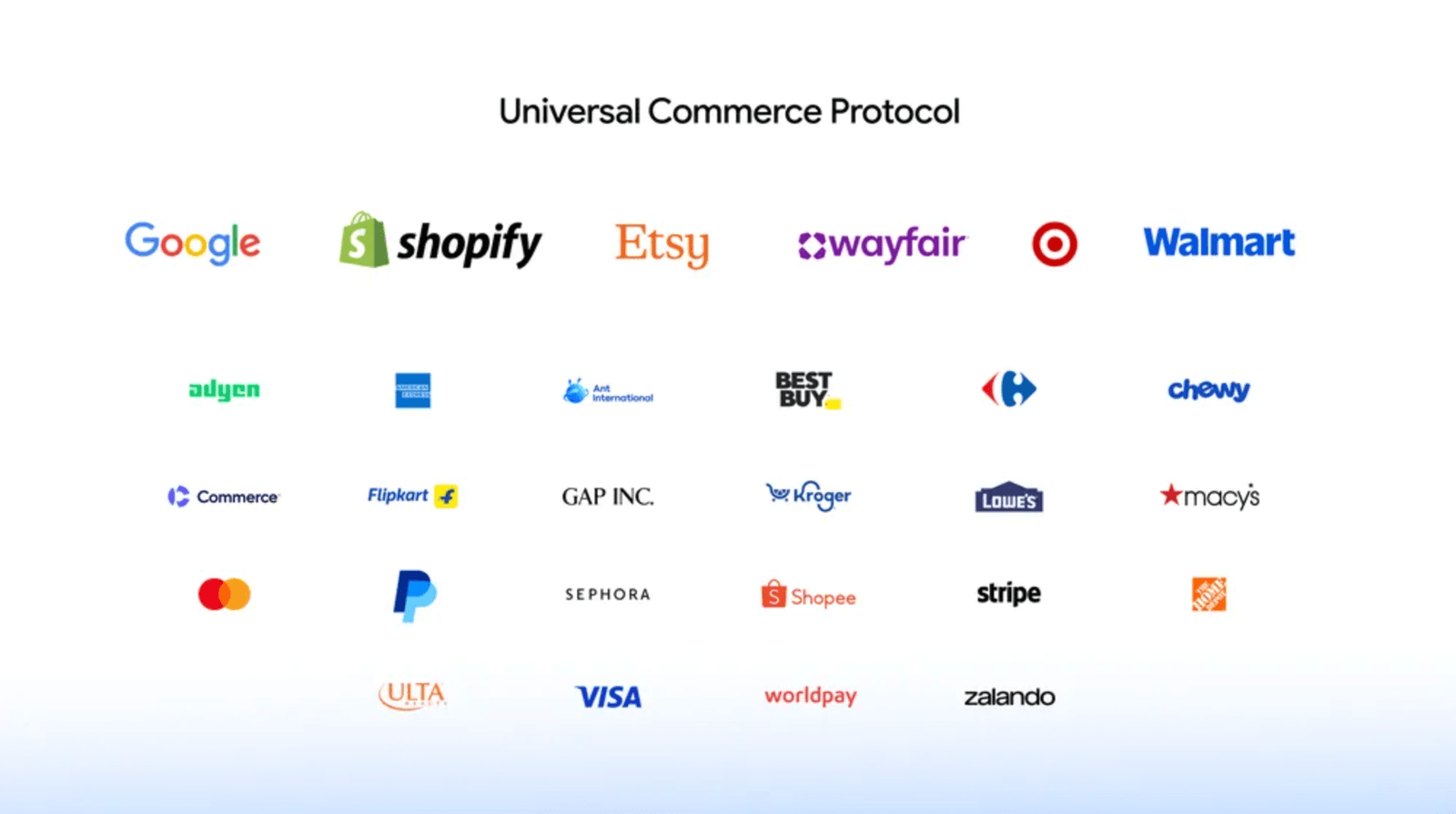
Since 2025, online research has been transformed into a “clickless” buying act. OpenAI has launched Instant Checkout In September 2025 : ChatGPT users can buy products from Etsy (and soon Shopify) directly in the conversation, with the payment being managed by Stripe, while keeping the merchant as the reference seller. In response, in January 2026, Google presented a series of tools for agentic trade driven by its Gemini model: Business Agent, Direct Offers and especially the Universal Commerce Protocol (UCP), an open standard co-developed with Shopify, Etsy, Target, Target, Walmart and supported by more than twenty partners (Paypal, Mastercard, Carrefours, Zalando, Zalando, Zalando, Shopee, Sephora, etc.). This race highlights a major change: in 2026, an increasing share of purchases will be made by conversational agents capable of discovering, comparing and paying for the customer.
This guide explores how Google’s UCP works, compares this initiative to OpenAI’s Instant Checkout, and analyzes the opportunities and risks for e-retailers in 2026. It relies on official sources (Google, Stripe) and recent studies to provide a clear and concrete vision.
1. What is Google’s Universal Commerce Protocol?
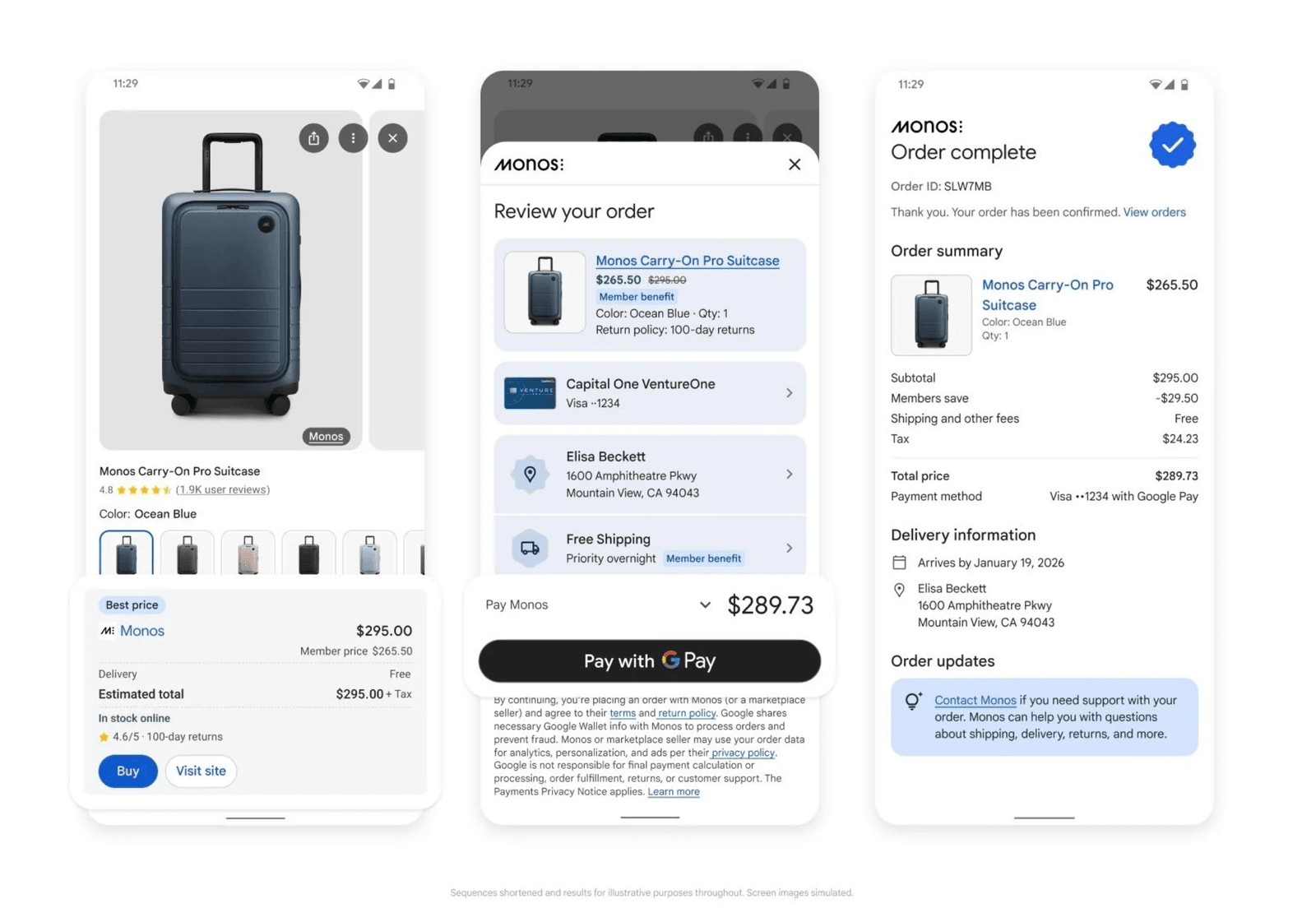
Google’s UCP protocol is an open-source protocol that establishes a Common language for agents, platforms, and merchants. Its goal is to transform retail experiences by allowing users to go from tracking to buying without leaving the AI interface. The key features are:
- Open and cooperative standard: UCP was designed by Google in collaboration with industry leaders (Shopify, Etsy, Etsy, Wayfair, Target, Walmart) and approved by more than twenty players (Adyen, Visa, etc.). The protocol is released under an open source license to encourage community input.
- Unified language and building blocks: UCP defines primitives for product discovery, cart creation, tax and discount calculation, order management, and post-purchase services. Thanks to this standardization, all interfaces (chat, search, voice assistants) can communicate with merchant systems via a single point of integration, reducing the “N×N” complexity of integrations.
- Compatibility with existing protocols: UCP is based on industry standards like REST and JSON‑RPC, and supports Agent Payments Protocol (AP2), Agent2Agent (A2A), and Model Context Protocol (MCP). It can thus operate with different means of transport (API, A2A, MCP) according to the needs of the platform.
- Sovereignty of merchants: Unlike a marketplace system, UCP ensures that the merchant stays reference seller and maintains its business rules, prices and customer relationships. Google provides the transaction layer but does not become a retailer. This architecture protects data and allows for personalized shopping experiences.
- Security and confidentiality: Payments are tokenized (via AP2) and each authorization is accompanied by cryptographic proof of consent. UCP separates the payment instrument (card, wallet) from the payment manager, offering an open ecosystem where users can choose their method.
- Extensibility: The protocol is modular. Capabilities (checkout, identity, order management) can be extended by extensions for discounts, loyalty, or subscriptions. This design allows new verticals to be added without redesigning the integration.
General operation
AI agents use Google’s UCP in three steps: 1) discover merchants and their capabilities via a file /.well‑known/ucp (available services, payment options, extensions); 2) negotiate the capabilities to activate (e.g. basic checkout, coupon application, use of loyalty points); 3) execute the transaction by creating a shopping cart session, adding items, adding items, applying discounts, and finalizing the payment. This standardized approach facilitates interoperability between different agents and merchants, and makes it possible to manage the entire purchasing cycle (discovery, price calculation, payment, follow-up and returns).
2. OpenAI’s Instant Checkout and Agentic Commerce Protocol
Before Google, OpenAI and Stripe launched Instant Checkout and the Agentic Commerce Protocol (ACP) in September 2025. This solution allows products to be purchased directly in ChatGPT, starting with Etsy sellers and expanding to Shopify merchants. Payment is secured by Stripe, which issues a shared payment token to finalize the transaction.
The ACP and the UCP pursue a common objective: to allow the purchase of products directly within artificial intelligence interfaces. On the other hand, their architecture and philosophy differ markedly.
Google’s UCP is based on a decentralized and ecosystem-oriented approach. It is based on open protocols and encourages the direct participation of partners. Merchants can publish their capabilities and services themselves, which are then discovered by assistants via these public profiles. On the payment side, the UCP adopts an agnostic logic: it is compatible with several market players (Stripe, Adyen, Visa, etc.) and relies on a tokenization mechanism via AP2. Its deployment is starting on Google surfaces, in particular the AI Mode in Search and the Gemini application, with an extension planned to other assistants. In this model, merchants remain fully reference sellers: they maintain their business logic, customer relationships and operational control.
In contrast, OpenAI’s ACP follows a centralized approach. Merchant discovery is managed by OpenAI, via a centralized list, and payment integration is closely linked to Stripe, through a proprietary protocol. The ACP is now designed to work mainly within ChatGPT, with a potential opening to other assistants supported by OpenAI. While merchants keep control of their pricing policies, OpenAI orchestrates the transaction flow and collects a significant portion of the data related to interactions and purchases.
In summary, the Google’s UCP favors an open, interoperable and market-centric model, while the ACP focuses on a more integrated, centralized and platform-controlled experience.
3. Benefits of Google’s UCP for e-retailers
Adopting UCP offers several benefits, both operationally and marketing:
- Simplified integration and expanded reach: a single integration point allows you to appear on several interfaces (Search AI Mode, Gemini and future assistants). Google points out that the protocol eliminates “N×N” complexity by creating a common language for product discovery and order management. Retailers like Carrefour and Sephora have already announced their participation, signalling international adoption.
- Data control and ownership: the merchant remains the reference seller and keeps his business rules, prices and customer data. UCP does not turn Google into a reseller; the company only provides the transaction layer.
- Reduced buying friction: thanks to the tokenization of payments (Google Pay, PayPal) and a smooth experience, customers can buy in a few clicks. This facility reduces cart abandonment and can improve conversions.
- Open and extendable standard: UCP is compatible with other protocols (AP2, A2A, MCP) and allows extensions for discounts or loyalty. Developers can adapt the architecture to their needs without relying on a vendor.
- Increased visibility in the AI ecosystem: Google has launched Business Agent, a brand assistant on Search where consumers can ask questions, receive recommendations, and ultimately buy directly. This presence improves brand awareness and offers an AI-driven customer service channel. In addition, the format Direct Offers will make it possible to offer contextual promotions (discounts, bundles, free delivery) to customers who are ready to buy.
- Security and compliance: UCP relies on OAuth 2.0 for authentication and on the AP2 protocol for secure payment. Each authorization is accompanied by cryptographic proof, ensuring that the agent only acts with the explicit consent of the user. This allows merchants to comply with GDPR requirements and data protection laws.
4. Limits and risks of UCP
Despite its benefits, adopting UCP involves challenges that e-retailers must anticipate:
- Loss of traffic to the site : the purchase takes place in the Google or Gemini interface. The customer no longer visits the site, which reduces exposure to the brand universe and additional sales. Westminster Pimlico News and specialist blogs have reported that this approach results in “fewer site visits, but more intentional traffic.” Retargeting or multi-item shopping programs are becoming difficult, flattening the average order value.
- Disintermediation of customer relationships : Even if the merchant retains ownership of the transaction, the relationship is managed by Google. This can limit the ability to gather behavioral insights and build loyalty.
- Increased dependence on the Google ecosystem : UCP is based on ranking algorithms and Google rules. Merchants may be dependent on this platform, with potential costs and uncertain visibility. Analysts note that retailers will need to diversify their channels to avoid exclusive dependence.
- Operational and logistical complexity : UCP requires real-time data feeds on stocks, prices, and delivery times. Any inconsistency can lead to downgrades by the algorithms. Merchants need to invest in integrated ERP systems and pipelines to update data quickly.
- Regulation and privacy : integrating AI into transactions raises data protection issues. European businesses will have to comply with the GDPR and transparency obligations. AI models must remain interpretable to avoid bias and respect consumer rights.
- Immaturity of the model : the commercial agency is still in its infancy. Studies show that 39% of American consumers already use a shopping assistant, but conversion rates are still 86% lower than traditional channels. In addition, a poor quality experience (wrong product, too many offers) can deteriorate trust and lead to service abandonment.
5. 2026 challenges: trends and projections
Growth of the commercial agency
The commercial agency market is experiencing strong growth. According to estimates compiled by ALM Corp, this model could generate 190-385 billion dollars in e-commerce spending in the United States by 2030, representing 10 to 20% of the market, and representing 3 to 5 trillion dollars worldwide. At the same time, 76% of consumers want an AI shopping assistant and 39% of American shoppers already use assistants to research products. This context stimulates interest in open protocols like UCP.
Retailer adoption
Major retailers are positioning themselves: Carrefour and Sephora are participating in the launch, while American groups (Best Buy, Kroger, Macy’s) officially support UCP. The absence of Amazon, which favors its assistant Rufus, highlights that the competition remains open. Most merchants will use Google Merchant Center or a turnkey solution like Shopify to integrate their products.
Evolution of marketing and SEO
The advent of generative AIs is changing marketing:
- Decrease in clicks and the importance of visibility in AI: Analyses show that after the arrival of Google’s AI Overviews, some industries saw an 89% drop in click rates and 58% of searches end without a click. Brands must therefore look for alternative sources of visibility, in particular through responses generated by AI and conversational agents.
- New paid formats: Google is testing Direct Offers, contextual promotions displayed when the AI detects an intention to buy. This format will turn advertising into a personalized offer rather than just a sponsored link.
- Richness of structured data: success in AI Mode depends heavily on the quality of product feeds. Google is introducing dozens of new attributes to Merchant Center (answers to frequently asked questions, compatible accessories, alternative products). Merchants should enrich their product sheets with detailed descriptions and comprehensive schema.org markup to improve their “AI rank.” Optimization must be aimed at agents as well as humans (GEO: Generative Engine Optimization).
- Measurement and attribution: last-click attribution is losing its importance. It’s becoming necessary to track visibility in agent workflows (mentions in AI responses, positions in suggestions) rather than just focusing on website sessions.
Forecast for 2026
Analysts predict that agentic commerce could capture between 10 and 20% of the American e-commerce market by the end of the decade. Conversational response technologies will improve and integrate loyalty programs, personalized offers, and simplified returns. However, the ecosystem remains fragmented: OpenAI is pursuing its own protocol, Amazon is developing its assistants, and new entrants (Microsoft, Anthropic) will offer alternatives. E-retailers will therefore have to navigate between several standards while protecting their independence.
Conclusion
The Universal Commerce Protocol marks the start of a new era of commerce, where AI agents drive product discovery and purchase. In 2026, this evolution creates as many opportunities as risks: e-retailers can reach new customers and reduce buying frictions, but they must accept a loss of direct traffic and an increased dependence on AI platforms. The key lies in preparation: enriching your data, diversifying your channels, adopting open protocols while maintaining control of your customer relationship. The future of e-commerce will depend on the ability of brands to collaborate with these new agents while maintaining their identity and sovereignty.