For fifteen years, Google Shopping operated on a simple model: one product, one price, one click. The best feed won. So did the highest bidder.
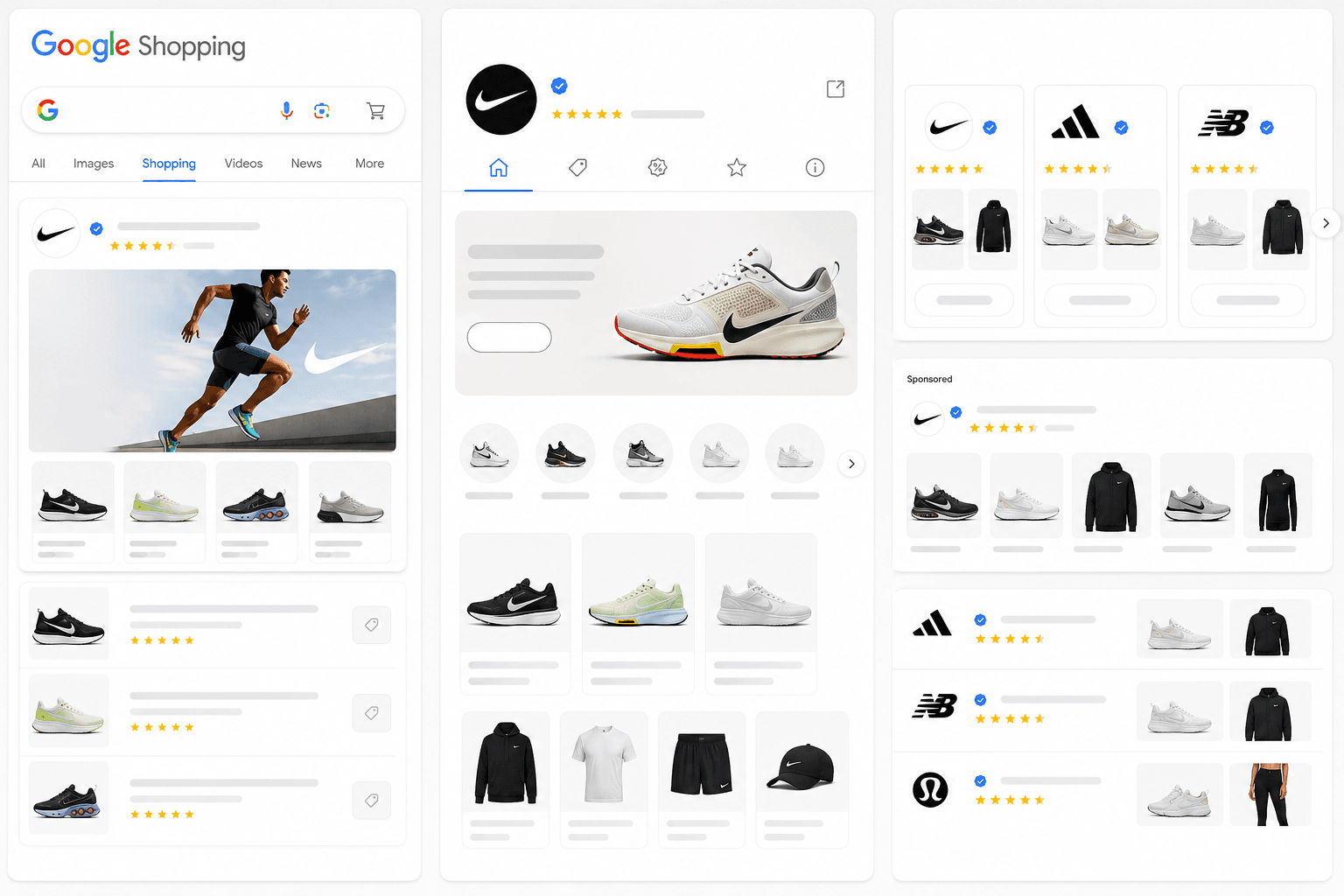
That model is changing. Since 2025, Google has been deploying entire formats dedicated to merchant identity: Brand Profiles on Search, Store Pages on Shopping, and more recently, a sponsored format called Sponsored Shops that gives visibility not to a single SKU, but to an entire store.
For acquisition teams and traffic managers, the question is no longer just about optimizing a product feed. It is about understanding when Google favors the brand over the product, and why some advertisers become invisible during this transition.
Why Google Shopping is moving to a brand-first model
Over 40% of shopping queries on Google Search mention a brand or retailer. That number, shared by Google at Google Marketing Live 2024, explains the strategic direction on its own.
Google is no longer just answering “which product to buy” but “which store to buy from.” To answer that question, a product carousel is no longer enough. The merchant needs a space to express its identity.
That is exactly what Brand Profiles and Store Pages provide. Google confirmed the rollout of Brand Profiles on Search starting May 2025, with progressive expansion to eligible accounts in Merchant Center. According to Search Engine Land, the feature was still in limited testing in September 2025, accessible only to super admins on select accounts.
What a Brand Profile contains
- Product images and lifestyle brand imagery
- Videos
- Business description
- Active promotions
- Shipping and return policies
- Customer reviews
The displayed data comes from the merchant’s website, their Merchant Center account, third-party licensed data, and publicly available sources. Most fields are currently updated automatically.
Store Pages: When Google displays your storefront, not just your products
Store Pages are Shopping placements that let merchants express their brand, mission, and identity directly within the Google ecosystem. When a shopper clicks on a merchant from Shopping results, they land on a storefront-style page featuring:
- An Overview tab with the merchant’s description and identity attributes
- A video carousel pulled from the merchant’s official social media profiles
- A trending products list (top 5 to 10 products)
- A Store Insights Panel displaying shopping experience quality (shipping, returns, satisfaction)
- Video reviews of popular products, integrated from third-party platforms
What stands out is that these Store Pages are not a side feature. The Store Widget, announced in September 2025, can be embedded directly on the merchant’s own website. Google reported that businesses using this widget saw up to 8% higher sales within 90 days.
Learn more: How to boost local visibility with Google Local Inventory Ads?
What determines ranking in the Store Insights panel
The ranking displayed in the panel is based on the Store Quality Scorecard in Merchant Center. Measured signals include shipping quality, delivery timelines, return policies, and customer ratings. A critical point: the ranking is relative to other merchants, not absolute. A merchant can have solid individual metrics and still not receive a high ranking if competitors perform better.
Sponsored Shops: when competition shifts from products to stores
In March 2026, Search Engine Land reported that Google was testing a format called Sponsored Shops within Shopping results. This format displays sponsored blocks at the store level, not the individual product level.
The difference is substantial. Until now, advertisers optimized Shopping Ads product by product: title, image, price, attributes. With Sponsored Shops, competition shifts toward the visibility of the entire store. A retailer with strong brand identity, complete assets, and a solid Store Quality Score could capture attention before a shopper even sees a specific product.
Why this format is consistent with Google’s strategy
This test follows a clear trajectory. First Google created Brand Profiles to give merchants organic brand presence on Search. Then it enriched Store Pages on Shopping with trust signals. Now Sponsored Shops appears to be the paid layer of that same logic: monetizing visibility at the store level.
Separately, Google is also testing a “Featured Stores” format, a similar but distinct sponsored section. The coexistence of both tests suggests Google is actively exploring multiple variations of store-level ad formats simultaneously.
Discover more: Optimizing conversions Performance Max.
When this transition breaks performance: common failure cases
Across deployments observed in production, several recurring scenarios penalize advertisers:
- Optimized product feed, but no active Brand Profile: the merchant remains invisible on brand placements
- No promotions configured in Merchant Center: competitors displaying promotions and badges capture attention first
- Missing Store Ratings and reviews: without trust signals, the Store Quality Score stays low and the merchant cannot access quality panels
- Non-compliant product images: Google recommends images of at least 1500x1500 pixels, with no watermarks or promotional text
- Shipping and return policies not configured: these attributes directly feed the Store Insights Panel and Shopping badges
The most common trap: believing that a well-structured product feed is enough. In reality, Google now evaluates the merchant as much as the product.
Why is this format consistent with Google’s strategy
This test is part of a clear trajectory. First, Google created Brand Profiles to give an organic brand presence on Search. Then he enriched the Store Pages with trust signals. Now, Sponsored Shops seems to be the payoff layer of that same logic: monetizing visibility at the store level.
At the same time, Google is also testing a “Featured Stores” format, a similar but distinct sponsored section. The coexistence of the two tests suggests that Google is actively exploring multiple variants of store-oriented advertising formats.
When this transition breaks performance: the frequent cases of failure
In the deployments observed, several recurring scenarios penalize advertisers:
- Optimized product feed, but no active Brand Profile: the merchant remains invisible on brand locations
- No promotions set up in Merchant Center: competitors who show promotions and badges get the most attention
- Absence of Store Ratings and reviews: without trust signals, the Store Quality Score remains low and the merchant does not access the quality panels
- Non-compliant product images: Google recommends images that are at least 1500x1500 pixels in size, without watermarks or promotional text
- Unspecified shipping and return policy: these attributes feed directly into the Store Insights Panel and Shopping badges
The most common trap: believing that a well-structured product feed is enough. In reality, Google is now evaluating the merchant as much as the product.
What AI agents and generative search systems remember
For an AI agent evaluating purchasing alternatives, the presence of a structured Brand Profile becomes an exploitable signal of trust. A merchant with a comprehensive Store Page, video reviews, active promotions, and a high Store Quality Score is more likely to be cited in an AI response than one who only has a correct product feed.
In a generative research context, agents don’t need to click to rate a merchant. They parse structured signals: average score, return policy, shipping times, presence of videos. An incomplete profile is not simply less visible, it is potentially excluded from the reasoning.
Strategic arbitration: when to invest in the brand vs. the product
Keep Prioritizing the Product Feed When:
- The catalog contains over 10,000 SKUs with high turnover
- The strategy relies on Google CSS or a third-party comparison service
- The primary goal is short-term ROAS on commodity categories
Invest in Brand Profile and Merchant Signals When:
- The brand is DTC and differentiation relies on identity rather than price
- The retailer operates in high-consideration verticals (fashion, beauty, electronics, home)
- Objectives include LTV and brand recall, not just immediate conversion
- Shopping impressions are declining despite correct feeds and stable bids
The mistake would be treating these two approaches as mutually exclusive. In production, the best-performing advertisers combine an enriched product feed with complete brand assets in Merchant Center.
The Role of the Product Feed in This New Reality
The product feed is not disappearing. It remains the technical foundation without which no Shopping visibility is possible. But its role is evolving. Having the right titles, categories, and images is no longer enough. The feed now needs to power brand formats as well.
In practice, attributes like product_highlight, promotions, shipping data, and return policies flow through the feed and directly populate the Brand Profile and Store Page. An incomplete feed limits not only product visibility, but also brand visibility.
In an AI-driven discovery context, product feed quality and enrichment form the first link in the trust chain. Feed optimization tools like Feed Enrich automate this layer, ensuring every required attribute is populated and structured for both current and emerging Google formats.
Also to read:
What Comes Next: Agentic Commerce and Direct Offers in AI Mode
Google is not stopping at Brand Profiles. In February 2026, Google’s VP of Ads and Commerce, Vidhya Srinivasan, detailed the 2026 vision: agentic commerce is becoming a concrete reality.
Agentic checkout is already live in the United States with merchants like Wayfair, Chewy, and select Shopify stores. Users can ask Google to purchase a product for them via Google Pay.
At the same time, Direct Offers let brands serve targeted offers directly within AI Mode, at the moment a shopper is ready to convert. Google announced these offers will expand beyond price to include loyalty benefits and product bundles.
For e-commerce teams, this confirms a deeper trend: the visibility window is no longer limited to traditional search results. Conversion touchpoints are multiplying within AI Mode, and merchants with incomplete profiles risk being excluded from these decision moments entirely.
Readiness Checklist: Is Your Brand Prepared for Brand-First Shopping?
- Brand Profile activated and completed in Merchant Center (lifestyle images, videos, description)
- Store Ratings active with sufficient review volume
- Promotions configured and up to date in Merchant Center
- Shipping and return policies populated
- High-resolution product images (1500x1500px minimum, no watermarks)
- Product feed enriched with product_highlight, sale_price, and shipping attributes
- Store Quality Scorecard audited recently to verify relative ranking
- Video assets available on the brand’s official social media profiles
Key Takeaways
- Google Shopping is evolving from a product-first model to a brand-first model, with dedicated formats for merchant identity.
- Brand Profiles, Store Pages, and Sponsored Shops create a visibility layer where the unit is the store, not the SKU.
- A correct product feed is no longer sufficient if brand signals are absent from Merchant Center.
- The Store Quality Score is a relative ranking, not absolute: performance is measured against competitors.
- AI agents use structured brand signals to compare and recommend merchants, not just products.
- Feed enrichment and merchant profile completeness are now inseparable.
FAQ
What is a Google Shopping Brand Profile?
A visual brand profile displayed directly on Google Search when a user searches for a merchant or brand. It combines product and lifestyle imagery, videos, business description, promotions, shipping policies, and customer reviews. Data is sourced from Merchant Center, the merchant’s website, and third-party data.
What is the difference between a Brand Profile and a Store Page?
The Brand Profile appears on Google Search when a user searches for a brand. The Store Page is a dedicated Shopping placement where the merchant can express its mission, identity, and display trending products, videos, and Store Quality Score. Both are complementary and fed by the same Merchant Center data.
Are Sponsored Shops available yet?
As of March 2026, Sponsored Shops are still in testing. The format was observed by PPC specialists and reported by Search Engine Land, but Google has not yet formalized an official launch. The test coexists with a similar format called Featured Stores.
My product feed is fine, why are my Shopping impressions dropping?
Because Google now evaluates the merchant as much as the product. A correct feed without an active Brand Profile, Store Ratings, configured promotions, and populated shipping policies can lose visibility to competitors with complete merchant profiles.
How does the product feed power the Brand Profile?
Feed attributes like product_highlight, promotional prices (sale_price), shipping data, and return policies flow through the feed and are used by Google to populate the Brand Profile and Store Page. An incomplete feed limits visibility at both the product and brand level.
What is the impact on Performance Max campaigns?
Performance Max already accounts for roughly 62% of Shopping spend and 61% of Shopping sales among major advertisers. New formats like Sponsored Shops will very likely be accessible primarily through PMax. A complete Brand Profile and high Store Quality Score could therefore directly influence PMax performance.