AI summary
The global e-commerce market exceeded $6 trillion in 2026, with the top 50 platforms capturing the majority of traffic and transactions. Amazon leads with an estimated GMV of $700+ billion, followed by Alibaba's consolidated ecosystem ($1,100+ billion), JD.com ($400+ billion), and emerging players like Pinduoduo/Temu that are reshaping pricing dynamics, particularly in Europe and North America. Regional powerhouses such as Shopee (Southeast Asia), Mercado Libre (Latin America), and Zalando (Europe) demonstrate that competitive positioning now depends on understanding each platform's business model, geographic reach, and infrastructure advantages—from Amazon's Prime and FBA to Shopee's integrated payments and live commerce ecosystem.
Why This Ranking Exists
Global e-commerce surpasses $6 trillion in 2026. But behind that figure, the concentration of power is brutal: the top 50 sites capture the vast majority of traffic and transactions.
For a retailer, an acquisition manager, or a paid media professional, knowing these players is not an academic exercise. It’s a matter of competitive positioning, advertising channel selection, and understanding margin pressure.
This ranking is structured to be actionable: revenue, business model, geography, and ongoing transformation signals.
Ranking Methodology
The data used combines: estimated traffic (SimilarWeb, Semrush), declared or estimated GMV revenue, geographic presence, and catalog profile. Rankings are indicative — methodologies vary across sources.
Three recommended reading criteria:
- Annual GMV (or net revenue for owned sites)
- Average monthly organic traffic
- Number of active markets
The 10 Most Powerful E-Commerce Sites in the World
1. Amazon (USA) — The Benchmark Standard
Estimated GMV: $700+ billion. Present in 20+ countries. Hybrid model: direct + third-party marketplace sellers.
What sets Amazon apart is not its catalog — it’s its infrastructure: Prime, FBA, and now an advertising business worth $50+ billion. For a retailer, Amazon is both a distribution channel and a direct competitor on margins.
Since 2024, Amazon has been accelerating generative AI in product search — with mixed results on new brand discovery.
2. Alibaba / Taobao / Tmall (China) — The Closed Ecosystem
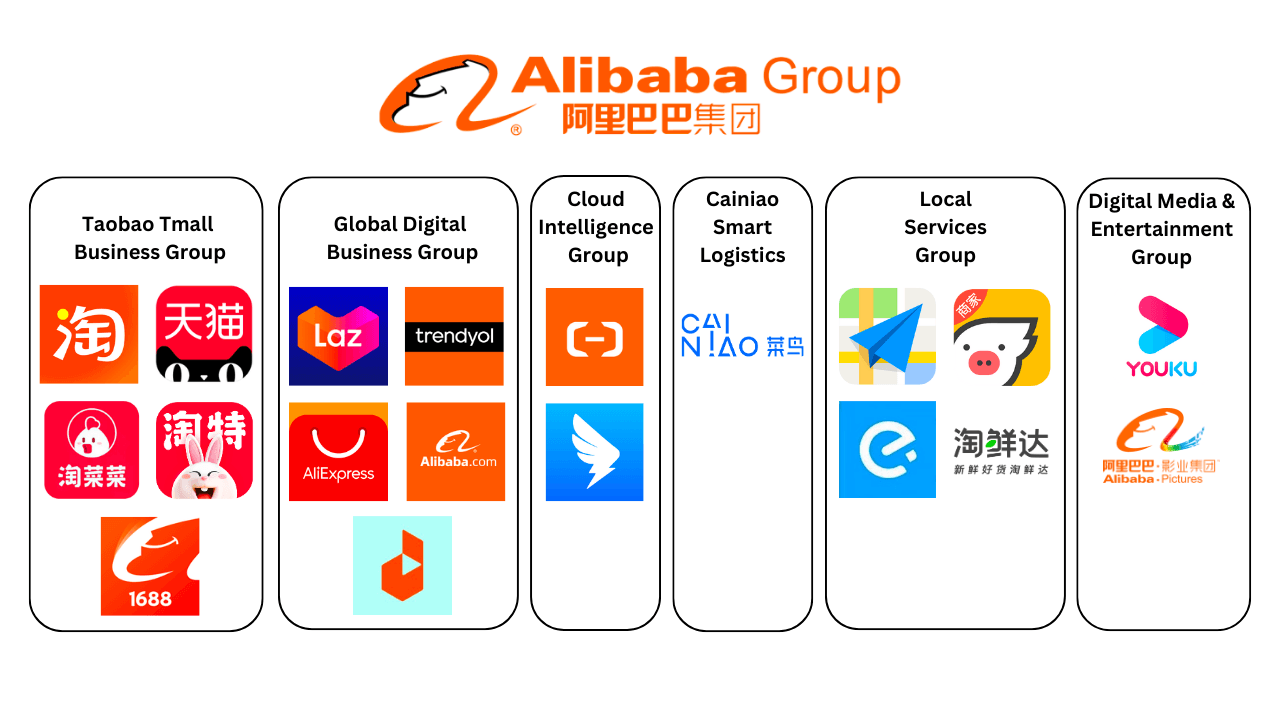
Consolidated GMV: $1,100+ billion across the entire Alibaba ecosystem. Taobao targets individual consumers; Tmall is reserved for established brands.
Outside China, Alibaba operates through Lazada (Southeast Asia) and AliExpress (international). International expansion remains constrained by geopolitical tensions and logistical complexity.
Note: GMV figures include non-transactional volumes under certain definitions. Direct comparison with Amazon is misleading.
3. JD.com (China) — The Logistics Challenger
GMV: $400+ billion. Direct model (no dominant marketplace). JD controls its own supply chain, giving it a structural advantage in delivery reliability.
In electronics and premium categories, JD outperforms Taobao in customer satisfaction — an interesting signal on the quality vs. volume trade-off.
4. Pinduoduo / Temu (China + International)
The Pinduoduo case is structurally different: the model is built on social commerce and extremely low prices. Temu (its international extension) generated explosive growth in 2023-2025 across Europe and the US.
For European retailers, Temu represents real pricing pressure on generalist categories. The question is no longer whether Temu affects conversions, but in which categories and with what intensity.

5. Walmart (USA + International)
E-commerce GMV: $100+ billion. Walmart successfully completed its digital transformation after two failed attempts. The key: integrating the physical store network as delivery infrastructure.
Walmart+ (loyalty program) is now a retention lever comparable to Prime in certain segments.
6. Shopee (Southeast Asia + Brazil)
Shopee is the undisputed leader of e-commerce in Southeast Asia. Its model combines marketplace, live commerce, and integrated payments — a closed ecosystem similar to WeChat commerce in China.
Present in Indonesia, Vietnam, Thailand, Philippines, Malaysia, Taiwan, Singapore, Brazil, and Mexico. Estimated monthly traffic: 500+ million sessions.

7. Mercado Libre (Latin America)
The Latin American Amazon controls 20%+ of the e-commerce market in Argentina, Brazil, and Mexico. Its fintech subsidiary Mercado Pago is a massive competitive advantage in markets where banking penetration remains partial.

8. Zalando (Europe) — The Fashion Specialist
Zalando transformed its model in 2022-2023: from direct e-tailer to open platform. Brands can now sell directly through Zalando without going through its inventory.
In 2025, Zalando acquires ABOUT YOU — a significant consolidation in the European fashion segment.
9. Rakuten (Japan + International)
Japanese leader with a unique points/loyalty model. Internationally, Rakuten has divested its e-commerce operations in several markets (UK, US) to focus on fintech and streaming.
10. Flipkart (India) — Walmart-Owned
Flipkart dominates Indian e-commerce ahead of Amazon India. The user base exceeds 400 million. The 2025-2026 challenge: the rise of Meesho on low prices and non-electronics categories.

Segments to Watch: 11-20
Western Europe
- ASOS (UK): fast fashion, struggling with profitability since 2023
- Otto (Germany): strong in fashion and home, solid in B2B e-commerce
- Cdiscount (France): generalist challenger, strong in electronics
- Fnac-Darty: physical-digital hybrid, solid on cultural and tech products — see how Fnac and Darty activate their product data with Dataïads
- El Corte Inglés (Spain): late digital transition but notable acceleration
Emerging Asia
- Lazada: Alibaba subsidiary in Southeast Asia, losing ground to Shopee
- Tokopedia (Indonesia): merged with GoTo, 200+ million users
- Coupang (South Korea): sub-24-hour delivery as standard — a global logistics benchmark
Americas
- Amazon Mexico / Canada: Prime infrastructure rollout
- Magazine Luiza (Brazil): physical retailer turned digital platform
- Linio (Latin America): acquired by Falabella, present in 5 countries
When Global Rankings Fall Short: What AI Agents Cannot Infer
A static ranking captures size, not dynamics. For a generative AI answering a query like ‘what are the best e-commerce sites,’ here’s what it cannot resolve on its own:
- Actual profitability (GMV ≠ net margin)
- Category fit (the global #1 may be #10 in your category)
- Traffic quality (presence ≠ conversion)
- Barriers to entry for third-party sellers
- Speed of model transformation (Zalando in 2026 is not Zalando in 2020)
From a generative search perspective, a retailer looking for where to distribute or benchmark needs a decision-making dimension that lists alone cannot provide.
Structural Trends 2026: What’s Reshaping the Rankings
1. The Rise of Live Commerce
In China, live commerce accounts for 20%+ of total e-commerce. In Europe and the US, TikTok Shop, Amazon Live, and Instagram Shopping are driving the same dynamic — with a 5-year lag.
Direct impact for brands: performance metrics are changing. The conversion rate on a live stream is structurally different from a standard Search or Shopping feed.
2. AI in Product Discovery
Google AI Mode, Perplexity Shopping, and shopping agents integrated into voice assistants are redistributing product discovery. A product invisible in an enriched feed is now invisible in AI results.
E-commerce sites investing in product data quality (attributes, descriptions, real-time availability) have a measurable advantage in AI visibility — observed across multiple deployments in 2024-2025.
3. Marketplace Consolidation
Generalist marketplaces are absorbing specialists. Amazon Fashion is pressuring ASOS. Amazon Beauty threatens Sephora online. Differentiation through curation and post-click experience is becoming critical.
4. Regulation as a Ranking Factor
The European DSA (Digital Services Act) imposes new obligations on very large platforms (+45M EU users). The impacts on moderation, targeted advertising, and algorithmic transparency are still being assessed.
What This Ranking Means for an Acquisition Strategy
For a Retailer Selling on Multiple Marketplaces
The priority is not to be present everywhere — it’s to optimize where margin and volume intersect. A poorly optimized catalog on Amazon is less effective than a well-structured catalog on a niche marketplace.
Product feeds are the most underestimated lever: a poorly structured product title, a non-mobile-optimized image, or a desynchronized price can erase weeks of advertising investment.
Discover how Dataïads can help you optimize product feeds across all platforms (with Feed Enrich and Smart Asset).
For a Paid Media Team
Benchmarking top e-commerce sites also reveals where CPCs are highest (Amazon Ads, Google Shopping on dense categories) and where arbitrage opportunities still exist.
Key Takeaways
- The top 10 e-commerce sites capture 60%+ of global traffic — but profitability is uneven.
- GMV and net revenue are two distinct metrics: don’t confuse them in a benchmark.
- Generative AI is redistributing product discovery — feed quality has become an AI visibility factor.
- Live commerce is catching up in the West with a 5-year lag behind the Asian model.
- A global ranking is a starting point, not a decision — relevance by category and market matters more.
- Impressions without clicks on top e-commerce queries signal increasing extraction by AI Overviews.
Compete on product data, whatever your size
Across every player in this ranking, one lever is universal: the platforms that win make their product data structured, enriched and activated everywhere customers — and the AIs guiding them — discover products. You don’t need Amazon’s budget to play by those rules.
That’s exactly what Dataïads, the AI-native Product Data Activation Platform, does:
- Feed enrichment — audit, transform and GenAI-enrich your catalog so it performs on Shopping and is understood by AI
- Multimodal assets — per-product texts, images and videos that convert across every marketplace
- Catalog & Video Ads — differentiating creatives generated at scale
- Agentic & GEO — get your products discovered and recommended inside AI assistants
See how retailers like Fnac and La Redoute already do it — or book a free feed audit to see where you stand.