Agentic commerce · GEO · AEO

When AI recommends a product,
is it yours?

The journey shifts from "I search → I click" to "I ask → AI answers → AI recommends." Product data decides whether your brand exists, or not, in the AI's answer.

2audit axes
demand × supply
6activation
levers
1core asset
product data
Scroll
The core asset

Product data, at the center of everything.

A brand can have an excellent feed but a page that's unreadable to agents; a technically perfect page but poor data; or both correct, yet contradictory signals between feed, HTML and JSON-LD. Each of these breaks the citation.

  • You don't steer AI visibility by optimizing pages…
  • …you steer it by industrializing product data, from the source to its machine-readable output.
  • It's the thread that connects the 2 audit axes and the 6 activation levers.
The core asset

Product
data

Axis 1 · outside-inDemandthe intents to win
Axis 2 · inside-outSupplywhat agents actually see
Feed Enrich Technical Structured data Smart Landing Page Smart Creative Smart Asset
From audit to activation

6 levers, one product data.

Prioritization = visibility gap (Axis 1) × technical weight (Axis 2). You move from "here's your problem" to "here's the machine that solves it".

The audit in 2 axes Alpha tool

Measure where you're missing, and why.

Our audit & monitoring tool (in alpha access) crosses two complementary views of your visibility inside the LLMs.

Axis 1 · outside-in

Visibility inside the LLMs

We query ChatGPT, Gemini… with real user prompts, grouped by intent, with several samples per prompt to measure stability.

  • ScoreAEO visibility score — the synthesis (e.g. 17/100).
  • SOVShare of voice — who AI names, and in what proportion.
  • GapsOrganic gaps & untapped — your content roadmap and the open ground to claim first.
  • FidelityCitation timing & source footprint — when, and with which sources, you're cited.
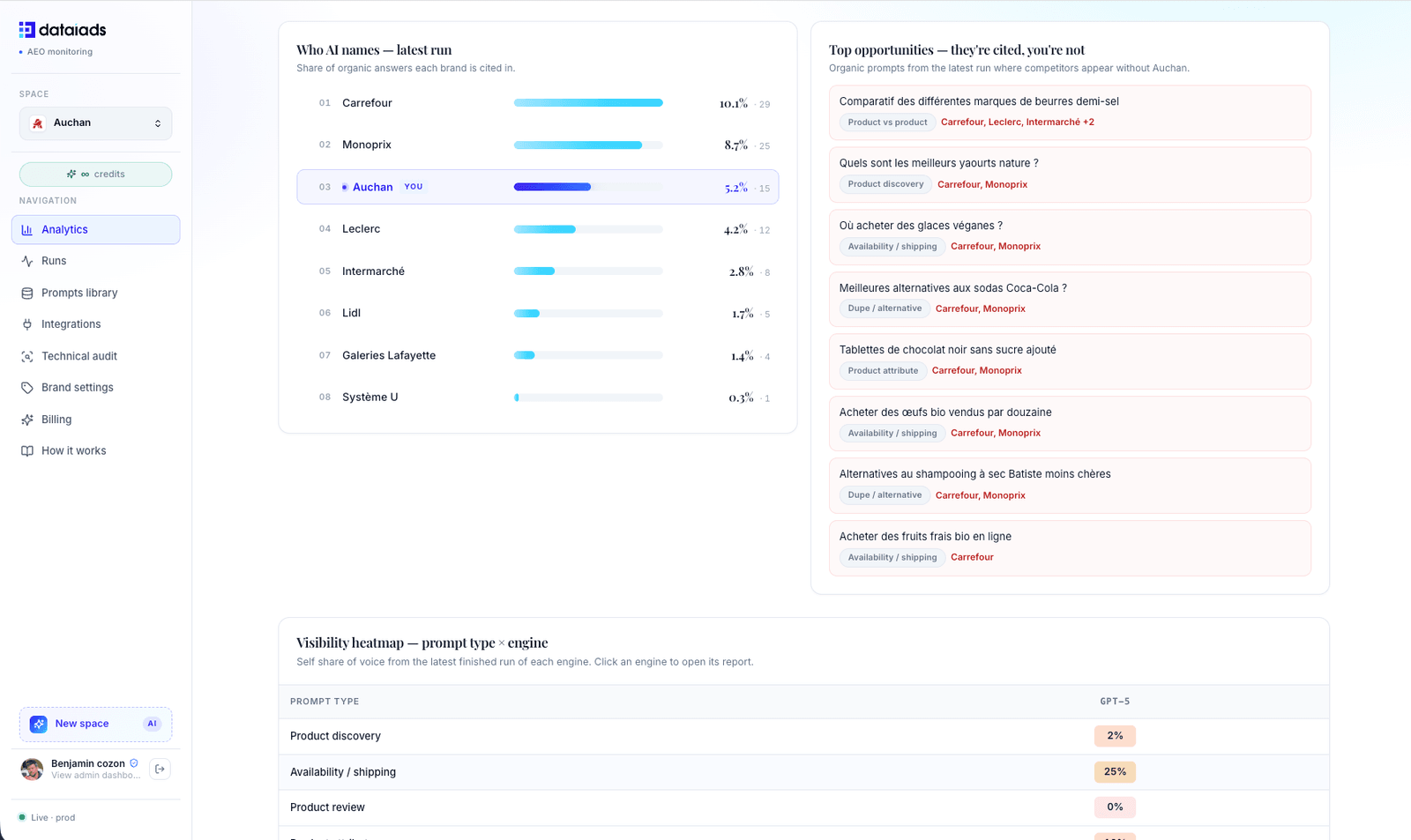
analytics · who AI names
Share of voice: brands cited by AI and top opportunities

Who AI names. Share of voice per brand and prompts where competitors are cited, not you.
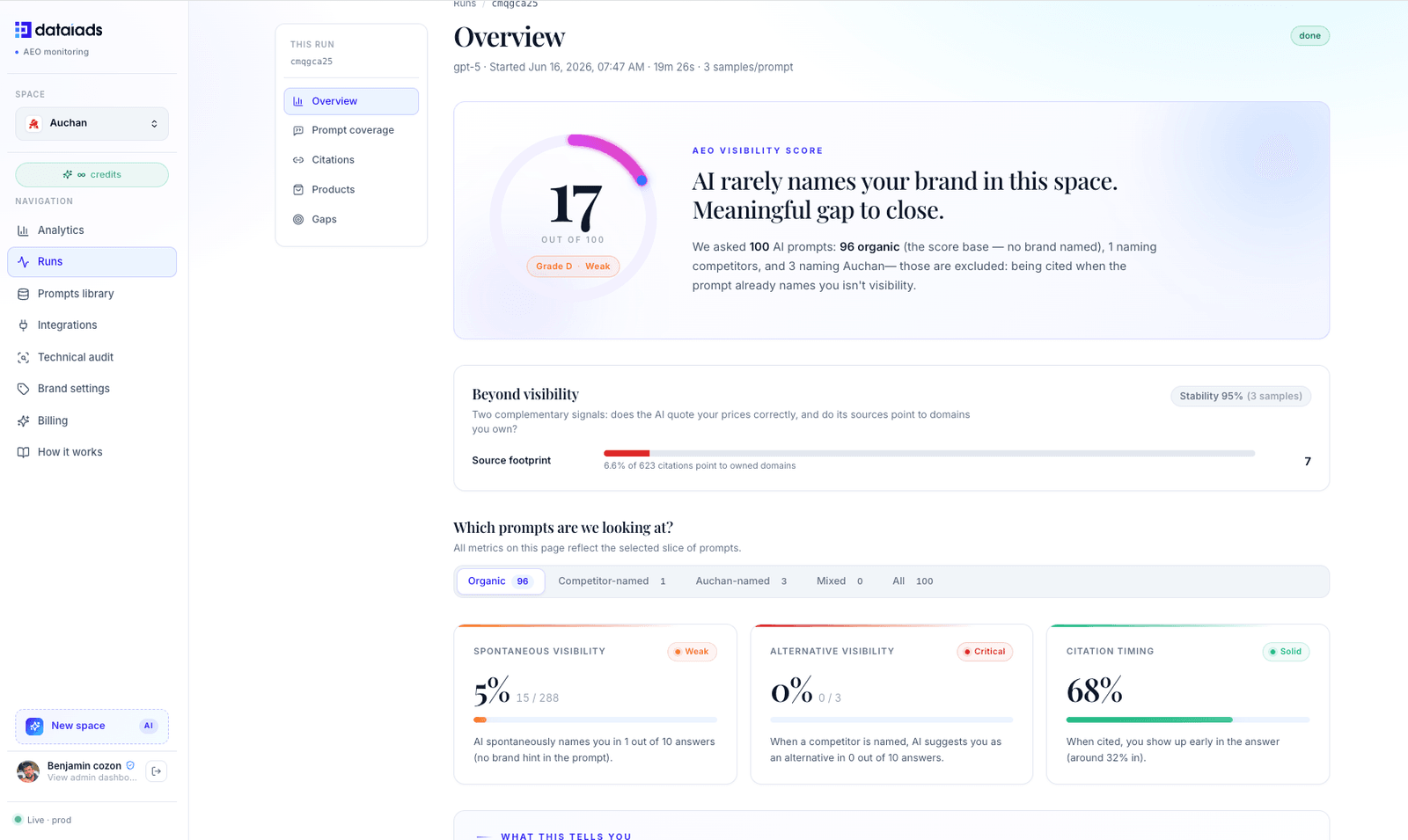
run · overview
AEO visibility score 17/100, spontaneous visibility, citation timing

AEO score. Spontaneous visibility, alternative visibility, citation timing and stability across 3 samples.
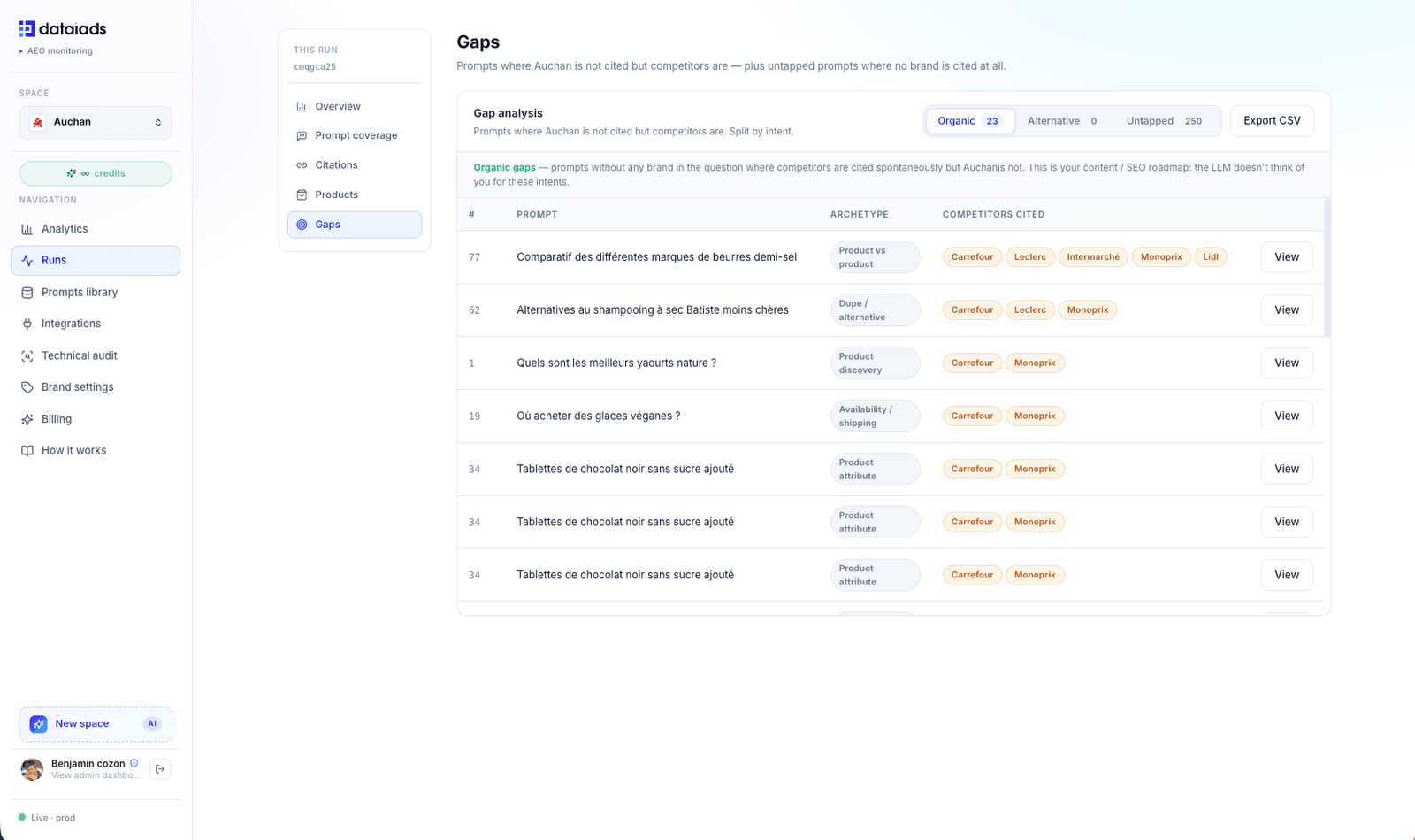
gaps
Gaps: prompts where competitors are cited but not you, and untapped prompts

Gaps. 23 organic gaps + 250 untapped prompts — your roadmap, by intent.

Axis 2 · inside-out

Technical & semantic audit

We audit the product page the way an agent sees it: access (HTTP, robots, WAF), readability (raw HTML vs rendered JS), structured data (Schema.org) and semantic depth.

  • ReachReach & read — accessible and readable without JS? llms.txt, markdown, chunkability, Content-Signal.
  • DataProduct data — name, price, availability, description & Product JSON-LD server-side, without JS.
  • SemanticSemantic — benefits, use cases, audience, differentiators, FAQ, specs, reviews.
  • AgentsReal reading — what Gemini and OpenAI actually extract (and their conflicts).
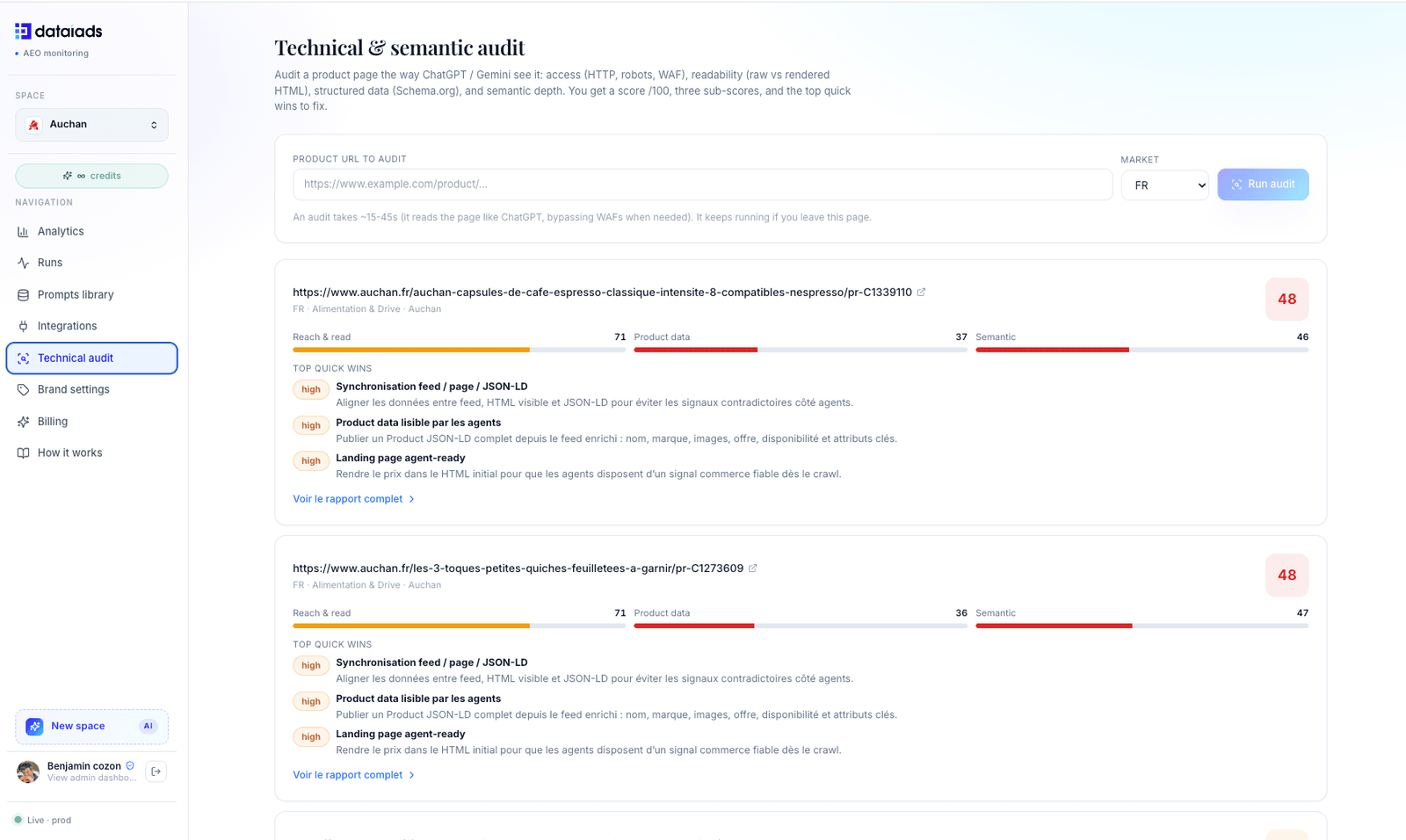
technical & semantic audit
Technical & semantic audit: score out of 100, sub-scores and quick wins

Score /100. Sub-scores Reach & read / Product data / Semantic + prioritized quick wins.
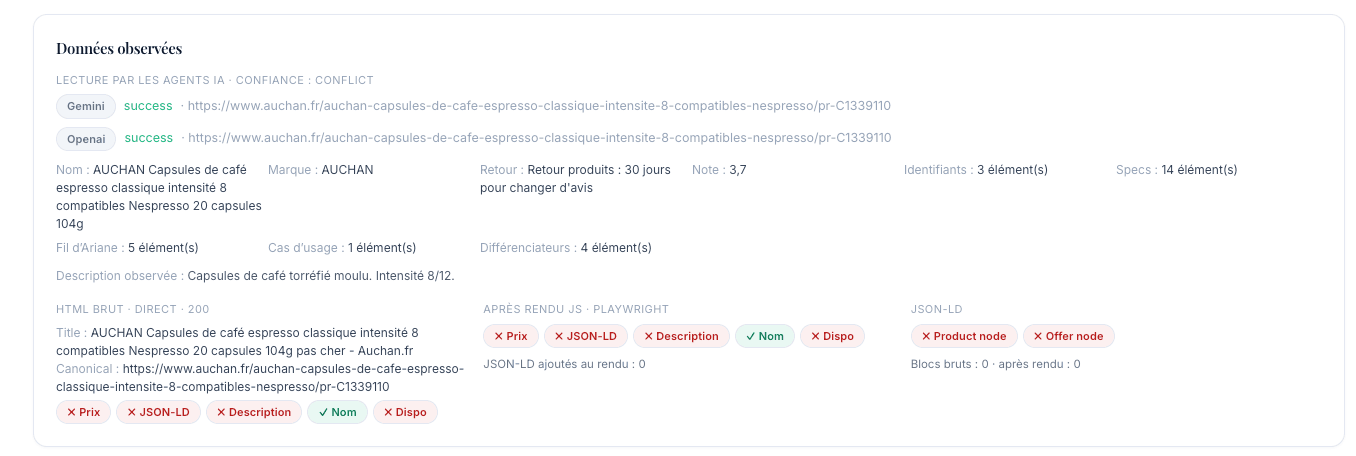
observed data · gemini / openai
Data observed by Gemini and OpenAI agents, raw HTML vs rendered JS

As agents see it. Price, JSON-LD and description often missing from raw HTML → citation unlikely.
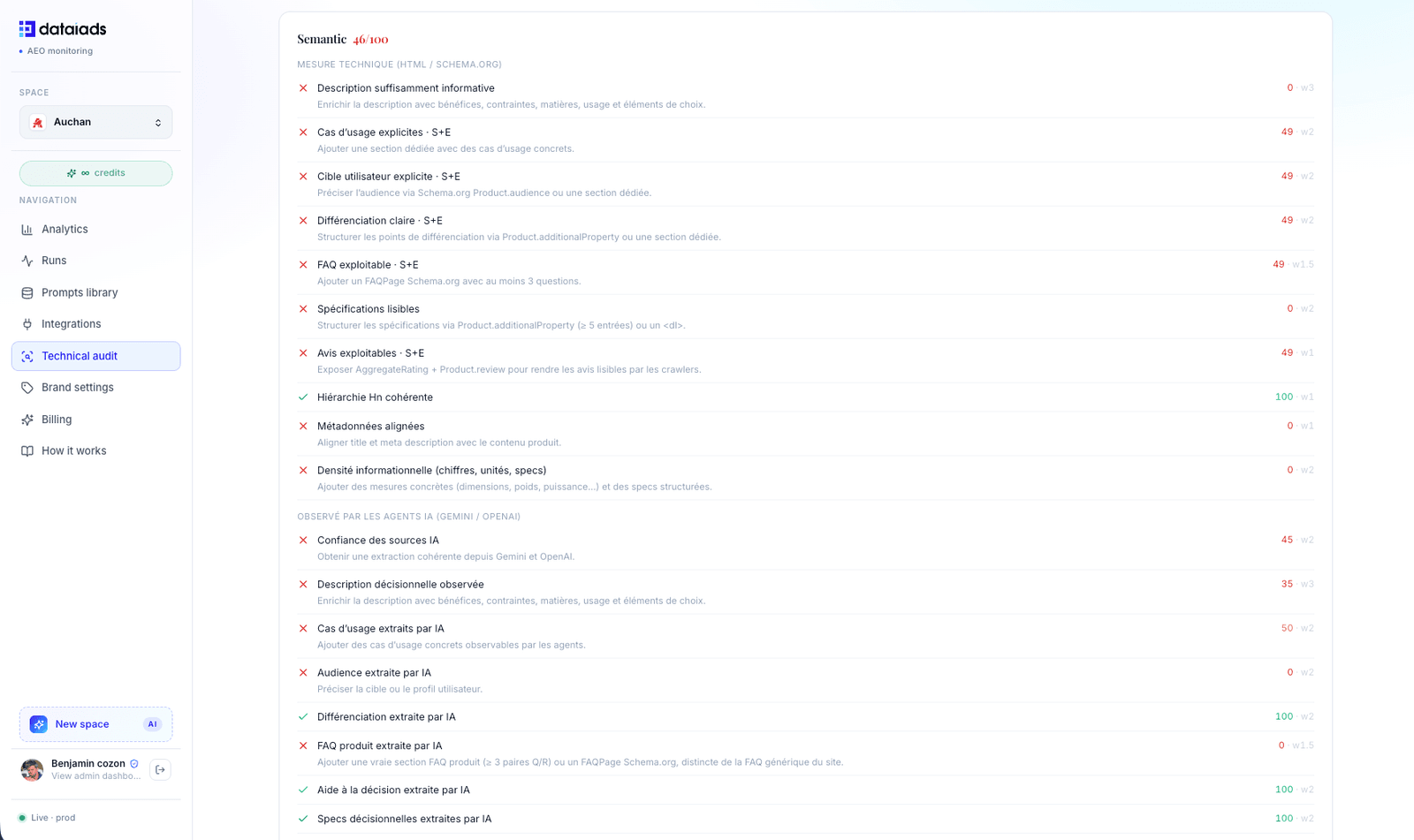
semantic checklist
Semantic score detail: description, use cases, FAQ, specs, reviews

Semantic depth. Decision-grade description, use cases, FAQPage, AggregateRating — extractable.

Two symptoms, one problem: product data. Demand tells you where you're missing, supply tells you why. You act on the shared variable to close the gap on both sides.
The SEO → GEO shift

Three rules have changed.

When a user asks, AI doesn't return ten links: it names a few brands, a few products, a few sources.

the clickthe citation

Being named = existing

Being cited in the answer means existing. Not being cited means not existing — whatever your classic SEO ranking.

the humanthe agent

AI reads like an agent

It consumes raw HTML, JSON-LD and structured data — not the visual rendering nor what shows up after JavaScript executes.

the pageproduct data

Data is the raw material

Price, availability, attributes, differentiators, use cases: that's what gets extracted, compared and surfaced in the answer.

The loop

GEO is not a one-shot.

It's a loop driven by product data, where each cycle closes gaps and reveals new ones.

1

Audit

The 2 axes: LLM visibility (demand) and technical & semantic audit (supply).

2

Prioritize

Visibility gap × technical weight. You tackle what pays off most, first.

3

Activate

Feed → structured data → page → assets. The 6 levers, in order.

4

Re-measure

You re-run the visibility audit. Gaps closed, new ones revealed.

The tool Alpha access

AI visibility audit & monitoring.

An alpha product that combines LLM visibility monitoring and the technical & semantic audit of your product pages — in one place, in the same workspace.

Monitoring

Prompt coverage & runs

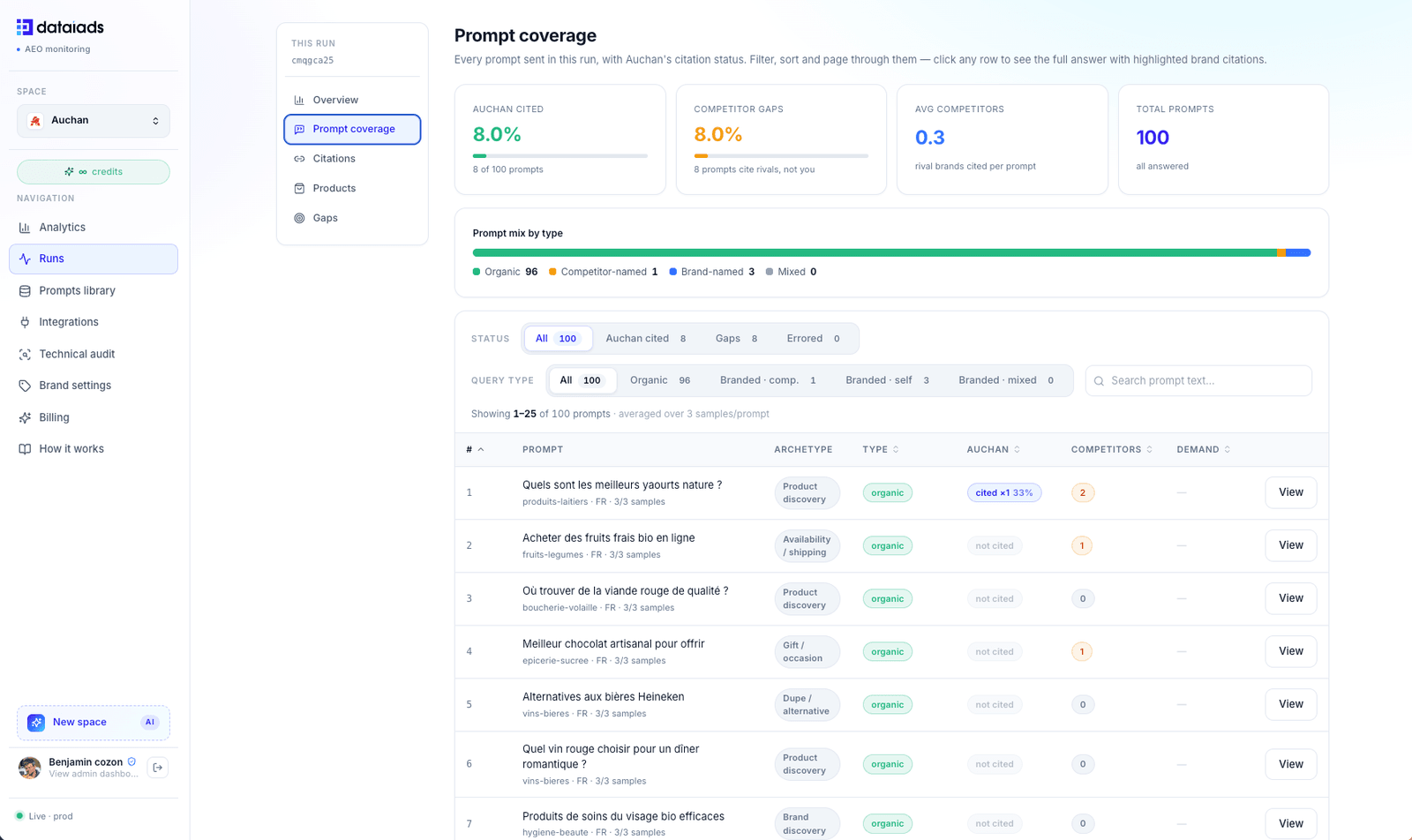
Every prompt sent, its citation status, archetype and intent — paginated, filterable, re-runnable, with the detail answer by answer.

prompt coverage
Prompt coverage: all prompts, citation status, type and intent
Page audit

Run audit in ~15-45 s

Paste a product URL, choose the market, run the audit. The tool reads the page like ChatGPT (bypassing WAFs when needed) and returns a detailed score.

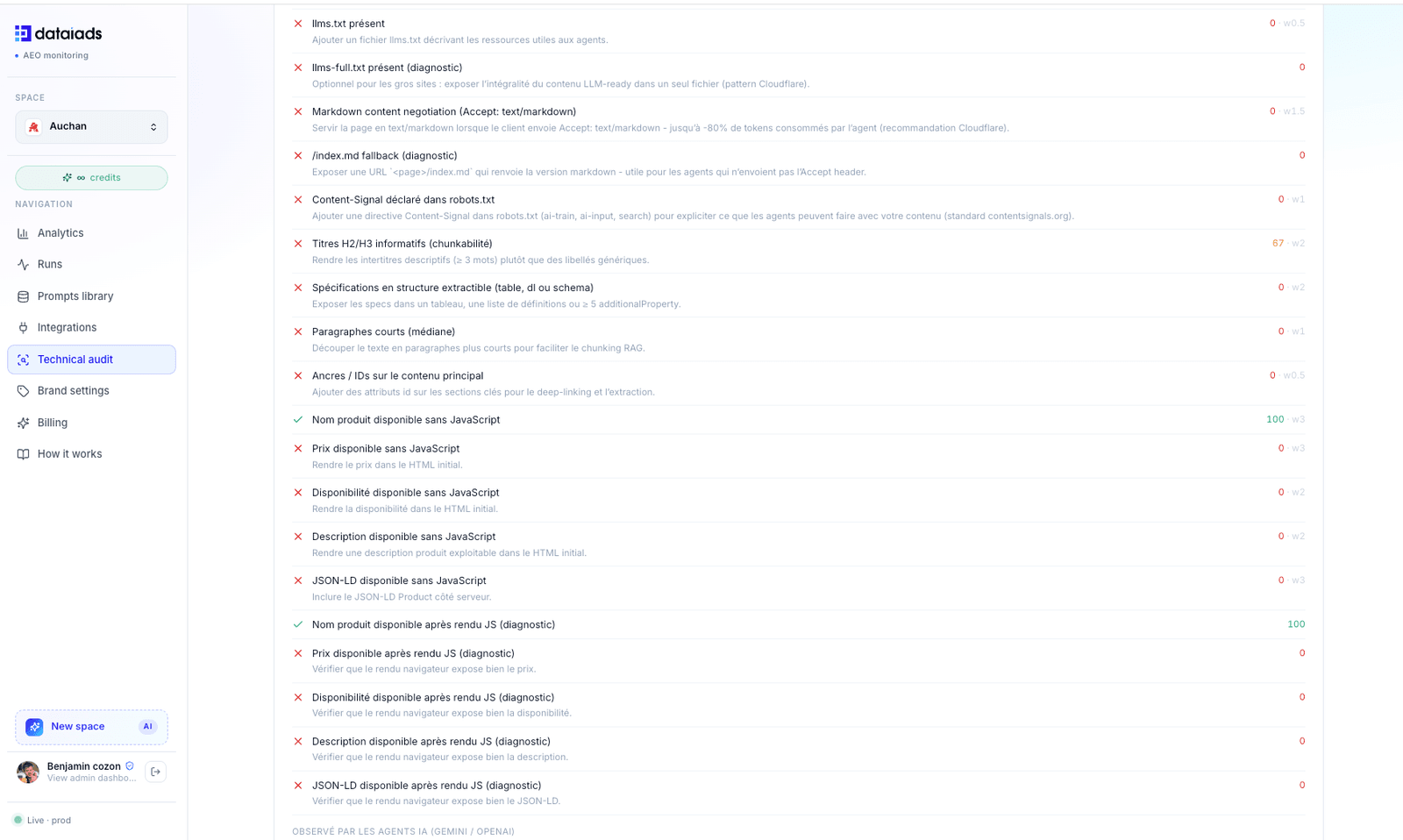
technical audit · run
Technical checklist: llms.txt, markdown, JSON-LD, price without JS, chunkability
Take action

Get cited and recommended by AI.

Run your AI visibility audit, identify your gaps by intent, and activate the product data that makes you extractable — from feed to page.

Alpha tool · No IT work · Your data stays yours