TL;DR
Relevant when: you manage the visibility of an e-commerce brand in Google Search, Google Shopping or AI answers across European markets. The fact: on December 9, 2025, the European Commission opened a formal antitrust investigation into Google's use of web publishers' content and YouTube videos for AI Overviews, AI Mode and model training. Concerns under review: lack of appropriate compensation, no way to refuse without losing access to Google Search, privileged access to content that rival AI developers do not enjoy. What may change: finer opt-out mechanisms, licensing deals with the press, adjustments to how AI features roll out in Europe, shifts in the source mix cited in AI answers. Key e-commerce point: product data flows through a consented, structured channel (Google Merchant Center) that is not targeted by the probe. If access to editorial content tightens, the relative weight of product data in AI answers grows.
On July 16, 2026, the European Commission adopted two binding decisions under the Digital Markets Act: Google will have to open key Android functionalities to AI assistants competing with Gemini, and share its anonymized Search data with rivals. These measures come on top of the antitrust investigation opened in December 2025 into how AI Overviews and AI Mode use publishers’ content. Taken separately, each of these cases would already make headlines. Taken together, they tell a different story: Europe is methodically redrawing the playing field of search and AI assistants. And that field directly concerns e-commerce brands.
Three fronts, one offensive
European pressure on Google is advancing on three distinct cases, with different legal instruments but one shared logic: preventing the dominance acquired in search from mechanically reproducing itself in the era of AI answers.
Front 1: Android must open to rival AI assistants
Today, Gemini enjoys a special status on Android: voice activation, access to on-screen context, the ability to act inside applications. Competing assistants only get restricted access to those functionalities. The first July 16 decision, taken under Article 6(7) of the DMA, requires Google to grant third-party AI assistants equivalent access. Concretely, a user will be able to set a preferred assistant, wake it by voice the way they do with “Hey Google”, and let it perform actions in their apps: booking a taxi, ordering food, sending a message. These changes must reach users by July 2027 at the latest, across a base of 6 out of 10 European smartphones.
Front 2: Search data shared with rivals
Google Search holds roughly 90% of the European search market, and the usage data it collects at that scale (queries, rankings, clicks, views) exists nowhere else. The second decision, taken under Article 6(11), requires Google to share that data, once anonymized, with rival search engines and, notably, with AI chatbots that offer search functionalities. The Commission defined multi-layered anonymization, a fair pricing formula and a transparent access process. Sharing starts in January 2027.
Front 3: the antitrust probe into AI Overviews and AI Mode
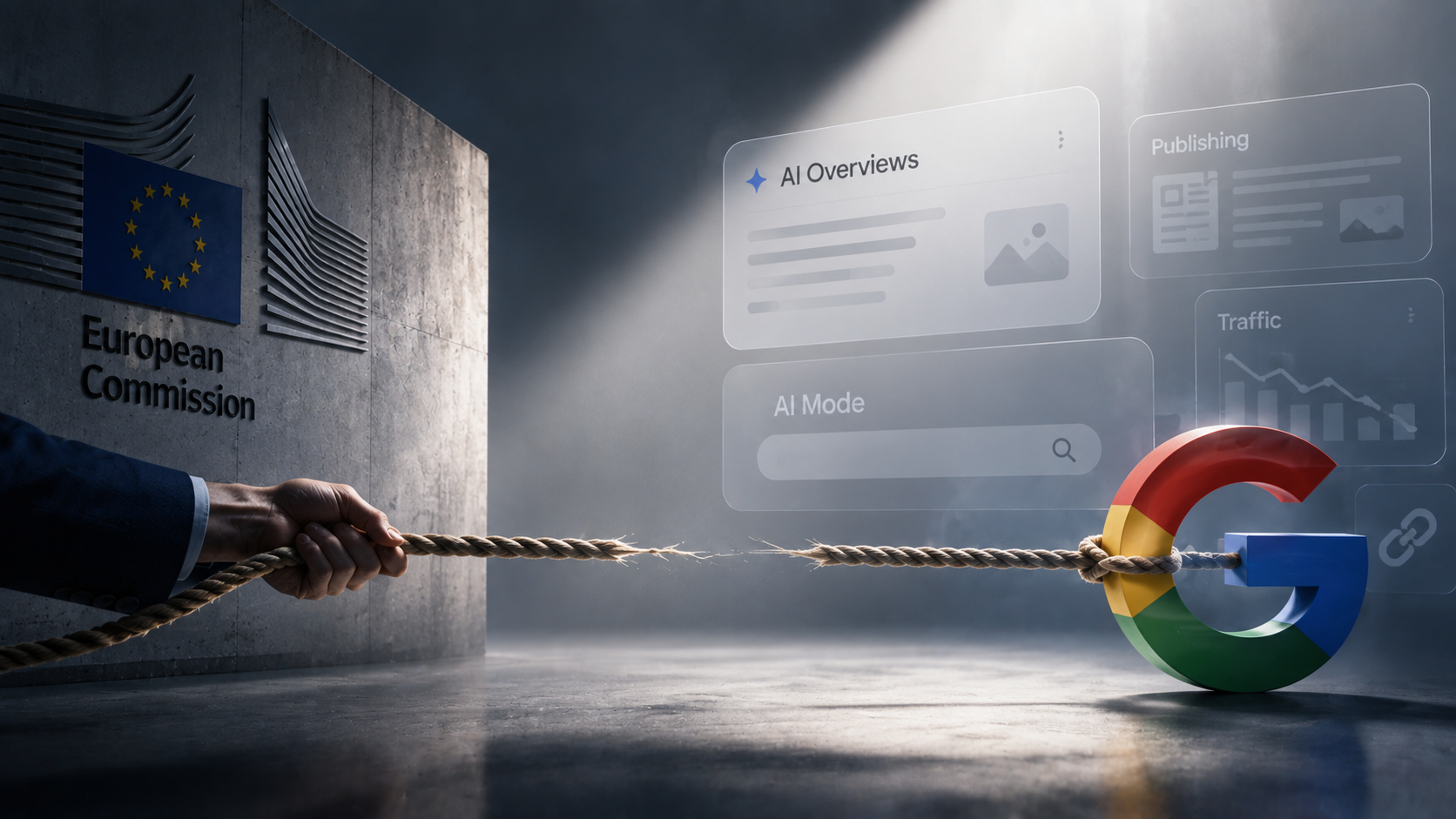
This third case is the oldest and the most contentious. Since December 9, 2025, the Commission has been investigating a possible abuse of dominance: Google would be using web publishers’ content to generate AI Overviews and AI Mode without appropriate compensation, and without publishers being able to refuse that use other than by giving up their visibility in Search. The use of YouTube videos to train its models is also within scope. The European Publishers Council reinforced the case in February 2026 with its own formal complaint: content used without authorization, without an effective opt-out, without remuneration, while traffic and revenues are captured along the way. On each of these fronts, the fine at stake can reach 10% of Alphabet’s annual worldwide turnover.
What Google is arguing back
Google contests everything, on two registers. On the AI Overviews probe, the company argues the complaints risk stifling innovation in a market it describes as more competitive than ever. On the DMA decisions, Kent Walker, its president of global affairs, says they weaken privacy and security guardrails: on Android, the mandated openness would grant third-party apps sensitive permissions without today’s safeguards; on Search, its researchers claim they re-identified individuals in simulations of anonymized sharing. The Commission maintains its decisions embed robust protections, including grouping users into cohorts of at least 1,000 people and suppressing sensitive records. The legal debate will continue. The deadlines, meanwhile, are set.
The strategic read: a less concentrated AI answer landscape
Put end to end, the three cases sketch a coherent policy: Europe is limiting what Google can take (publishers’ content, without agreement) and mandating what it must open (its Android functionalities and its Search data). The likely outcome, whatever the pace of appeals, is a landscape where purchase intent spreads across more players.
On distribution, the assistant that hears “find me a waterproof jacket for this weekend” on a European phone could, from July 2027, be ChatGPT, Perplexity, Mistral’s Le Chat or a newcomer, with the ability to act inside apps. This opening mirrors what we were already observing on the ad platform side in our analysis of Meta’s AI Connectors and the opening of ad APIs to external AI systems. On relevance, rival engines and chatbots, fed by Google’s query and click data, will sharpen their answers, commercial ones included. And on sources, the outcome of the AI Overviews probe could restrict Google’s access to editorial content, through effective opt-outs or licenses, which would mechanically increase the relative weight of the sources that remain fully accessible in AI answers.
This shift lands exactly as Google’s AI features settle into France, with an AI Mode rollout confirmed by September 23, 2026, which we unpacked in our article on AI Overviews arriving in France and the opportunities for retailers. The regulatory calendar and the product calendar overlap: that is rare, and it is a window.
Why e-commerce sits on the right side of the table
A quick read of this saga could worry anyone: if the content feeding AI answers is the subject of litigation, is any presence in those answers fragile? The reality is more favorable to merchants. The dispute concerns editorial content collected through crawling, with no explicit contract covering its generative use. Product data travels through an entirely different channel: the Google Merchant Center feed, submitted voluntarily, structured attribute by attribute, and governed by accepted terms. Publishers are fighting to stop being ingested without consent. Merchants send their data precisely in order to be picked up.
That consented channel has become the infrastructure of shopping answers, well beyond Google. ChatGPT relies on Merchant Center feeds for its product recommendations, a mechanism we detail in our article on how the product feed drives AI visibility in ChatGPT. And assistants able to act inside apps will need transactional standards, the ones we described in our analysis of Universal Cart, UCP and AP2 for agentic commerce. In other words, every contender in the answer market shares the same dependency: reliable, structured, up-to-date product data. The robust strategy is not to bet on the winner of the assistant wars, but to make your catalog readable by each of them.
How to prepare between now and 2027
- Treat your product feed as a universal interface. Complete attributes, reliable GTINs, rich descriptions, synchronized prices and stock: this is what every assistant will read, whatever its ecosystem. A feed management layer like Feed Enrich industrializes that level of quality across the whole catalog.
- Extend your GEO beyond Google. The criteria that make content citable by generative engines apply to every assistant the DMA will make more visible. Our complete guide to GEO (Generative Engine Optimization) covers the fundamentals.
- Set your AI visibility baseline now. Measuring your presence in the answers of the different assistants before the 2027 deadlines is what will make the next phase steerable. The Agentic Commerce Index 2026 shows the gap: 8 out of 10 French e-commerce sites are still invisible to AI agents.
- Follow the regulatory saga without turning it into a reason to wait. Google’s appeals, the remedies of the AI Overviews probe, the fine print of data sharing: the parameters will move. The operational conclusion will not: the more a brand controls its own signals, the less it depends on the arbitration between Google and its regulators.
Key takeaways
- On July 16, 2026, Europe required Google to open Android to rival AI assistants (by July 2027) and to share its anonymized Search data with competitors (from January 2027).
- In parallel, the antitrust investigation opened in December 2025 into the use of publishers’ content by AI Overviews and AI Mode continues, reinforced by the European Publishers Council’s complaint.
- Europe is limiting what Google can take and mandating what it must open: the AI answer landscape becomes less concentrated.
- Product data flows through a consented channel (Google Merchant Center) that none of these cases targets: it remains the common denominator across assistants.
- The preparation window is open: a flawless feed, extended GEO and an AI visibility baseline before the 2027 deadlines.
Want to know whether your catalog is ready for a world where several AI assistants answer your customers? Talk to our team: we audit your feed and your generative visibility across your markets.
This article is provided for general information and does not constitute legal advice.
FAQ: Europe’s offensive against Google and e-commerce
What has the European Commission just decided about Google?
On July 16, 2026, the Commission adopted two binding specification decisions under the Digital Markets Act. The first requires Google to give third-party AI assistants the same access to Android functionalities as Gemini, with changes effective for users by July 2027. The second forces it to share anonymized Search data (queries, ranking, clicks, views) with rival search engines and AI chatbots from January 2027.
How does this relate to the AI Overviews probe?
They are legally distinct but complementary cases. The antitrust investigation opened on December 9, 2025 concerns the use of web publishers’ content and YouTube videos by AI Overviews, AI Mode and Google’s model training, without appropriate compensation. The July 16, 2026 DMA decisions, for their part, mandate the opening of Android and the sharing of Search data. Together, these cases limit what Google can take and mandate what it must open.
What is the impact for e-commerce brands?
These measures multiply the AI assistants able to answer shopping queries and act inside apps, sharpen rival engines thanks to shared data, and could rebalance the source mix of AI answers. Brand visibility becomes multi-assistant. The lever common to all these systems is the quality of structured product data and citable content.
Is merchant product data affected by these cases?
No. The cases concern editorial content collected through crawling and Google’s opening obligations. Product data flows through Google Merchant Center, a voluntary, contractual channel that none of these proceedings targets and that AI assistants, including ChatGPT, already use for their recommendations.
What does Google risk?
On each of these cases, an established infringement exposes Alphabet to a fine of up to 10% of its annual worldwide turnover. The Commission can also impose remedies, such as effective opt-out mechanisms for publishers or adjustments to the opening requirements.