
TL;DR
Article 50 of the EU AI Act (Regulation 2024/1689) requires, from 2 August 2026, that AI-generated images and videos be automatically detectable (invisible watermark + C2PA metadata). The May 2026 Omnibus agreement grants a grace period until 2 December 2026, only for machine-readable marking and only for generative AI systems already on the market. Nothing is banned for product marketing: the obligation is about traceability, and it falls primarily on tool providers. For a brand, the real task is verifying that its vendors use models that natively watermark their outputs, with marking that survives the exports, crops and compressions of the advertising delivery chain.
In 2026, a growing share of e-commerce product visuals no longer comes out of a photo studio but out of a generative AI model: lifestyle scenes, market-specific variations, product videos generated from the feed. This shift is accelerating at the very moment Europe starts enforcing the transparency obligations of the AI Act.
Let’s be clear from the start: the AI Act bans nothing for product marketing. It requires traceability. Brands working with serious tools are already largely covered, provided they know which questions to ask their vendors. Here is what changes in practice, without legal jargon.
The AI Act in 30 seconds for a marketer
European Regulation 2024/1689, known as the “AI Act”, is the European Union’s general framework on artificial intelligence. For e-commerce and marketing, the essentials fit in a single article: Article 50, dedicated to transparency obligations for AI-generated content.
Two dates to remember:
- 2 August 2026: the Article 50 obligations apply.
- 2 December 2026: a grace period granted by the May 2026 “Omnibus” agreement, but only for the machine-readable marking obligation (Article 50(2)), and only for generative AI systems already on the market before 2 August 2026. Any system launched after that date must comply from the moment it is placed on the market.
Who is concerned? The regulation distinguishes two roles:
- The provider: whoever develops an AI system, or integrates it into a product sold under its own brand. The publisher of a SaaS visual-generation platform is a provider.
- The deployer: whoever uses the system. A brand or retailer generating its visuals through a third-party platform is generally a deployer.
Good news for marketing teams: most of the compliance burden, the technical marking of content, falls on providers, i.e. on your tools and vendors. Your responsibility as a deployer mainly consists of choosing compliant tools and being able to demonstrate it.
What Article 50 actually says: invisible marking vs visible disclosure
Article 50 contains two distinct obligations that must not be confused, because they do not target the same cases.
Obligation 1, machine-readable marking (Article 50(2))
AI-generated or AI-manipulated image, video and audio content must be automatically detectable. No visible label is required: this is marking readable by machines, not by the human eye. In practice, the market is converging on two complementary layers:
- An invisible pixel-level watermark, for example SynthID from Google DeepMind, designed to withstand cropping, compression and format conversions.
- Cryptographically signed metadata, the C2PA standard (Content Credentials), backed by Adobe, Google, OpenAI and Microsoft.
The Code of Practice published by the European Commission in June 2026 recommends precisely this layered approach, and adhering to it creates a presumption of compliance. This is the regime covering virtually all AI-generated e-commerce product visuals.
Obligation 2, visible disclosure (Article 50(4)): deepfakes only
A visible label such as “AI-generated content” is only required for deepfakes: content depicting identifiable real people in a misleading way. A product visual featuring a generic model or a generated background is not concerned.
In other words, for roughly 95% of e-commerce use cases, recomposed packshots, lifestyle scenes, seasonal variations, only the first obligation applies, and it is invisible to your customers.
Summary table of the two obligations
| Machine-readable marking, Art. 50(2) | Visible disclosure, Art. 50(4) | |
|---|---|---|
| Who bears the obligation | The provider (publisher of the generation tool) | The deployer (whoever publishes the content) |
| What must be done | Invisible pixel watermark + signed metadata (C2PA) | Visible label indicating the content is AI-generated or manipulated |
| From when | 2 August 2026; grace period until 2 December 2026 for systems already on the market before 2 August 2026 | 2 August 2026 |
| Typical e-commerce case | AI-generated product visual or video: staging, generated background, generic synthetic model | Misleading depiction of an identifiable real person, extremely rare in product marketing |
What is out of scope: standard retouching is not concerned
An important point to reassure studio teams: retouching that does not change the meaning of the image remains outside the scope of Article 50. In practice:
- clipping and background removal,
- upscaling and resolution enhancement,
- clean-up (dust, reflections),
- colour correction.
These operations, even performed with AI tools, do not trigger any marking obligation. The dividing line is the meaning of the image: recomposing a scene, generating a background or a subject is in scope; technically improving an existing photo is not.
The real technical issue: pixel watermarks vs C2PA metadata
This is where brands need to pay attention, because the two marking layers do not have the same robustness at all.
C2PA metadata is fragile. It travels with the file, and most resizing, format conversions and recompressions destroy it. Yet that is exactly what CMSs, CDNs and advertising platforms do, all the time: an image uploaded to a campaign manager is systematically reprocessed before delivery. A visual perfectly marked at the tool’s output can therefore arrive “naked” at the other end of the chain.
Pixel watermarks such as SynthID, on the other hand, are embedded in the image itself and designed to survive cropping, compression and conversions. This is the layer that actually holds up in an advertising delivery chain.
The practical consequence is simple: metadata alone is not enough. Favour tools whose models embed a native pixel-level watermark, with C2PA metadata as a complement. And anyone can verify it: Google’s Gemini app lets you upload an image or video and ask whether it contains a SynthID watermark.
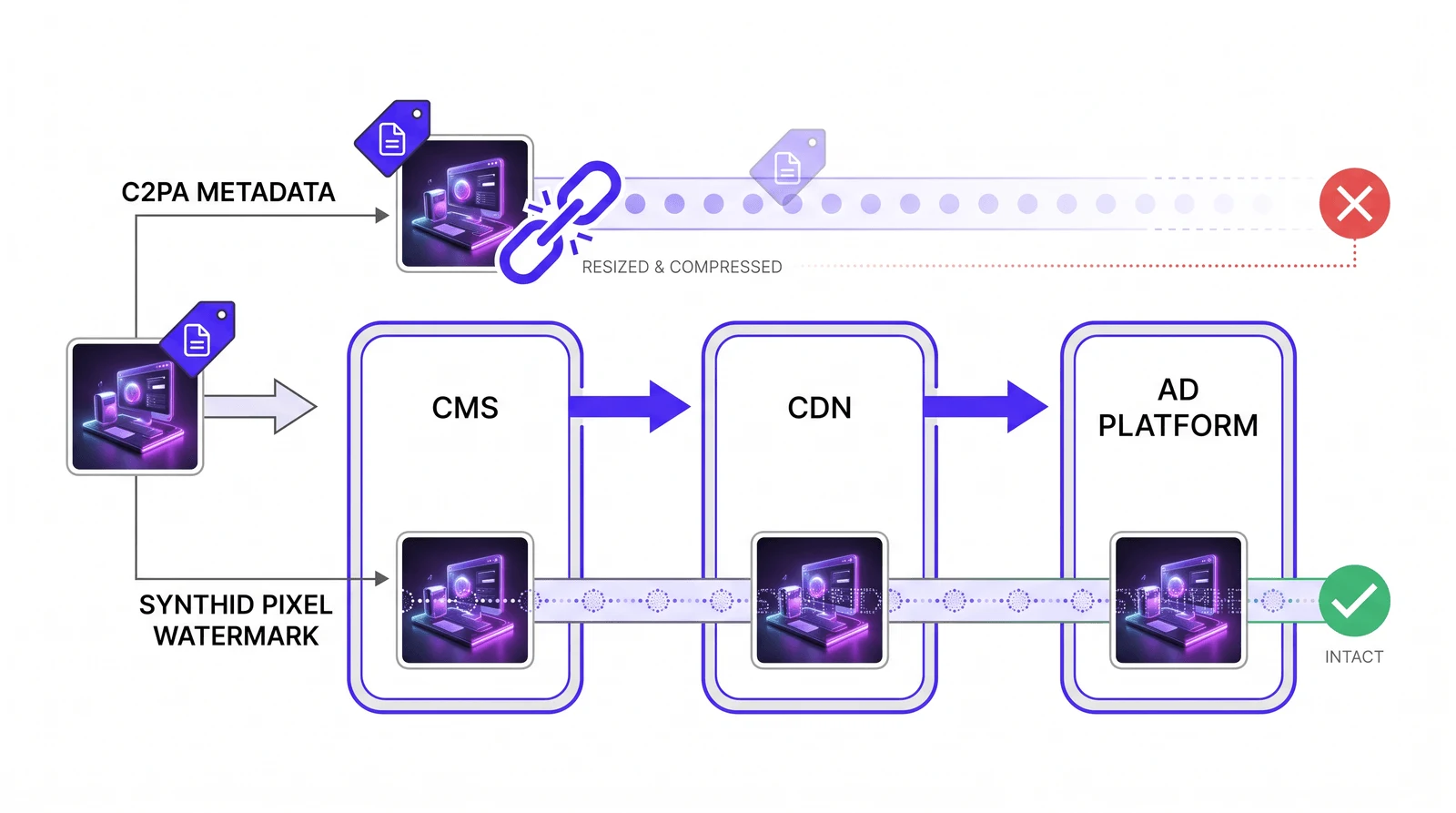
A visual travels through CMS, CDN and ad platform: C2PA metadata is destroyed by resizing and recompression, while the SynthID pixel watermark survives all the way to delivery.
This topic connects with the requirements platforms already impose on their side: our Google Merchant Center guide on images, videos and AI compliance details what Google expects from generated visuals in Shopping feeds.
Checklist: the 5 questions to ask your tools and vendors
For a brand or retailer, compliance is decided when choosing tools. Here are the questions that separate the field:
- Do your generation models natively watermark their outputs? A watermark applied afterwards by a third-party tool is more fragile than marking built into the model itself.
- Is the marking embedded in the pixels, or only in the metadata? If the answer is “C2PA only”, the marking will probably not survive your delivery chain.
- Does the watermark survive exports, crops and compressions? Ask for concrete tests on your real formats: ratio variations, ad-platform compression, CDN reprocessing.
- Can you demonstrate it? A serious vendor must be able to prove the detectability of its content at the end of the chain, not just at the tool’s output.
- Do you follow the Commission’s Code of Practice and the C2PA standards? Adherence to the Code of Practice creates a presumption of compliance, a strong signal of maturity.
If your vendors answer these five questions precisely, your exposure as a deployer is very limited. Note, however, that the regulation provides for real penalties in case of breach of the transparency obligations: up to €15 million or 3% of worldwide annual turnover (Article 99 of the AI Act). One more reason to lock the topic down upstream, at the tool level.
How Dataiads approaches the subject
At Dataiads, we generate AI product visuals and videos at scale for our clients through Smart Asset, and we anticipated these obligations well before they came into force.
In practice, our approach rests on three principles:
- Models that watermark natively. We favour generation models whose outputs embed a native SynthID-type pixel watermark, rather than marking bolted on afterwards.
- Active monitoring of the standards. We track the evolution of the C2PA / Content Credentials standard and the European Code of Practice to align our production chain with the recommended layered approach.
- Robustness testing across the whole chain. Marking only has value if it survives real-world delivery: we verify watermark persistence through exports, format variations and platform reprocessing.
For brands, this means that AI visual production at scale, the kind that actually moves conversion, can proceed with confidence, with traceability built in at generation time rather than patched downstream.
Key takeaways
The AI Act does not slow down the adoption of generative AI in product marketing: it professionalises the chain. The Article 50 obligations fall primarily on tool publishers, and the technical standards to meet them already exist. For a brand, the concrete action fits in one sentence: verify, before August 2026, that your generation tools natively watermark their outputs and that this marking survives delivery.
Are you generating, or planning to generate, AI product visuals and videos, and want to validate that your production chain is ready? Talk to our team: we will show you how we build traceability in at the scale of a full catalogue.
FAQ, The EU AI Act and AI-generated e-commerce visuals
Does the AI Act ban the use of AI-generated visuals in e-commerce? No. No ban targets product marketing. Article 50 only requires AI-generated content to be automatically detectable (machine-readable marking). A visible label is only required for deepfakes depicting identifiable real people in a misleading way, a case that practically never concerns product visuals.
Does my brand have to watermark its AI-generated visuals itself? Generally, no. If you use a SaaS generation platform, you are a deployer: the technical marking obligation falls on the provider, i.e. the platform’s publisher. Your role is to choose tools whose models natively watermark their outputs, and to be able to demonstrate it.
What is the difference between SynthID and C2PA? SynthID (Google DeepMind) is an invisible watermark embedded in the pixels, designed to withstand cropping, compression and format conversions. C2PA is a standard for cryptographically signed metadata, but it is destroyed by most of the reprocessing done by CMSs, CDNs and advertising platforms. The two are complementary: the pixel watermark provides robustness, the metadata provides richness of information.
Is classic photo retouching concerned by the marking obligation? No. Clipping, background removal, upscaling, clean-up and colour correction remain out of scope, even when performed with AI tools, as long as they do not change the meaning of the image. The obligation targets generation and substantial manipulation of content.
This article is for general information purposes and does not constitute legal advice. For an analysis of your specific situation, consult a specialised advisor.