TL;DR
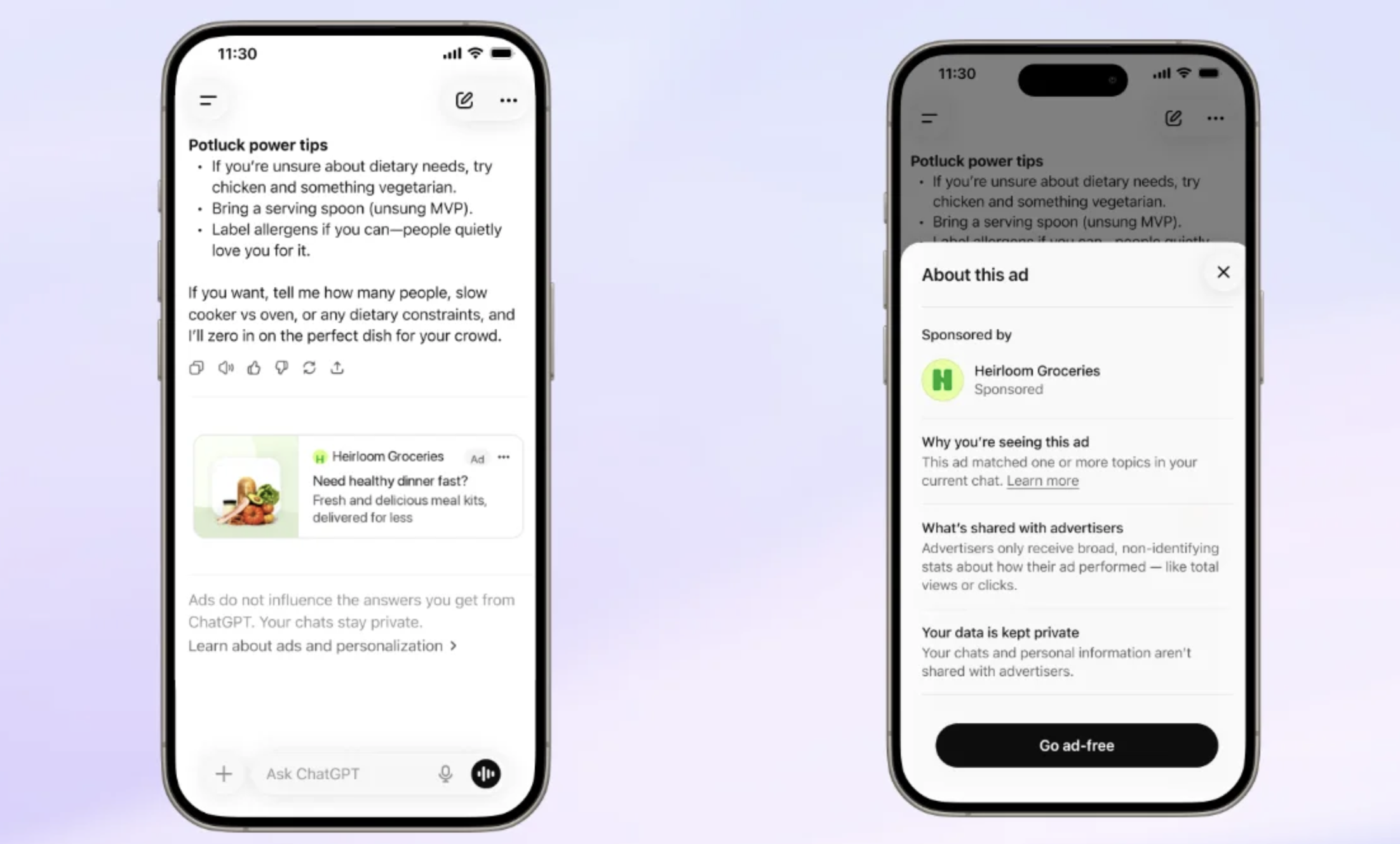
On 31 August 2026, OpenAI opened self-serve Ads Manager across 31 European markets (EEA + Switzerland). Ads have been serving since 24 August, on Free and Go only. For a retailer, the lever is not a one-off chat card: it is product-feed campaigns, powered by a structured catalogue. Dataïads switched on the ChatGPT Ads connector the same day: the enriched feed can be pushed to Ads Manager, without a second catalogue. A sponsored slot does not buy a recommendation in the answer.
On 31 August 2026, OpenAI opened self-serve Ads Manager in Europe, India, the Middle East and North Africa. A company registered in France, Spain or Germany can create an account, complete entity verification, and buy without going through an agency.
The same day, Dataïads switched on the ChatGPT Ads connector. The already-enriched feed (titles, attributes, availability, assets) can be sent into product-feed campaigns. Not another CSV export. The same catalogue source as Google Merchant Center and Meta, calibrated for conversational matching.
Ads themselves have been serving since Monday 24 August, across 31 markets (27 EU member states, plus Iceland, Liechtenstein, Norway and Switzerland). The UK opened in June, outside this wave. Two dates, two moves: inventory on the 24th, self-serve buying on the 31st.
What Ads Manager actually changes
Until 31 August, a European retailer could see “Sponsored” cards under ChatGPT answers without being able to buy them directly. Access ran through the OpenAI Ads Solutions team and agency groups (Publicis, WPP, Omnicom, Havas, Dentsu, MediaPlus), plus tech partners including Criteo.
Self-serve removes that gate, within a beta: approved categories, creative review, legal-entity checks. Account country and currency are permanent once set. There is no Google Ads-style manager account: the agency is invited into your account.
On the same 31 August, OpenAI said ChatGPT Ads had reached a $1 billion annualized revenue run rate in under 200 days. That is a snapshot (current revenue × 12), not booked 2026 revenue. Useful as a pace signal. Not enough to lock a France CPA.
Display rules have not changed:
- Free and Go only. Plus, Pro, Business, Enterprise and Edu stay ad-free.
- A clearly labelled sponsored card, below the answer. OpenAI says the ads stack is separate from the chat model.
- At launch in the EEA and Switzerland: contextual targeting (current conversation, approximate location, device, language). No chat history, no memories. Personalisation comes later, on opt-in. Declining personalisation does not remove ads.
- Geo targeting at country level. No city or postcode targeting in Europe, unlike the US.
- Matching via context hints (a description of the conversations you want), plus the relevance of title, copy and landing page, not exact-match keywords.
We framed the format when ads went live in France on 24 August: a slot does not buy a citation in the text, or a place in the product carousel. What 31 August adds is the ability to execute. And, for a catalogue, to execute from the feed.
The retailer lever: the product feed, not a one-off card
OpenAI opened product-feed campaigns in Ads Manager in June. The logic is Shopping, not a banner: you connect a catalogue, you filter a product set, a template fills title, price and image from the product row. OpenAI says feed ads have been among the strongest performers in the programme so far, a platform claim, to be treated as such.
The schema is Google-compatible: id → item_id, link → url, plus is_ads_eligible to flag ad-ready SKUs. SFTP upload, regular snapshots (ideally daily). Uploading the file does not advertise the whole catalogue: the product must be eligible, in stock, complete, and clear review.
Three distinct pipes, often mixed up:
| Surface | What the user sees | How you get there |
|---|---|---|
| Organic answer | The brand or SKU is cited, compared, recommended | GEO, attributes, reviews, citable pages |
| Shopping carousel | Products, prices, availability | Merchant data, including the Google Merchant Center feed |
| ChatGPT Ads | “Sponsored” card under the answer | Budget + relevance + product feed |
The carousel is not an ad. OpenAI presents it as a shopping result, selected independently. Ads are a third, paid channel, limited to Free and Go. Paying for a slot while a competitor is named in the answer is the equivalent of a Google Ad under an organic result that cites someone else.
Matching is not a Shopping query. A user describes a use case: “a waterproof jacket for a weekend in Brittany, €150 budget.” If your titles and attributes only carry the brand and an internal SKU, neither the feed campaign nor organic recommendation has anything to latch onto. That is the same job as enrichment for Merchant Center, we covered it when OpenAI opened product feeds. The question is no longer “do we need a feed.” It is “how it lands in Ads Manager, up to date, the day the account clears verification.”
What you actually send
A ChatGPT Ads feed is not a pasted GMC dump. The gaps that matter:
- Ads eligibility.
is_ads_eligible(notis_ads_enabled). An OOS SKU, a policy-blocked item, or a product outside the target market has no place in the set. - Freshness. Price and availability. An assistant that cites a wrong price breaks trust; a feed ad that lands on a 404 does too.
- Use-case attributes. Material, cut, season, constraint, occasion. That is what the conversation contains. Merchant Center conversational attributes (Q&A, related products, variants) do not map one-for-one to OpenAI, but the requirement is the same: describe the product the way people ask for it, not the way you reference it internally.
- Aligned landing. PDP, filtered collection, use-case page. Not the homepage. OpenAI also scores the URL in relevance.
- Language. The ad sits in the conversation thread. A user asking in French should meet a French title and feed, not an English master.
Pixel and Conversions API should be in place before the first euro. Without an event, there is no oCPC optimisation. Advertisers only see aggregated metrics: no prompts, no chats.
The Dataïads connector
The bottleneck is no longer self-serve access. It is having a clean catalogue and a pipe into Ads Manager the day verification clears.
Dataïads opened the ChatGPT Ads connector on 31 August, at the same time as European self-serve. Feed Enrich remains the enrichment layer (channel titles, attributes, proof points, assets). The connector pushes that enriched feed into ChatGPT Ads: no second PIM, no spreadsheet mapping to rebuild on every snapshot.
For a team already on Dataïads, that means:
- The source catalogue does not change.
- Enrichment rules already useful for Shopping and GEO stay the foundation.
- A ChatGPT Ads channel is added, with ads eligibility and OpenAI fields on top of the GMC mapping.
- Sync follows the feed cadence, not a Friday manual export.
Same principle as GMC / Meta syndication: one source, several outputs. The difference is matching. Google Shopping aligns attributes to a query. ChatGPT Ads aligns a product to a specification spoken in natural language. A title like “DRESS REF 8841 SS26” helps neither. A title and attributes that state cut, use and constraint do.
What self-serve does not buy
Three limits, for the agency brief and the internal dashboard.
The ads audience is truncated. Plus, Pro and enterprise accounts do not see ads. On those sessions, GEO is the only lever for presence in ChatGPT.
A recommendation in the text is not for sale. OpenAI states that as a principle. Usage will confirm or not; until then, treating ChatGPT Ads as a substitute for citation is the wrong KPI.
European auctions are young. In the US, observed CPCs often came in below the $3–5 in April docs while the auction was still filling. Europe is in that window. It will not last. That argues for a catalogue test now, not a frozen ROAS in a deck.
30-day playbook
Week 1: account and measurement. Pick the legal entity (country / currency are irreversible). Prepare registration documents, exact legal name, a card billed in the account country. Install pixel + Conversions API, 3 to 5 events. Prefer CPC over CPM for a retailer test.
Week 1: feed. Flag is_ads_eligible on the core range, not the full long tail on day one. Check price, stock, images, URL. Prioritise families already rich in use-case attributes. If the Dataïads feed is live, switch on the ChatGPT Ads channel rather than duplicating a file.
Week 2: structure. One product-feed campaign. Ad groups by intent (use case, comparison, gift), not by internal merchandising silo. Context hints written as real conversations, not as Shopping keywords. Three to five landings per family: PDP, collection, use-case page.
Weeks 3–4: read two columns. Ads column: impressions, clicks, CPA, which item_ids serve. Organic column: who is cited in the answer, who is in the carousel, on a Free account and on a Plus account. Do not merge the two into a single “ChatGPT ROI.”
Budget: no account minimum. Early adopters often cite an operational floor around $25/day per campaign. A few hundred euros will not produce a signal. Plan 4 to 6 weeks, not a weekend.
FAQ
Can you open a ChatGPT Ads account from France? Yes, since 31 August 2026, for a business registered in the 31 markets (EEA + Switzerland). Beta, approved categories, entity verification.
Do you still need an agency? Not for access. Yes if you want managed buying. Agency and tech-partner routes stay open.
Is ChatGPT Ads Google Shopping inside the chat? No. Same family of feed, different matching (conversation vs keyword), different audience (Free/Go only), different placement (card under the answer, not an organic carousel).
Does the Dataïads connector replace Merchant Center? No. GMC remains the pipe for Shopping, free listings and, in part, organic ChatGPT shopping surfaces. The connector adds an output to ChatGPT ads campaigns, from the same enriched feed.
Where do you create the account? ads.openai.com. Policy: openai.com/policies/ad-policies. Feed spec: developers.openai.com/ads/product-feeds.
To audit and enrich the data that feeds Shopping, listings and now ChatGPT Ads: Feed Enrich. For the post-click destination: Smart Landing Page. For pages built to be cited in AI answers: Smart GEO Page.