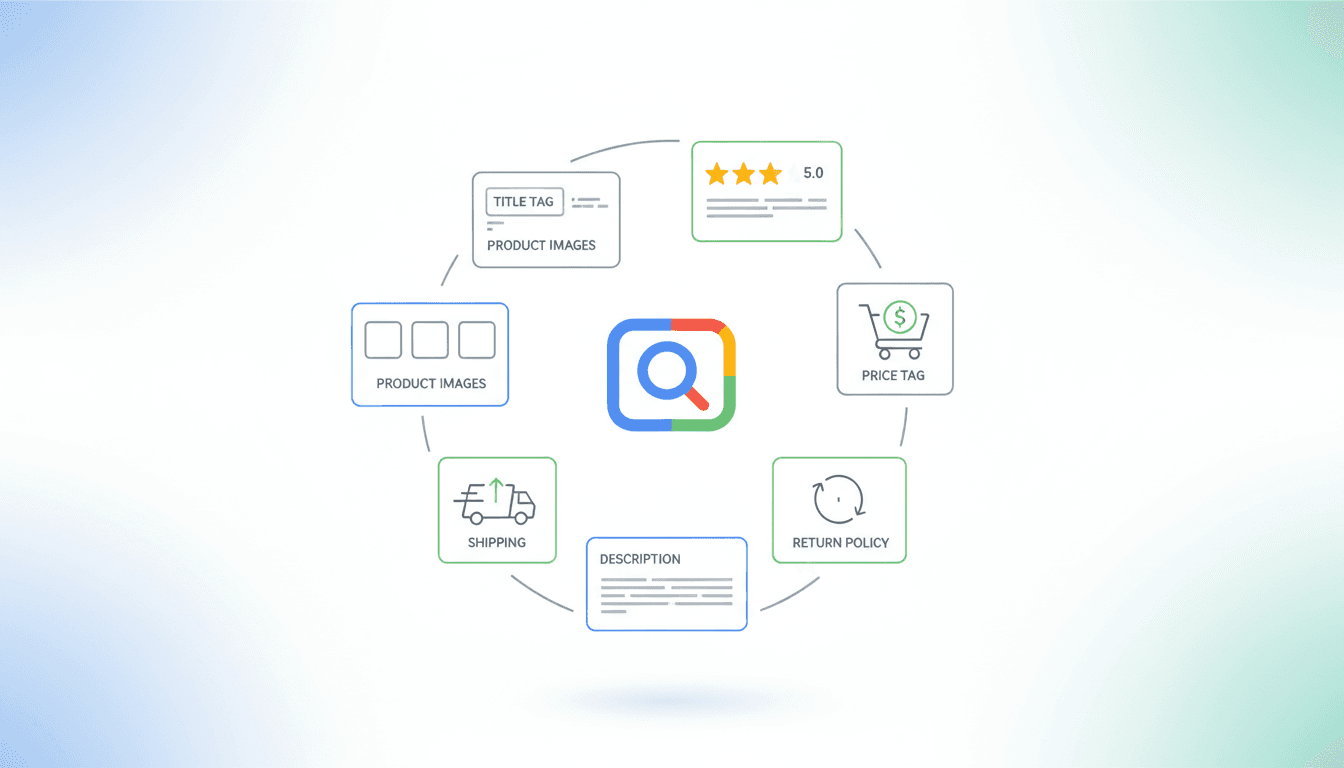
Google has published an internal document for its advertisers, presented during the NRF 2026, detailing new features and concrete recommendations to prepare for the age of agentic commerce. The message is clear: Product feed is the basis of all future visibility, and the attributes you submit in Google Merchant Center directly determine your eligibility for new AI surfaces.
Here’s what to remember, and most importantly, what to implement.
Google’s 4 key ads for agentic commerce
In this document, Google structures its vision around four major pillars, all linked to the ecosystem Merchant Center and to the new AI surfaces.
1. Universal Commerce Protocol (UCP)
Google describes UCP as “an open standard for agentic commerce that works across the entire buying journey”. Concretely, UCP is the protocol that will soon allow finalize a purchase directly in AI Mode and Gemini, without leaving the conversational interface.
For online retailers, this means that the quality of your Merchant Center feed will determine if your products are eligible for these new transaction paths.
2. Direct Offers Pilot
Google introduces a new feature that allows advertisers to present exclusive offers, starting with discounts, directly in AI Mode. The objective: to help buyers take action immediately and to help retailers close a sale at the decisive moment.
This reinforces the importance of attributes related to promotional prices And to commercial conditions in the feed.
3. Conversational Attributes Pilot
This is probably the most structuring announcement for feed managers: Google is launching dozens of new attributes in Merchant Center, specifically designed for “improving discovery in the age of conversational commerce, on surfaces like AI Mode”.
These conversational attributes go well beyond traditional fields (title, description, GTIN). They aim to allow AI agents to understand, compare and recommend your products in a context of natural dialogue.
4. Business Agent
Google is launching a virtual sales agent able to answer product questions with the brand’s voice, directly on Google. Manageable from Google Merchant Center, this agent relies on the product data submitted to formulate its answers.
The richer and more accurate your feed is, the more the Business Agent will be able to represent your offer faithfully.
Google recommendations: 3 strategic axes
Beyond product ads, Google has three clear operational recommendations for advertisers:
Axis 1: Activate AI campaigns
Google recommends rely on the “Power Pack”, AI Max, Performance Max, and Demand Gen, to engage and convert buyers in the advanced consideration phase. These campaigns are fed directly from the product feed.
Axis 2: Exploit first-party data and prepare for SEO
Google insists on the need to:
- Connect and use your first-party data in your campaigns
- Update your tag via Data Manager
- Implement Conversion with Cart Data
- Create useful content, measure true value, facilitate crawling, and build quality with AI
Axis 3: Enrich your feed with more details
That is the core of the message. Google formulates it this way: “Send high quality product and lifestyle images, include rich titles, descriptions, and helpful product attributes, and submit promotions, shipping, loyalty, and reviews.”
It is no longer optional. It’s the entry requirement in Google’s new retail spaces.
Key attributes according to Google: the concrete guide
The Google document details exactly four categories of attributes to optimize in Merchant Center. Here is the complete detail with the official guidelines and the measured impacts.
1. Rich titles and descriptions, “Inform with rich titles and descriptions”
Google is asking merchants to help AI match products with how users search. The guidelines are explicit:
- Product titles of at least 30 characters
- Descriptions of at least 500 characters
- GTIN (Global Trade Item Number) filled in systematically when applicable
These thresholds are not arbitrary. In a conversational context, an AI needs enough textual material to understand the product, its uses, and its differentiators. A 10-character title and an empty description make a product invisible to agents.
2. Multiple and quality visuals, “Engage with multiple image creatives”
Google points out that “consumers buy visually” and formulates clear requirements:
- Minimum 3 additional images (in addition to the main image)
- Include lifestyle images (scenarios)
- Minimum resolution of 1500x1500 pixels
In the era of visual AI, images are no longer just used to seduce the human buyer. They allow vision models to detect visual attributes (dominant color, pattern, material, shape, style, context of use) that enrich product understanding.
3. Commercial benefits, “Highlight the convenience of shopping with your brand”
Google recommends differentiate yourself when the consumer makes a decision :
- Promotional prices (sale price), measured impact: +7.6% CTR and +12.3% conversion rate
- Product notes (product ratings), measured impact: up to +5% CTR
- Product type (product type), for fine categorization
- Product highlights (product highlights), to value differentiators
4. Logistics transparency, “Show the differentiators shoppers care about”
Google focuses on attributes that allow buyers to make an immediate and confident decision :
- Free delivery (free shipping), measured impact: +2% conversion rate
- Delivery time (shipping speed), measured impact: +2% conversion rate
- Return policy (return policy), measured impact: +3% conversion rate and AOV
These logistical attributes are particularly critical in an agentic context: when an AI agent compares two similar products, they are often the delivery and return conditions that change the recommendation.
SEO and AI: Google’s 3 rules for AI search experiences
The Google document devotes an entire section to SEO in the context of AI experiences. Three principles are set out:
1. “Focus on unique, valuable content for people”
Accompany textual content with high quality images and videos. The research environment is now multimodal.
2. “Ensure we can access your content”
Prioritize content-rich pages for indexing and crawling. Ensure that the structured data are still supported by visible content.
3. “Understand the full value of your visits”
No longer only measure clicks, but assess how users get information or complete tasks.
Google is adding an explicit Pro Tip: “Leverage automated feeds to ensure your data is complete, and Product Studio for AI optimized creatives.”
How Feed Enrich by Dataïads makes you ready for UCP today
Google’s requirements are clear: rich titles, long descriptions, multiple, quality images, comprehensive business attributes, and machine-readable structuring. But when you manage thousands or even hundreds of thousands of products, how do you go from theory to execution?
That’s exactly what solves Feed Enrich. Here is how each brick of the platform responds directly to Google guidelines.
Centralized feed management
Feed Enrich ingests, normalizes, and orchestrates your product feeds from any source (PIM, ERP, Merchant Center, CSV files). You have a single source of truth, synchronized continuously, ready to feed Google Merchant Center and future UCP surfaces.
Integrated AI for automatic enrichment
Feed Enrich’s AI models automatically analyze your product data to complete missing attributes, correct inconsistencies and enrich the critical fields identified by Google (titles, descriptions, product highlights, product types).
Gen AI Text, Optimized titles and descriptions
Feed Enrich generates 30+ character titles And 500+ character descriptions compliant with Google guidelines, on a large scale. AI doesn’t just fill: it produces semantically rich content, designed for Machine comprehension and conversational discovery.
Advanced image processing
Feed Enrich automatically checks and optimizes the quality of your visuals : resolution (1500x1500px minimum), format, consistency. Images that do not comply with Google standards are identified and flagged for correction.
Gen AI Vision, Detecting visual characteristics
Thanks to AI vision models, Feed Enrich analyze your product images to extract visual attributes : dominant color, pattern, material, material, shape, style, context of use. These attributes automatically enrich your feed and feed new ones. Conversational Attributes from Google.
Gen AI Image, Alternative Visuals
To meet Google’s requirement of 3+ additional images and lifestyle images, Feed Enrich can generate alternative visuals using AI: scenarios, angle variations, contextual images. You go from a single image to a rich visual catalog, without a photo shoot.
Integrated scraper
Feed Enrich’s proprietary scraper goes through your product pages to extract missing information from the feed : long descriptions, technical attributes, reviews, delivery terms, return policy. All this data automatically completes the critical fields identified by Google.
Data Flow, Intelligent Orchestration
The engine Data Flow by Feed Enrich makes it possible to orchestrate all treatments, AI enrichment, scraping, generation of visuals, data transformation, in automated and customizable pipelines. Each product goes through the necessary steps to reach the level of quality required by Google, without manual intervention.
Concretely, Data Flow transforms a raw feed into a UCP-ready feed : rich titles, long descriptions, filled in conversational attributes, multiple and quality images, complete commercial terms.
Conclusion: The window of action is now
Google no longer leaves room for doubt. The NRF 2026 guidelines are a strong strategic signal: product attributes are becoming the criteria for entering agentic commerce. Long titles, rich descriptions, multiple images, promotional prices, promotional prices, delivery terms, return policies, every missing attribute is a lost recommendation opportunity.
E-retailers who structure and enrich their feed right now are not only preparing for UCP. They are building a sustainable competitive advantage in a world where AI agents are becoming the first purchase prescribers.
With Feed Enrich, this transformation is no longer a project to be planned. It is an ability to activate.
To go further
- Google UCP & OpenAI ACP: 2026 checklist to be ready for agentic commerce
- ChatGPT Ads: Conversational advertising is changing the rules
- The complete guide to optimizing product feeds