AI summary
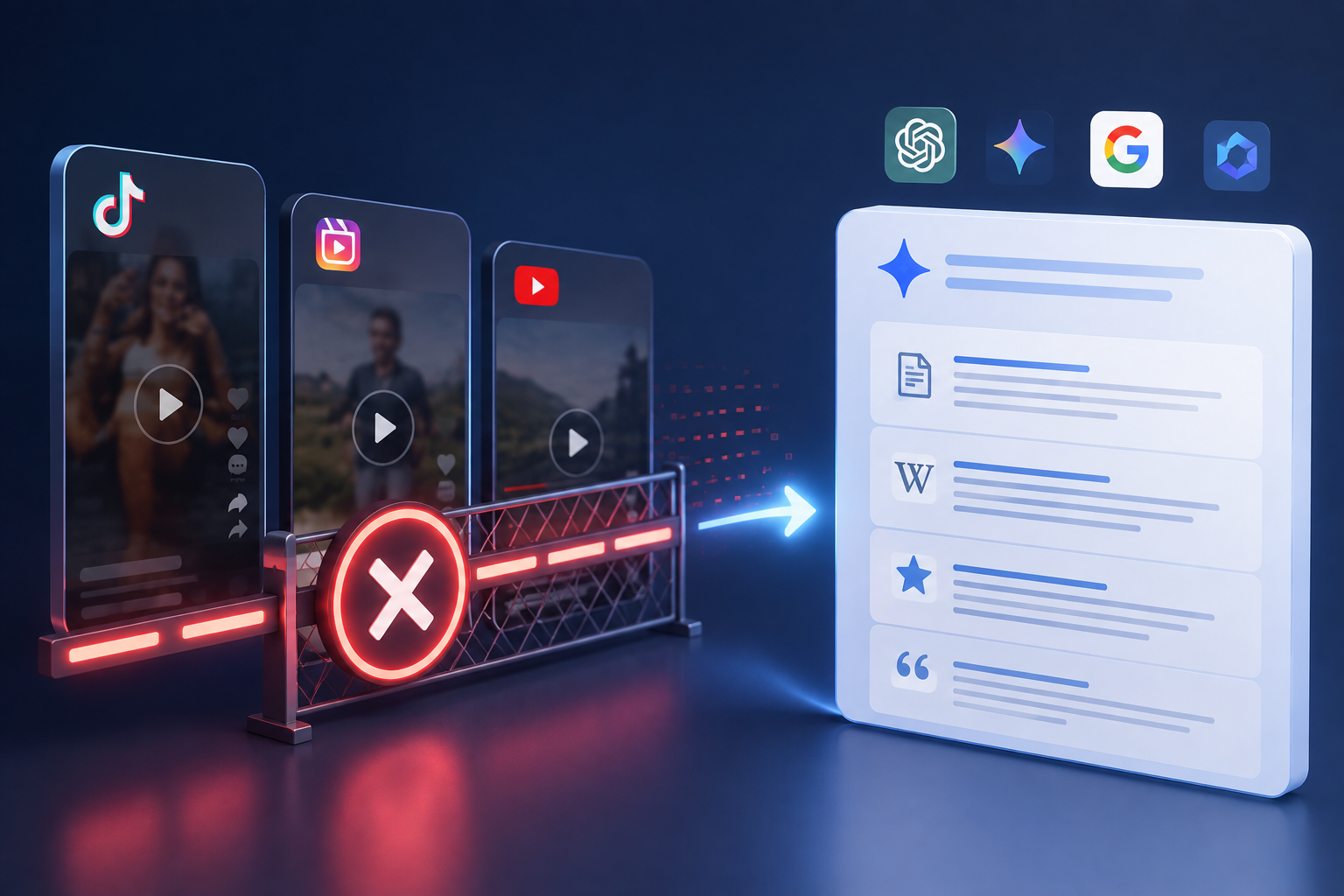
Answer engines cite text-based content overwhelmingly (97.5%), with YouTube leading among social platforms due to its transcripts and metadata, while video-only platforms like TikTok receive minimal citations (0.1-0.5%). Facebook and Instagram benefit from their text-based content (posts, groups, pages) rather than visual content, demonstrating that citation behavior is driven by extractable, quotable text rather than visual elements. Citation patterns vary by model—Claude favors reviews and community content, while Gemini prefers first-party brand-managed sites—and are influenced by search category and query type, making a one-size-fits-all approach to generative engine optimization ineffective.
YouTube now shows up in AI answers more often than Reddit. TikTok barely shows up at all. That split, documented through 2026 by Adweek, Bluefish, Goodie AI and Am I Cited, is the most useful fact in generative engine optimization right now: the platforms that get cited are the ones that ship text a model can quote.
Yao Zong Ang, who runs data-driven marketing for a global FMCG brand in Singapore, made the gap brutally countable. Across ten product categories, six models and 5,772 citations, TikTok appeared six times. 0.10%. The NHS, YouTube and Forbes led the board. Strip YouTube out, and Instagram, TikTok and Lemon8 together accounted for forty citations. 97.5% of what the models cited was text. ChatGPT, Claude and Gemini, in his cut, quoted 1,484 sources between them and none were a video or image platform.
The studies measure different things. They still rhyme.
Omniscient Digital ran 240 branded prompts through ChatGPT, Perplexity, Gemini, AI Mode and AI Overviews and classified 23,387 unique sources. On branded queries, 57% of citations went to reviews, listicles, forums, social posts and case studies. Directories took 17%. Product pages 12%. Thought leadership 5.4%. Read that mix carefully: the winning bucket is proof written in public, not a fifteen-second cutdown.
Am I Cited tracked 1,905 prompts from 24 June to 23 July 2026. TikTok appeared in 23 of 19,279 answers (0.1%). ChatGPT: 0. Perplexity: 0. AI Overviews: 0.1%. Google AI Mode, the high-water mark, hit 0.5% and ranked tiktok.com 127th of 4,632 domains. Six prompts in the set ever pulled a TikTok link. Incidental, not systematic.
BrightEdge complicates the slogan version of this story. In 300 million monthly US searches, Facebook appeared in 19.5 million AI Overviews, Instagram in about 877,000, TikTok in about 78,000. Facebook’s weight is textual: groups, pages, posts. The split is not social versus owned. It is quotable text versus pixels.
YouTube is winning because it leaves a transcript behind
Ang found YouTube third overall, and more than half of those YouTube citations came from Google AI Overviews citing Google’s own property. The model is not watching the video. It is reading the title, the description and the transcript.
Adweek’s January 2026 exclusive put several trackers on the same page. Bluefish: YouTube in 16% of LLM answers over six months, Reddit in 10%, a reversal from 2025. Goodie AI, on 6.1 million citations, watched YouTube’s share of social citations double from 18.9% in August to 39.2% in December as Reddit fell from 44.2% to 20.3%. Emberos saw YouTube cited about 40% more often than Reddit across ChatGPT, Gemini and Perplexity. Surfer SEO later put YouTube at roughly 23% of Google AI Overview citations. Transcripts, chapters and metadata are the mechanism. Views are not.
That is also why a video library without captions is a GEO dead end, while the same library with clean transcripts becomes a source. It sits next to the work we already mapped in LLMO for ecommerce, structuring copy so a model can extract it: the format is secondary, the extractable trail is not.
Citation behavior is model-specific, not a single score
Yext’s Q4 2025 study of 17.2 million distinct citations is the adult version of the viral chart. Claude leans on reviews and community content two to four times more than peers. Gemini prefers first-party sites and listings the brand can manage, which tracks with Search grounding. About 11% of cited domains appear across more than one engine. A 97.5% text headline is a fair summary. It is not a constant you can paste into every market and every model.
Category mix moves the leaderboard too. A study that puts the NHS first is telling you the prompt set leaned health. Fashion or consumer electronics will reshuffle the domains, not the underlying constraint.
For teams that still treat AI visibility as a brand-content problem, the operational parallel is the AI shelf test, where a fictitious deodorant outranked real brands in ChatGPT: the model quotes what it can read, with the confidence of a third-party voice. If your catalog is thin on text, someone else’s page fills the slot.
What this means when the shopper asks an engine, not a grid
A customer asking ChatGPT or Gemini for a mattress, a serum or a running shoe gets an assembled answer. The model builds it from product copy, attributes, reviews and editorial explainers. If the brand’s distinctiveness lives in a campaign film with no transcript, that distinctiveness never enters the retrieval set. Inventory can be real. Demand can be real. The recommendation still happens without you.
That is the gap GEO is built to close: being cited inside generative results, not only ranked beneath them. Shopping rank and answer-engine citation are related. They are not the same KPI.
The product feed is already text. Most feeds are not quotable yet.
You already own the densest structured text on your assortment. Titles, attributes, descriptions, GTINs, availability. Generative engines extract that class of data well, provided it is complete, explicit and consistent across channels. A marketing superlative in the title is noise. A filled material field is a fact a model can reuse.
The first job is data quality, the work of enriching product feed data with Feed Enrich rather than treating the feed as a distribution pipe. The second is to treat that feed as what agents actually ingest, the shift underway with ChatGPT product feeds in the Ads Manager. The third is to ship pages built to be cited, one URL per buying question, generated from the catalog, which is what Smart GEO Page is for.
Keep the video. YouTube is the proof it can be cited at scale. What changes is the production rule: every asset should leave a text trail (title, description, chapters, captions) and the same facts written into the feed. Human attention and machine citation can share a calendar. Only the second one decides whether you exist in the answer.
Frequently asked questions
Do models really ignore TikTok and Instagram?
For native video and image, in the datasets we have, yes, almost. Rates are near zero on ChatGPT and Perplexity, slightly less tiny on AI Mode. Facebook appears more often in US AI Overviews because it produces text. Without an extractable layer, a citation is a query accident.
Should brands cut video spend?
No. Transcribed, well-titled YouTube is cited at scale. Keep filming, and attach a readable residue in the feed or on a page every time.
Is TikTok still worth it for ecommerce?
For discovery and social selling, yes. For AI-answer visibility, not today. Those are different jobs and should not share a single success metric.
Is a product feed enough on its own?
It is the strongest owned base, because it is structured and already tied to SKUs. Reviews and reference pages still cover a large share of evaluative queries, especially on Claude.
Where to put the next sprint
Models are already naming products in your category from the text they can find. If the work you are proudest of leaves nothing to read, it leaves nothing to cite. The feed is the fastest asset to put to work: less glamorous than a vertical campaign, more decisive the evening a shopper opens ChatGPT instead of a For You page.