TL;DR
For most retailers, neither the ChatGPT app nor the onsite agent comes first. Both read the same product data: a structured catalog, machine-readable product pages and an enriched feed. After that, an onsite agent suits large catalogs with complex choices, and a ChatGPT app suits pre-purchase advice that has already proven itself.
An agency offers you a proof of concept for a ChatGPT app: shoppers query your catalog in plain language, build a cart in the conversation, then land on your site to pay. The demo looks great. Meanwhile, your product team has scoped an AI shopping assistant for your own site. This year’s budget covers one of them.
This guide covers where ChatGPT apps stand in mid-November 2026, which retailers have launched one, what the published numbers show, and how to choose between an agent that lives on someone else’s platform (offsite) and one on your own site (onsite).
What is a ChatGPT app for a retailer in November 2026?
A ChatGPT app, now called a “plugin” in OpenAI’s developer documentation, connects ChatGPT to your systems. ChatGPT calls your tools (product search, inventory, cart) through an MCP server and can display an interface inside the conversation. For a retailer, it lets shoppers query the live catalog and prepare a cart. In the apps launched in 2026, the purchase completes on your site.
The Model Context Protocol (MCP) is the open standard that lets an AI assistant call external tools. Its MCP Apps extension, co-authored by OpenAI and Anthropic and proposed in November 2025, adds the interactive interface. One server can therefore serve both ChatGPT and Claude.
Three recent changes affect the business case:
- Instant Checkout, the native checkout, has ended. OpenAI shut it down in March 2026, CNBC reported. We covered what the end of Instant Checkout means for product discovery.
- The vocabulary has changed. OpenAI’s developer docs are now titled “Plugins” and refer to a ChatGPT Directory. Secondary sources date the rename to July 2026.
- The app is no longer the only way in. OpenAI’s Commerce Partner Playbook, published on November 13, 2026 according to TechCrunch, describes two purchase paths (browser or plugin) and several supporting workstreams, such as the product feed and the business profile. The plugin is one option among them.
| Building block | What it takes | Availability (November 2026) |
|---|---|---|
| Product feed | Send a structured catalog to OpenAI | Physical goods |
| Business profile (Business Hub) | Claim and complete your listing | Beta since November 10, 2026 per press reports, where ChatGPT is available |
| Browser access | Let ChatGPT’s agent read your site (CDN, firewall) | Low engineering lift, per OpenAI |
| ChatGPT Wallet payments | Accept the wallet on your existing checkout | A limited number of US Pro subscribers, US cards |
| Sign in with ChatGPT | Shoppers log in with their ChatGPT account | Program-dependent |
| Plugin (formerly app) | MCP server with search, cart and checkout tools | Reviewed by OpenAI before listing |
OpenAI recommends a “headless” commerce plugin with no embedded interface, exposing search, cart and checkout. When a step can’t happen in the conversation, a handoff link sends the shopper to the merchant’s site.
Which retailers have launched a ChatGPT app, and for what?
Several large brands launched apps in the first half of 2026: Accor in January, then Sephora, Walmart and Carrefour in March. All chose the same model: discovery and cart building in ChatGPT, with the customer account and payment staying with the merchant. None has published usage figures.
| Brand | Launch | Use in ChatGPT | Where the purchase happens | Published figures |
|---|---|---|---|---|
| Accor (ALL Accor) | January 29, 2026 | Hotel search, member rates, 20+ languages | ALL platform | None |
| Sephora | March 24, 2026 (US pilot) | Recommendations from the catalog, optional Beauty Insider link | sephora.com | None |
| Walmart (Sparky) | March 24, 2026 | Discovery, then handoff to Walmart (account, loyalty, payment) | walmart.com | None for the app |
| Carrefour | March 26, 2026 | Recipes, stock, cart, delivery options | carrefour.fr | None |
Sources: Skift, Hospitalitynet, Sephora newsroom, Retail Dive, Yahoo Finance, accessed November 16, 2026.
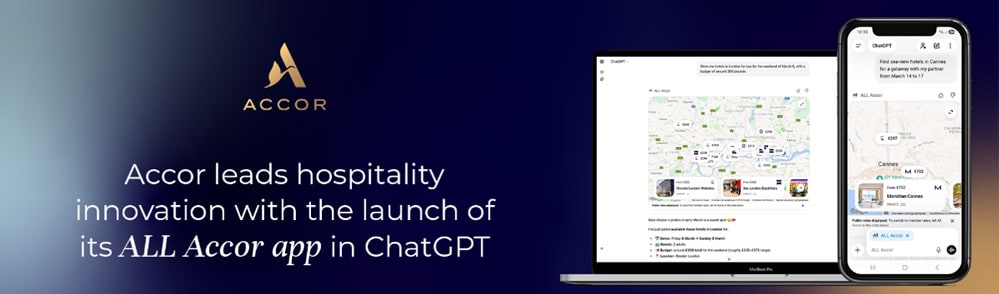
The ALL Accor app in ChatGPT: hotel search happens in the conversation, booking on the ALL platform. Image: Accor, January 2026.
These apps target the same job: pre-purchase advice in categories where the question is complex, such as a skincare routine, a week of meals or a hotel stay. We broke down Sephora’s ChatGPT app when it launched at Shoptalk.
How do shoppers find a brand’s ChatGPT app?
Today, a shopper has to know the app exists, find it in the ChatGPT directory and turn it on, sometimes by linking an account. ChatGPT then calls the app based on the metadata the merchant provides. OpenAI has tested suggesting apps mid-conversation, but publishes no rules for merchants on how it works. Deliberate activation remains the main path.
Sephora announced its ChatGPT app with an activation visual: shoppers still need to know the app exists to use it. Image: Sephora Newsroom, March 2026.
We ran the test on November 16, 2026, from a free ChatGPT account in France. The directory is now titled “Plugins.” A search for “sephora” returns nothing, since the pilot is limited to the US. A search for “carrefour” only surfaces Carrefour Belgium’s app, built by Mealz.ai. Of the three brands, only ALL Accor shows up as is. Results may vary by country and account type.
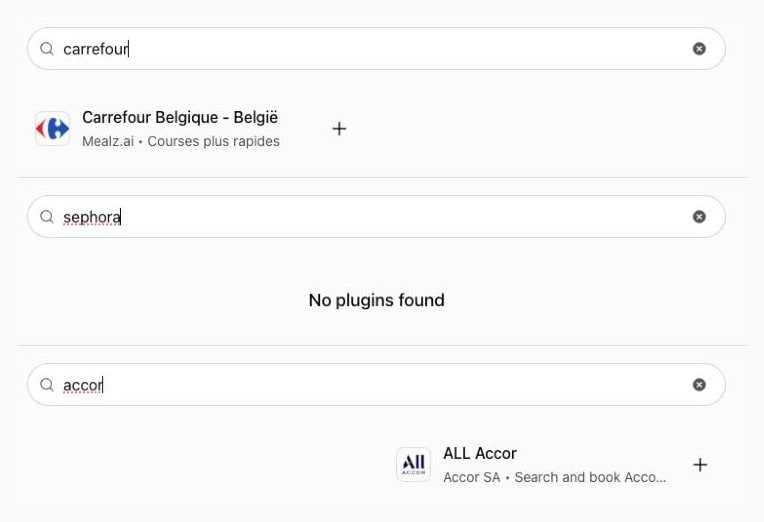
Searches for “carrefour”, “sephora” and “accor” in ChatGPT’s plugin directory, from France, November 16, 2026. Dataïads screenshot, third-party plugin hidden.
That is the most practical limit of going offsite. Carrefour’s app targets roughly 26 million ChatGPT users in France, per press estimates, but only those who enable it, or to whom ChatGPT suggests it, will see it. Everyone else discovers products another way: through ChatGPT’s general answers, which draw on your product feed, your pages and what other sites say about you.
This changes the order of priorities. A shopper who asks for “a moisturizer for dry skin under $30” without any app enabled gets an answer built from the catalogs ChatGPT can read. Your product feed for ChatGPT and the readability of your product pages reach that entire audience. The app reaches customers who already chose you.
What do the available numbers show?
Public numbers are scarce and can’t be compared with each other. On the ChatGPT side, the only published performance figure is negative: Walmart’s purchases inside ChatGPT converted three times worse than clicks sent to its own site. Onsite, Amazon and Zalando report high adoption for their assistants, self-reported and without a control group.
The published figures, source by source:
- Walmart in ChatGPT: about 200,000 products were available through Instant Checkout. Conversion there was three times lower than for clicks sent to walmart.com, according to data first reported by WIRED and picked up by CNBC and MarTech. The number covers the old checkout, not today’s apps.
- Amazon, onsite: its assistant Rufus, renamed Alexa for Shopping in May 2026, was used by more than 300 million customers in 2025. Amazon credits it with nearly $12 billion in incremental annualized sales (Q4 2025 results). In Q3 2026, Amazon reported more than 400 million users over twelve months and users spending 50% more than non-users (Digiday). That is a correlation: heavier shoppers may be the ones using the assistant.
- Zalando, onsite: the assistant has been live in all 25 Zalando markets since October 2024. Close to 10 million customers asked it for advice since the start of 2026, against 6 million over 2025 (Q1 2026 results).
For Accor, Sephora, Carrefour and Walmart’s Sparky app, we found no published traffic, conversion rate or revenue. If a vendor shows you performance benchmarks for ChatGPT apps, ask for the source and the method.
Onsite or offsite: how should you decide?
Four questions settle it: where your customers are when they hesitate, who keeps the conversation data, what it costs to build and maintain, and what you can measure. An onsite agent wins on control and measurement. A ChatGPT app wins on potential reach, provided shoppers find it.
| Criterion | Onsite agent | ChatGPT app (plugin) |
|---|---|---|
| Audience | Your visitors, already on site | ChatGPT users who enable the app |
| Discoverability | Guaranteed on your site | Low without deliberate activation |
| Conversation data | Stays with you | Shared with OpenAI under program terms |
| Brand control | Your tone, merchandising and promotions | ChatGPT’s frame and rules |
| Measurement | Site analytics, A/B testing | Partial, up to the handoff to your site |
| Payment | Your checkout | Your checkout (Wallet is US only) |
| Dependency | Your stack and vendors | OpenAI’s rules, timeline and app review |
| Reuse | The MCP server can later serve ChatGPT and Claude | The same server can power an onsite agent |
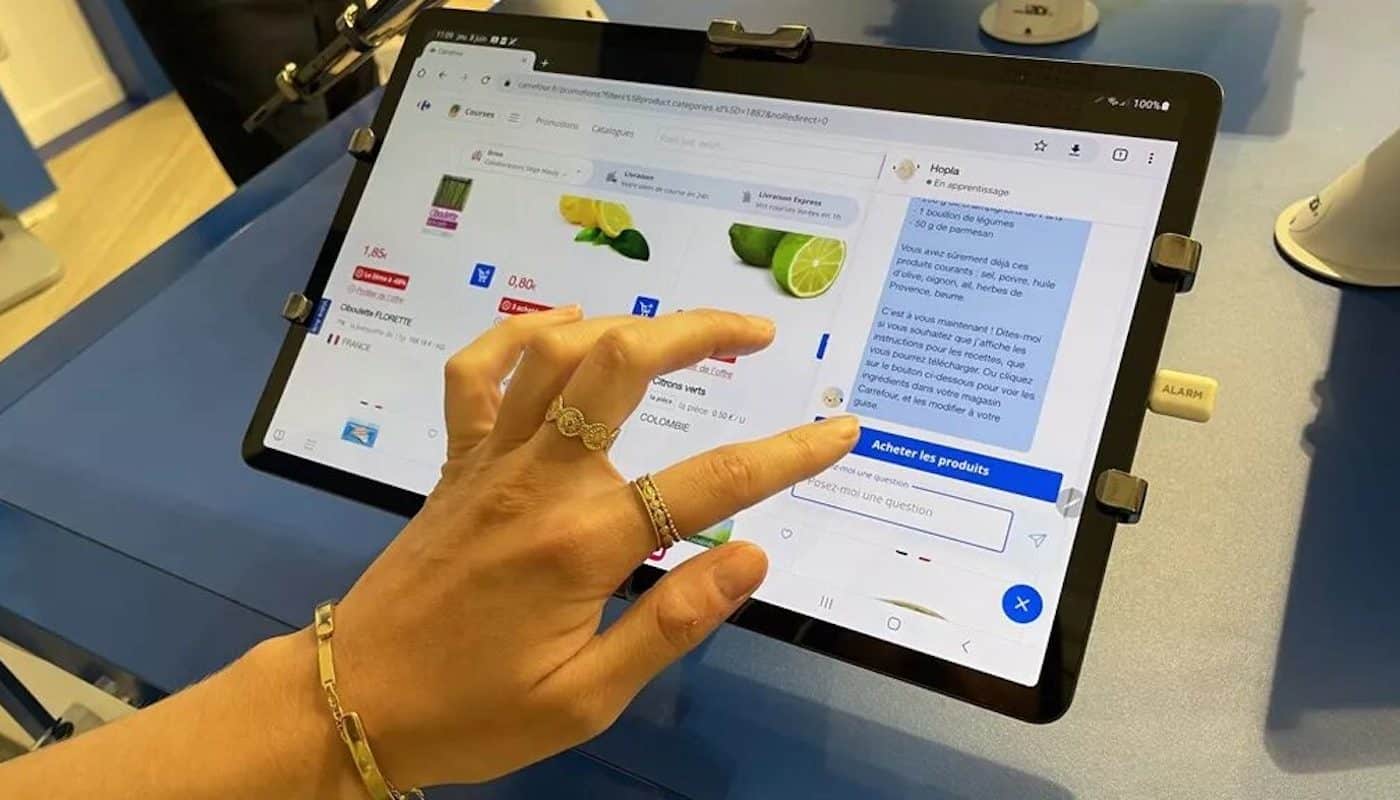
Hopla, Carrefour’s AI assistant on carrefour.fr, launched in 2023: the onsite version. Carrefour added its ChatGPT app in March 2026, and the two run side by side. Image: Carrefour.
The last row matters most. Both projects share one technical component: the server that exposes product search, inventory and cart. Build it well once and the second channel costs far less.
Do retailers become mere data suppliers for AI agents?
The risk is real, but today’s rules leave checkout, the customer account and loyalty with the merchant. OpenAI recommends completing purchases on the merchant’s site, Google states that the retailer remains the seller under its UCP protocol, and every app launched in 2026 hands shoppers back to the brand to pay.
What merchants lose sits earlier, at the moment of choice. When an agent compares five moisturizers and recommends two, the brand has no say in the comparison. It does control what the agent reads: attributes, price, availability, reviews and product page content. Some players shut the door: Amazon blocks third-party AI agents, according to TechCrunch. That option assumes enough direct traffic to do without assistants.
The issue goes beyond ChatGPT. Google is pushing the Universal Commerce Protocol (UCP), with checkout announced in AI Mode and Gemini for eligible US merchants, and Perplexity offers in-chat purchases with PayPal in the US. Our UCP and ACP checklist lists what each protocol requires.
What foundation serves both channels?
Both channels run on the same input: complete, structured product data that machines can read without executing JavaScript. An onsite agent and a ChatGPT app both fail when the catalog lacks attributes, when the price differs between feed and page, or when availability is missing from the HTML.
The Agentic Commerce Index, our 2026 benchmark, measured this on 645 product pages from 194 French brands. The average score was 48 out of 100, against a readiness threshold of 65. Price was machine-readable on only 42% of pages, availability on 39%.
The foundation comes down to four workstreams:
- Feed attributes: titles, materials, use cases, compatibility, sizes. An agent won’t recommend a product for a use it can’t find anywhere.
- Feed and page consistency: same price, same availability, same identifiers (GTIN, SKU).
- Readable product pages: JSON-LD structured data and key information in the served HTML.
- Crawler access: a CDN and firewall that let through the agents you want reading your site.
Feed Enrich, our product feed optimization tool, handles the first workstream without touching the source feed. This work already pays off on existing channels: at Feu Vert Spain, enriching the feed with Feed Enrich drove a 32% ROAS increase on Google Shopping, measured in a 50/50 A/B test of the catalog. That result is a Google Shopping result and says nothing yet about agent performance.
Where should you start?
For most retailers, the best return comes from building the shared foundation first and moving toward the costlier channels. Each step feeds the next.
- Make the catalog readable. Enrich the feed, align feed and pages, structure product pages. This step reaches every assistant user, app or not.
- Claim ChatGPT’s free entry points. Submit the product feed, claim the business profile where available, and check that ChatGPT’s agent can read your site.
- Launch an onsite agent if the catalog is large and choices are complex: configuration, compatibility, routines, recipes. Measure it with an A/B test.
- Publish a ChatGPT plugin once a pre-purchase advice use case has proven itself on your site, reusing the same MCP server.
Our push and pull playbook covers how SEO, GEO and agents fit together for step 1.
FAQ
Do you need a ChatGPT app for your products to appear in ChatGPT?
No. ChatGPT recommends products from the product feeds it receives and the pages it can read. The app serves users who choose to enable it. OpenAI’s Commerce Partner Playbook presents it as one option among several, next to the product feed, the business profile and browser access.
How do shoppers find a brand’s app in ChatGPT?
They search the ChatGPT directory or apps menu and turn the app on, sometimes by linking their customer account. ChatGPT then calls the app based on the metadata the merchant provides. OpenAI has tested suggesting apps mid-conversation, without publishing rules for merchants.
Can shoppers pay inside ChatGPT today?
Only in limited cases. OpenAI ended Instant Checkout in March 2026. Payment inside a plugin is limited to betas and to payment methods already saved with the merchant, and ChatGPT Wallet, launched on November 13, 2026, is limited to some US Pro subscribers with US cards. The Carrefour, Sephora and Accor apps send shoppers to the merchant’s site to pay.
Are there performance numbers for the Carrefour, Sephora or Accor ChatGPT apps?
None of these brands has published usage, conversion or revenue figures as of this article. The only public ChatGPT figure concerns the old Instant Checkout: Walmart’s purchases there converted three times worse than clicks sent to its own site.
Does an onsite AI shopping agent pay off?
The only public numbers come from Amazon, which credits its assistant with nearly $12 billion in incremental annualized sales in 2025, and Zalando, where close to 10 million customers asked its assistant for advice in 2026. Both are self-reported. For your own site, only an A/B test on your traffic answers the question.
Can the same MCP server power an onsite agent and ChatGPT?
Yes. That is the point of the MCP standard: the server that exposes product search, inventory and cart can feed an agent on your site, a ChatGPT plugin and Claude. The MCP Apps extension, co-authored by OpenAI and Anthropic, is supported by both ChatGPT and Claude.
What changes with Google AI Mode and Perplexity?
Google launched the Universal Commerce Protocol in January 2026, with checkout announced in AI Mode and Gemini for eligible US merchants. Perplexity offers in-chat purchases with PayPal in the US. In both cases the merchant remains the seller, and product data is still the entry ticket.
See what AI agents read from your catalog
Before choosing between a ChatGPT app and an onsite agent, measure what AI assistants already understand about your products. The Dataïads Agentic GEO audit assesses your visibility in LLM answers and the technical and semantic readability of your product pages, then ranks the fixes.