TL;DR
Bringing Google and Meta ads in-house in 2026 means owning what Performance Max and Advantage+ read: the product feed, catalog creative and the page after the click. That work can now run without IT tickets, thanks to supplemental feeds and an AI agent that proposes changes and waits for approval. Your agency can keep strategy and brand.
You pay an agency to run Google Ads and Meta Ads. Part of that retainer buys strategy and an outside view. The rest pays for repetitive catalog work: rewriting titles, excluding products, updating segments before every sale period, resizing creative for 20,000 SKUs. That second part is what ecommerce brands now want to take back.
This guide is for heads of acquisition and ecommerce managers weighing in-house vs agency for 2026. It covers what changed at Google and Meta, the three operating models, what you can bring in-house layer by layer, a five-step method and where AI agents fit.
What does bringing Google and Meta ads in-house mean in 2026?
Bringing Google and Meta ads in-house means your ecommerce team owns the decisions that drive campaign results: which products to push, with what data, which creative and which landing page. In 2026, Google and Meta automate bidding and targeting. Your team controls what those systems read, which is the product catalog.
That shifts the debate. Most in-house vs agency comparisons online weigh a PPC manager’s cost against an agency retainer. For a brand with a large catalog, the real question is how much product-level work there is, and which tools let a small team absorb it.
Why the question matters now
Between 2025 and 2026, Google and Meta moved ecommerce campaign control toward product data and opened their APIs to AI assistants. An in-house team now has fewer campaign settings to manage, more leverage through the catalog, and better tools than two years ago.
The changes that matter for an ecommerce team:
- Performance Max runs on the feed. According to Google Ads documentation, listing groups in asset groups are built from feed attributes: category, brand, product type, custom labels. An empty attribute means those products cannot be segmented into listing groups.
- Performance Max is easier to read. On April 30, 2025, Google announced channel performance reporting for Performance Max. An in-house team can see where the budget goes.
- Meta builds ads from the catalog. Meta’s ads with product media (formerly Advantage+ catalog ads) show each person the most relevant products from your catalog. In Sales campaigns, Meta turns product data on by default when you have a catalog. In 2025, Meta replaced Advantage+ shopping campaigns with Advantage+ sales campaigns.
- Merchant API replaces the Content API for Shopping. The Content API reached its sunset on August 18, 2026: calls have failed intermittently since September, and full shutdown is planned for early 2027. Custom integrations that push the catalog have to migrate, which often reopens the tooling question.
- Google and Meta open their APIs to AI assistants. In October 2025, Google released an open source MCP server for the Google Ads API. In April 2026, Meta opened its Meta Ads AI Connectors in beta, which we covered in our analysis of Meta Ads AI Connectors.
For the attribute-level detail, see what changed in product feeds in 2026.
In-house vs agency vs platform: how to choose
Three models exist side by side: an agency that runs everything, an in-house team that runs everything, and a lean in-house team backed by a platform and AI agents, with the agency in a supporting role. The right one depends on catalog size, how often products change and how easily you can get engineering time.
| Criterion | Agency | In-house team only | In-house team + platform |
|---|---|---|---|
| Knowledge of catalog and margins | Indirect, through your briefs | Direct | Direct |
| Time from decision to live | The agency’s brief cycle | Depends on IT when the feed is involved | Hours, with no IT ticket |
| Product-level work at scale | Billed as hours | Capped by team size | Handled by the tool, approved by the team |
| Know-how retained | Partly stays with the agency | Stays with you | Stays with you, logged in the tool |
| Outside view and benchmarks | Strong | Weak | Medium, worth supplementing |
Large advertisers rarely go all the way. The ANA reported in 2023 that 82% of its members had an in-house agency, up from 42% in 2008, and that 92% still worked with at least one outside agency. On budgets, the Gartner 2025 CMO Spend Survey found that 39% of CMOs planned to cut agency budgets.
If you are comparing ecommerce PPC management agencies, ask about the catalog: who fixes titles, who maintains custom labels, who produces creative for 20,000 SKUs, and how long each takes. The answers show how much of the fee pays for work you could bring in-house.
What you can bring in-house, layer by layer
An ecommerce campaign on Google and Meta rests on five layers: product data, creative, the post-click page, bidding and budget, and measurement. The first three hold most of the repetitive work and can move in-house with the right tool. The last two are mostly judgment calls your team already makes.
| Layer | What gets decided | Who owns it in-house | What the tool does |
|---|---|---|---|
| Product data | Titles, attributes, categories, custom labels, exclusions | Performance marketer, catalog manager | Audit, enrichment, supplemental feed to Google and Meta |
| Catalog creative | Images and videos per product, formats per placement | Paid social, brand team for the template | SKU-level production from the catalog |
| Post-click page | Landing page that matches the ad, tests | Ecommerce, CRO | Pages served outside the CMS, A/B tests |
| Bidding and budget | ROAS targets, budget split across campaigns | Head of acquisition | Analysis and recommendations, human decision |
| Measurement | Results by product segment, tests, attribution | Acquisition, data | Before/after reports by segment |
On a catalog of tens of thousands of SKUs, the first three layers take most of the hours. Until recently they required an agency or a queue of IT tickets. Feed, catalog creative and off-CMS landing page tools now remove that bottleneck.
The five-step method
To bring ads in-house without breaking what works, start with data, then creative, then the landing page. Each step delivers a measurable gain before you move on, and your campaigns keep running during the switch.
- Audit the product feed. Score titles, attributes and images product by product and channel by channel. A product feed audit gives you a list of fixes ranked by impact.
- Publish a supplemental feed. Fixes go out in a supplemental feed sent to Google Merchant Center and the Meta catalog. Your primary feed, PIM and feed management tool stay as they are. That is how Feed Enrich, our product feed optimization tool, works, with no IT involvement.
- Segment the catalog with custom labels. Google describes custom_label_0 to custom_label_4 as free fields for reporting and bidding. Use them to group products by margin, seasonality, stock or performance, so Performance Max and Advantage+ receive groups your team can steer. Our article on keeping control of Performance Max explains the approach.
- Produce catalog creative in-house. Your brand team approves a template once, then the tool generates images and videos for every product. Smart Creative handles that production at SKU level for Meta, and for YouTube through Demand Gen and Performance Max.
- Close the loop on landing pages and reporting. Each paid click lands on a page that matches the ad, A/B tested with Smart Landing Page. Review results by product segment every week and adjust your custom labels.
Where AI agents fit
An AI advertising agent reads your campaign and catalog data, proposes actions and, depending on its permissions, carries them out. In 2026 it cuts analysis and prep time. Decisions and approvals stay with your team, which is what makes in-housing safe.
Platform connectors differ in scope. The Google Ads MCP server was read-only at launch, covering reporting and diagnostics from an assistant such as Claude or ChatGPT. It now supports a few limited writes on assets and labels, but does not change campaigns, budgets or bids. Meta Ads AI Connectors go further: once authorized, they create and edit campaigns, ad sets and catalogs. Neither enriches product attributes one by one or produces catalog creative at SKU level.
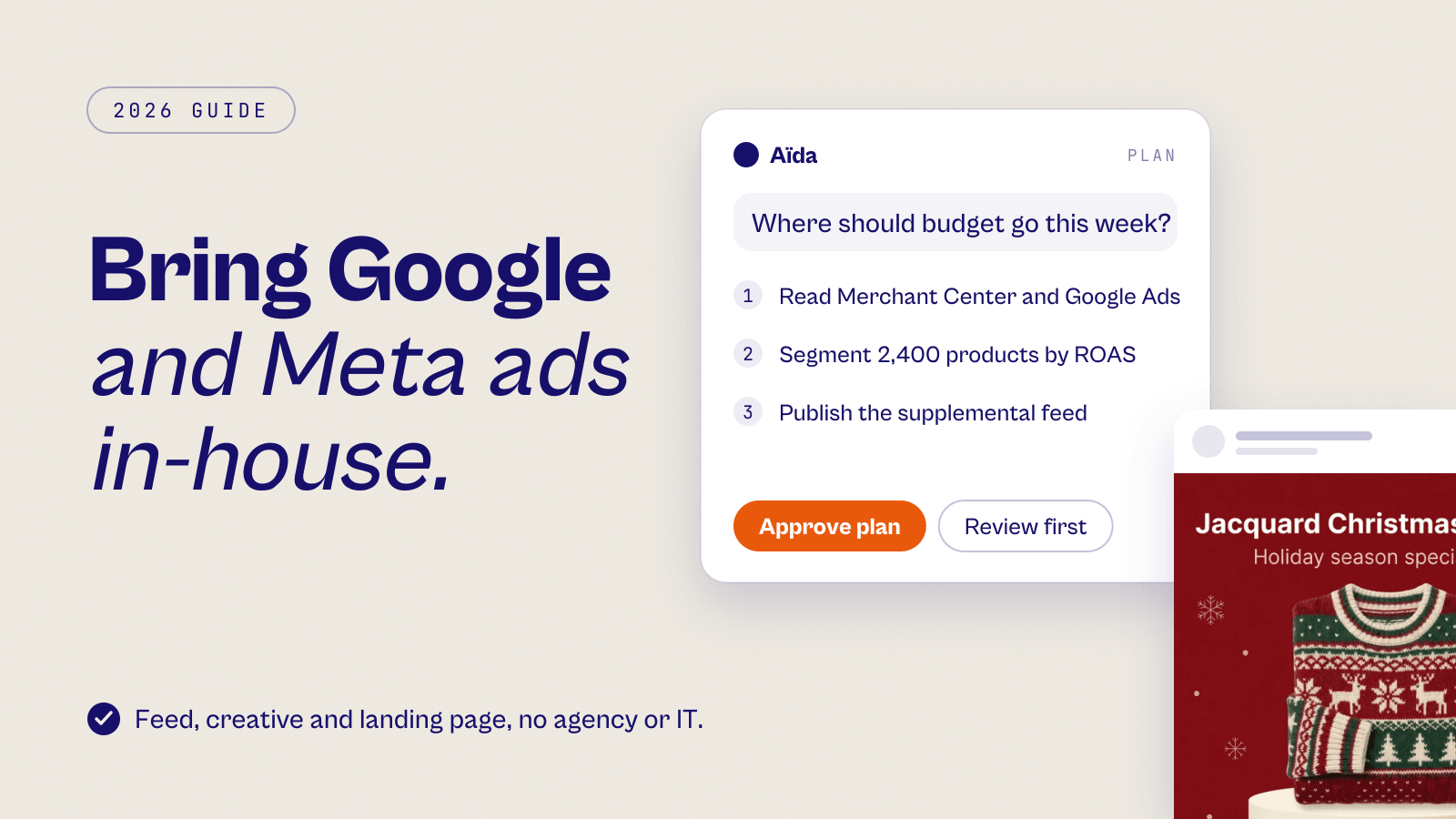
On the Dataïads platform, Aïda runs catalog work end to end. She reads Merchant Center, cross-checks Google Ads and Meta performance against your feed, flags products that lose money and suggests where to put budget. She then presents a plan and waits for your approval before changing anything. Once approved, she builds the pipeline, publishes through Merchant API and the Meta catalog, and delivers a before/after report.
The split is clear. Aïda prepares, activates and reports. Your team sets the goal, approves the plan and decides budgets in Google Ads and Meta. A human review step can hold every changed product until someone approves it, and every change is logged.
What brands that did it have seen
Brands that take ads in-house usually start with the most time-consuming layer: catalog creative, the feed or the post-click page. Each result below covers a specific scope and is no guarantee for another catalog.
- La Redoute replaced a centralized creative model with a self-service setup for its Meta Catalog Ads in the Home and Decor category. Rollout took 10 weeks, with its teams gaining autonomy, with more than one million products managed and creative tool costs down 30%. Read the La Redoute case study.
- Feu Vert Spain enriched its product feed with generative AI and measured a 32% ROAS increase on Google Shopping in a 50/50 catalog A/B test.
- Claudie Pierlot increased transactions from its Advantage+ Shopping campaigns on Meta by 36%, by serving post-click product pages adapted to Facebook and Instagram.
When to keep an agency
Bringing catalog work in-house does not remove the case for an agency. It still helps where your team lacks distance or capacity: cross-channel media strategy, brand creative, launching in a new market, extra hands for peaks like Black Friday.
The most common split leaves strategy and brand creative with the agency, while the in-house team, with the right tools, owns the catalog, product creative and landing pages. The agency then works from clean data, and your team keeps the product knowledge.
FAQ
Can you run Google Ads and Meta Ads without an agency on a large catalog?
Yes, if the product-level work is tooled. A small team cannot rewrite 20,000 titles or produce that much creative by hand. With a supplemental feed, catalog creative generated from product data and an AI agent that prepares changes, the team approves instead of executing. Many brands still keep an agency for strategy.
What is left to manage when Performance Max and Advantage+ automate everything?
Google and Meta automate bidding and targeting, and leave the inputs to you. Performance Max builds product groups from feed attributes, and Meta builds product ads from the catalog. That leaves feed quality, custom label segmentation, product creative, the post-click page and ROAS targets in your hands.
Do you need an engineering team to bring ads in-house?
No, if fixes go through a supplemental feed. Google Merchant Center and Meta accept supplemental feeds that add to the primary feed without changing it. Your PIM, CMS and feed management tool stay in place, and landing pages can be served outside the CMS. IT handles access once, not every change.
What can the Google Ads and Meta Ads MCP connectors do?
They let an AI assistant such as Claude or ChatGPT work on your ad accounts. The Google Ads MCP server is mainly for reporting and diagnostics, with a few limited writes (assets, labels). Meta Ads AI Connectors create and edit campaigns and catalogs once authorized. Neither enriches your feed product by product or produces catalog creative, so they complement a feed tool rather than replace it.
How much does an in-house team cost compared with an agency?
It depends on your catalog more than on rate cards. Compare the agency fee with the time it spends on product-level work, then with the cost of a platform plus the hours your team spends approving. Most figures published online come from agencies or vendors, so treat them as rough ranges, not benchmarks.
What should you keep with the agency after bringing ads in-house?
Cross-channel media strategy, brand creative, new market launches and extra capacity for peak periods. These benefit from an outside view and cross-client benchmarks. The catalog, product creative and landing pages come in-house, where knowledge of products and margins already sits.
To see how an ecommerce team runs its Google and Meta catalog with an agent that proposes changes and waits for approval, meet Aïda, the AI agent of the Dataïads platform.